

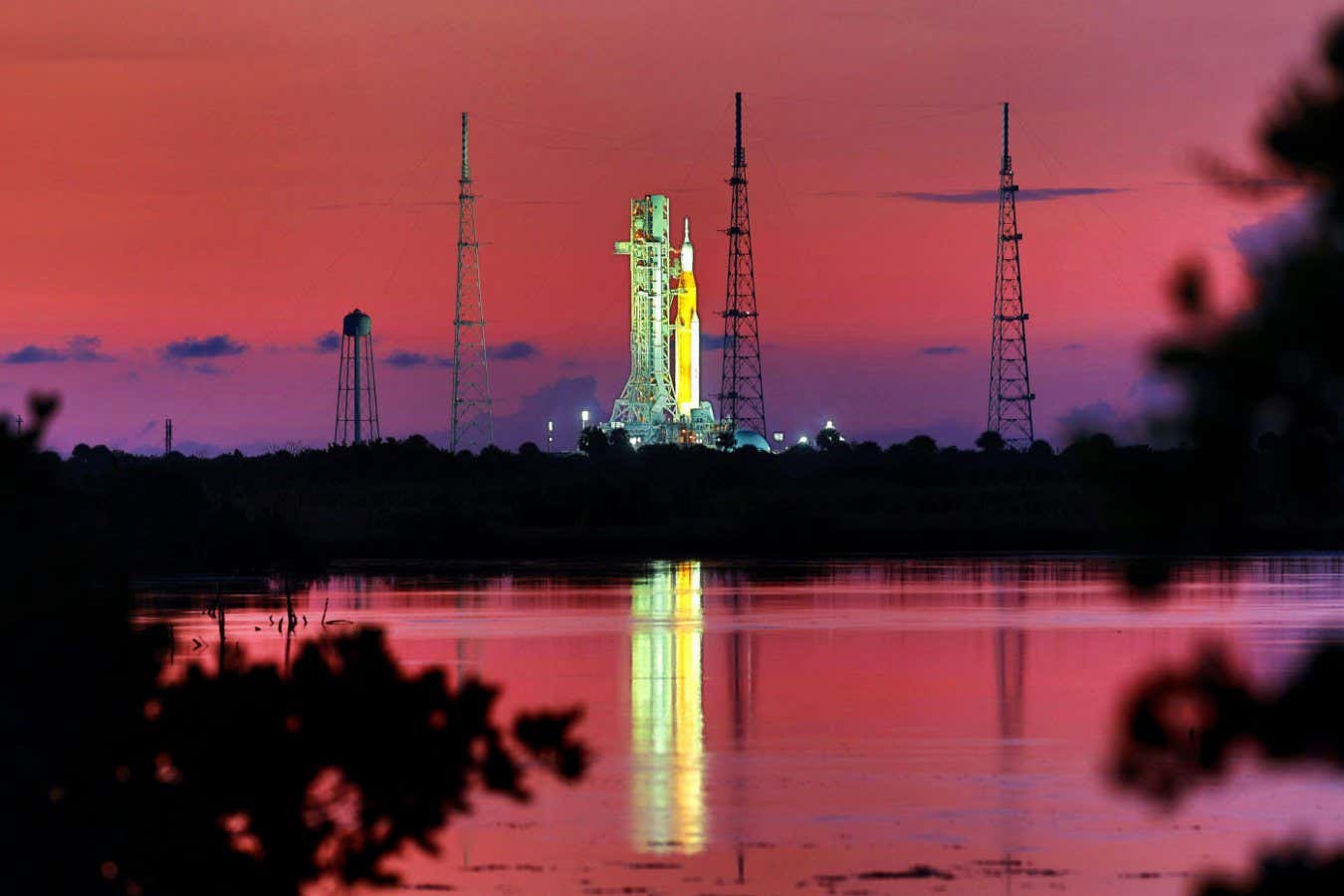
Artemis I sits at Launch Pad 39-B at Kennedy Space Center
Tribune Content Agency LLC/Alamy
The Stern-Gerlach experiment is, in my opinion, truly the first test that forced the results of quantum mechanics onto the scientific community. Proposed by Otto Stern and conducted by Walther Gerlach in 1922, it showed that atoms have a quantum structure. Electrons, it turned out, must follow quantum rules. The Stern-Gerlach experiment also highlights a weird feature of the quantum world: it seems that the observer can determine the possible properties a particle can have. If I measure a quantum property known as spin, the fact the measurement happened seems to change the possible values of spin a particle can have later. In other words, whether a particle was observed or not determines its future.
In physics, we are socialised to the idea that we are outside of the physical system, watching it. In this experiment, suddenly we aren’t. In my experience, students initially absorb this as a fact they must accept. Only after being forced to think about it a few times do they realise it isn’t consistent with their sensibilities about how reality works. Accepting the results is a surreal experience. Wonderfully surreal.
When I sat down and thought about how to communicate what it is like to watch the demise of US science in real time, “surreal” is the word that came to mind. It isn’t the same kind of surreal as Stern-Gerlach, which feels like being re-introduced to reality – although you realise you had been living with a false sense of the world before, the new one is cool and exciting, so that’s all right.
Our current political moment instead feels like realising that we had been living with a false sense of security – that US science and government support for it would be there tomorrow – but without a cool new reality on the other side. Instead, the US government is dispensing with publicly funded culture, throwing it into a black hole. I don’t make that metaphor lightly; I think it’s important. When an object crosses a black hole’s event horizon, it is the point of no return. The object can’t go back.
We are in the same situation. While the universe will still be there to be understood, the damage to our capacity for research will be long lasting and the alteration to our trajectory permanent. Already, a generation of master’s and PhD students has had the number of available slots reduced. Aspiring professors aren’t being trained in the same numbers; this affects not just future scientists but science communicators, too.
The US government is dispensing with publicly funded culture, throwing it into a black hole
A whole future is being disposed of. And while Donald Trump’s proposed cuts to NASA’s astrophysics budget and the National Science Foundation’s physics, mathematics and astronomy budgets won’t keep the rest of the world from doing science, there will be far-reaching consequences. This is due to the US’s role as a global investor in particle physics, cosmology and research into fundamental reality.
News of the devastating cuts to NASA’s budget came out while I was attending the 2025 Natural Philosophy Symposium at Johns Hopkins University in Baltimore, Maryland. The event opened with a fascinating talk by philosopher and cognitive scientist David Chalmers, who spoke about the possibility of developing a mathematics of consciousness. He was followed by philosopher Sandra Mitchell, who spoke about the nature of human reasoning, and theoretical physicist Nima Arkani-Hamed, who said physicists should respond to being confused about the big picture by doing more calculations.
There we were, talking about the questions that have driven humanity for millennia: what is reality, and how do we engage with our study of that reality? Events like this highlight what is possible when we are given the space, time and financial resources to live in the world of ideas.
While we were there, NASA’s astrophysics division was being readied for a bonfire. The potential damage will reverberate for decades. In 1922, Germany was the global epicentre of science. After the rise of the Nazis, who worked hard to remake German science in their image, that standing never fully recovered.
It is easy to read this as a story about a group of people with fancy degrees, sitting around in rooms and luxuriating in the universe of ideas. But these rooms make the people who write publications like this one. I was trained with the support of government Pell grants for poor and working-class undergraduates and a National Science Foundation Graduate Research Fellowship. The research I have written about in this column has been funded by three different federal agencies.
This surreal moment isn’t just happening to US-based scientists and the US public. Because so much of the science we all read about comes from the US, it’s happening to you, too.
Chanda’s week
What I’m reading
I’m halfway through Rickey Fayne’s intriguing debut novel, The Devil Three Times.
What I’m watching
I love Mission: Impossible and have watched every single film at least once in the past two weeks.
What I’m working on
Drafting my third book, The Cosmos is a Black Aesthetic (forthcoming from Duke University Press).
Chanda Prescod-Weinstein is an associate professor of physics and astronomy, and a core faculty member in women’s studies at the University of New Hampshire. Her most recent book is The Disordered Cosmos: A journey into dark matter, spacetime, and dreams deferred
Topics:
