
Close Menu
    National News Brief
    Sunday, June 14
    • Home
    • Business
    • Lifestyle
    • Science
    • Technology
    • International
    • Arts & Entertainment
    • Sports
    National News Brief
    Home » A Neanderthal-shaped skull may explain why some people get headaches

    A Neanderthal-shaped skull may explain why some people get headaches

    Team_NationalNewsBriefBy Team_NationalNewsBriefJuly 1, 2025 Science No Comments3 Mins Read
    Share
    Facebook Twitter LinkedIn Pinterest Email


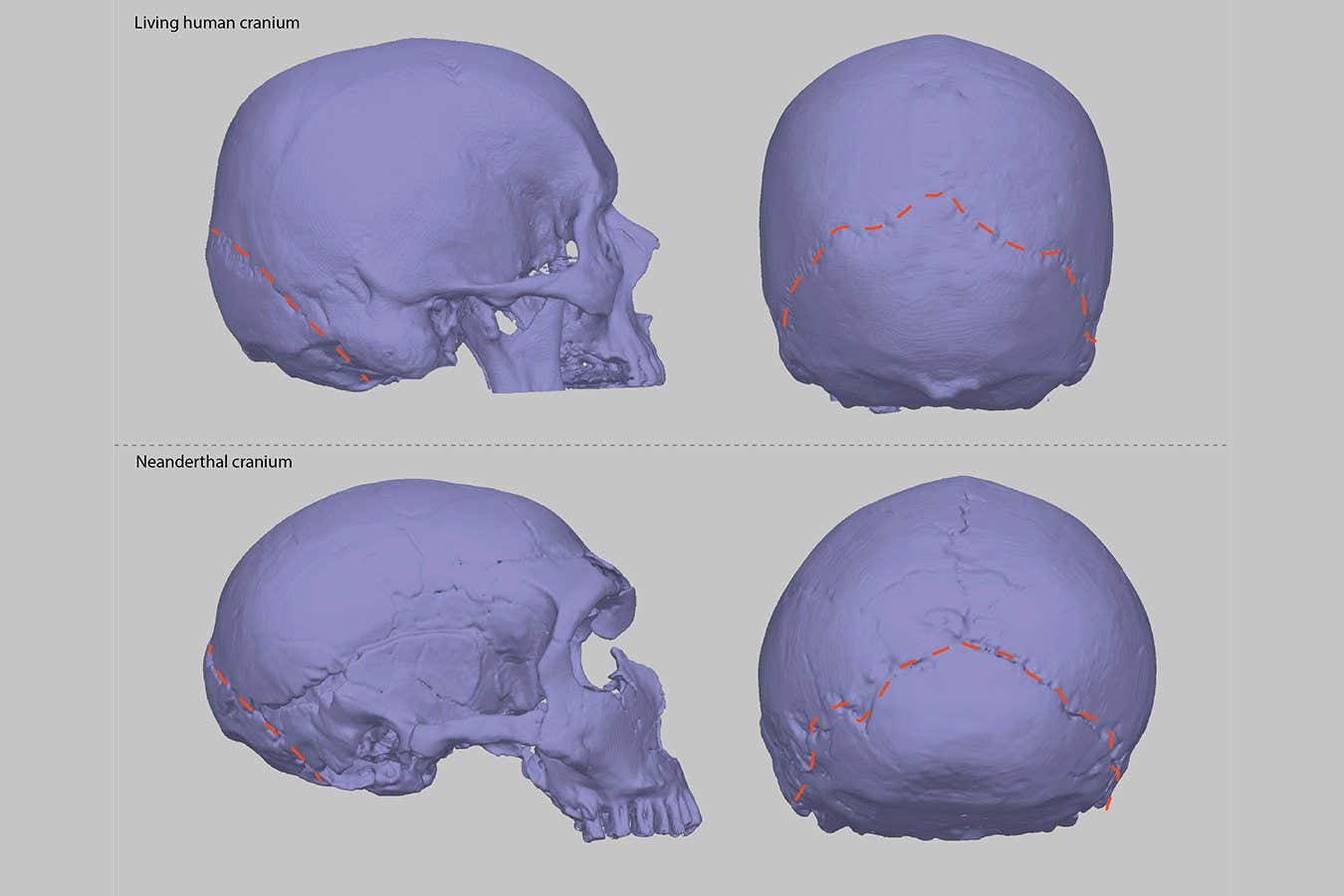
    3D models of the skulls from a modern human and from a Neanderthal

    Courtesy of Kimberly Anne Plomp

    A skull abnormality that squeezes the lower brain, often causing headaches and other neurological problems, might be part of our genetic inheritance from Neanderthals.

    People with Chiari malformations have a smaller and flatter base of the skull around the area where it connects to the spine. As a result, part of the brain – the cerebellum – is squashed into the spinal canal in the neck.

    Type 1 Chiari malformations, the mildest form, are thought to affect up to 1 in 100 people. They can cause symptoms like headaches, neck pain, sleep apnoea and numbness, but some people never show signs at all.

    About 15 years ago, Yvens Barbosa Fernandes, a neurosurgeon at the State University of Campinas in Brazil, noticed that the base of his Chiari patients’ skulls resembled those he had seen in Neanderthal specimens in European museums, especially in the mild slope of the occipital bone, where the cerebellum rests. While Neanderthal brains were larger than modern humans’ are, they slanted back more from the forehead and across the base, giving them a flatter shape compared with the rounder form of modern human skulls.

    In 2013, Barbosa Fernandes published a hypothesis proposing that the Chiari skull shape might have been inherited from extinct humans who interbred with Homo sapiens. “I started to think there was a lost link between anthropology and medicine in Chiari cases,” he says.

    Inspired by this suggestion, Kimberly Plomp at the University of the Philippines Diliman in Quezon City and her colleagues built digital 3D models of the skulls of 46 people with Chiari type 1 and 57 without Chiari, based on their CT scans. Their detailed mathematical analyses confirmed that the Chiari-affected skulls had a smaller occipital bone with a flatter angle, and more brain compression at the base of the skull where the cerebellum sits.

    Next, the team examined how those modern skulls compared with digital models of eight fossil heads from Homo neanderthalensis, Homo erectus, Homo heidelbergensis and ancient Homo sapiens.

    They found that the skull bases of Neanderthal heads had remarkably similar measurements to those of modern humans with Chiari, while all the other ancient cranial bases resembled those of modern humans without Chiari. “It highlights the idea that these are Neanderthal traits – not just early traits,” she says. “It looks like this is just another way that Neanderthal genes might be influencing our health – and in this case, in a negative way.”

    For Barbosa Fernandes, the study provides strong evidence in support of his theory. “It makes sense: if you have less angulation, you have less space for the modern human brain,” he says. “I didn’t have the science to prove my hypothesis. This paper is a big step closer towards that proof.”

    As a next step, the team hopes to analyse the DNA of people with Chiari malformations to look for Neanderthal genes, Plomp says.

    Other types of Chiari malformations – types 2 to 4 – are thought to have different causes. Type 2 is linked to a severe form of spina bifida, while types 3 and 4 are extremely rare and may be life-threatening.

    Topics:


    Source link

    Team_NationalNewsBrief
    • Website

    Keep Reading

    Ancient ground squirrels feasted on carcasses like ‘zombies of the Pleistocene’

    NASA’s experimental quiet supersonic plane passes another critical milestone

    World Cup camera coverage poses a moving math puzzle

    World-first: therapy to make cells young again given to a person

    U.S. Industries Push to Revive Tungsten Production Amid Shortage

    Fully autonomous drones have killed human soldiers for the first time

    Add A Comment

    Comments are closed.

    Editors Picks

    MLB legend explains leaving Astros role

    November 10, 2024

    Pierce County news site debuts, Meta starts paying for news and more

    December 11, 2025

    UChicago offers free tuition for some students as college costs skyrocket, especially for private institutions

    May 15, 2026

    Market Talk – September 29, 2025

    September 30, 2025

    OpenAI Asks Court to Bar Elon Musk From Unfairly Attacking It

    April 10, 2025
    Categories
    • Arts & Entertainment
    • Business
    • International
    • Latest News
    • Lifestyle
    • Opinions
    • Politics
    • Science
    • Sports
    • Technology
    • Top Stories
    • Trending News
    • World Economy
    About us

    Welcome to National News Brief, your one-stop destination for staying informed on the latest developments from around the globe. Our mission is to provide readers with up-to-the-minute coverage across a wide range of topics, ensuring you never miss out on the stories that matter most.

    At National News Brief, we cover World News, delivering accurate and insightful reports on global events and issues shaping the future. Our Tech News section keeps you informed about cutting-edge technologies, trends in AI, and innovations transforming industries. Stay ahead of the curve with updates on the World Economy, including financial markets, economic policies, and international trade.

    Editors Picks

    US asks Anthropic to block global access to top AI models: Why it matters | Technology News

    June 14, 2026

    Guardians get brutal update on Jose Ramirez

    June 14, 2026

    Here’s how Seattle Times is doing endorsements a little differently

    June 14, 2026

    Flag Day 2026 explained: The origin and history of America’s most recognizable symbol

    June 14, 2026
    Categories
    • Arts & Entertainment
    • Business
    • International
    • Latest News
    • Lifestyle
    • Opinions
    • Politics
    • Science
    • Sports
    • Technology
    • Top Stories
    • Trending News
    • World Economy
    • Privacy Policy
    • Disclaimer
    • Terms and Conditions
    • About us
    • Contact us
    Copyright © 2024 Nationalnewsbrief.com All Rights Reserved.

    Type above and press Enter to search. Press Esc to cancel.