

At a Pride parade in Half Moon Bay, Calif., a few days ago, my daughter bought a pink T-shirt with a hand-printed design. As she draped the garment on her arm to dry the ink in the sun, an older woman came up to her, looked at the Spanish words on the shirt and asked what they meant.
My daughter interpreted the seemingly unobjectionable phrase as “Together, we rise.”
“To heaven?” the woman asked. Then, caustically, she added, “Well, you’re going to the other place.”
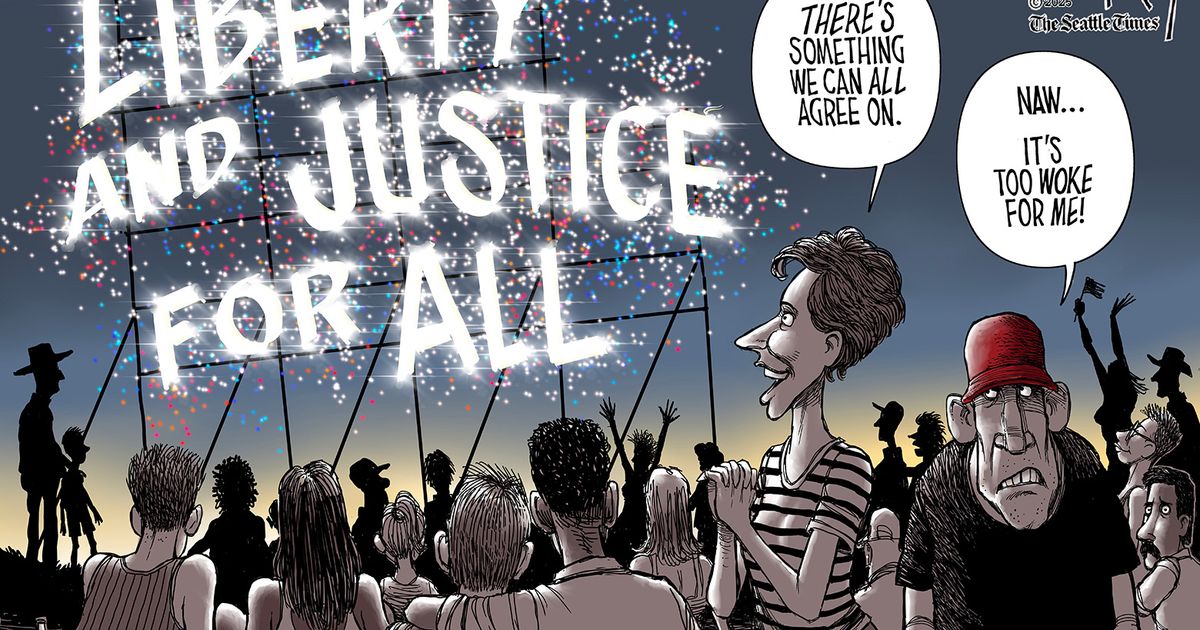
Welcome to the United States in 2025, a nation where some citizens would happily send other citizens straight to hell rather than rise together.
Politicians and pundits habitually employ phrases such as “the American people have spoken” or “the American people support this” or “the American people oppose that,” but the reality is that the American people have never been unanimous in making any choice or holding any belief. A current cable TV ad that is promoting the American Civil Liberties Union declares that the U.S. Constitution is the one thing that all Americans agree upon.
Even that is not so.
From Christian Nationalists to certain tech bros in Silicon Valley, there are some Americans who openly state their preference for a system run by a leader with dictatorial powers, whether a God-anointed king or a CEO with a high IQ. Right now, a significant number of Republican members of Congress are freely giving over their constitutional prerogatives to the executive branch while proposing legislation that would curtail the powers of the judiciary. Meanwhile, the Trump administration is boldly ignoring constitutional provisions that are meant to limit the power of the president and uphold the rule of law — perhaps most egregiously in the cruel campaign to round up undocumented immigrants in their homes, their cars, their workplaces, their schools, their churches and, in the case of one young woman who has resided in the United States since she was eight years old, upon her arrival home from her honeymoon.
In this summer of discontent, a great many Americans are appalled by what they see as an assault on the Constitution and American values. Yet, plenty of others believe Trump’s policies are necessary correctives aimed at upholding a vision of America as white, heterosexual and Evangelical Christian.
Today’s division is stark, but it is not new. American unity has been — for most of two-and-a-half centuries — an illusion. Competing conceptions of what America is all about have been manifested since the beginning.
Back in 1775, certain Southern colonies hesitated before teaming up with the sons of liberty in the North. The Deep South’s planter aristocracy first had to judge whether their slave system would fare better under a decentralized American government or under the continuing rule of the British king. For the next nine decades, white Americans in the South enslaved other Americans whose skin was dark until American armies in blue and gray fought each other in a horrifically bloody war that led to the abolishment of slavery.
The Civil War, however, did not end the stark divisions in this country. For the following century, the Southern states reconstituted a system of oppression that was as vicious as slavery. Thousands of Black Americans were lynched and otherwise terrorized. They were kept in poverty and in their place, unless they could migrate north in search of a better life. It took the courage of a small legion of young civil rights activists who were ready to put their lives on the line to finally defeat the Jim Crow system.
It may have been in the South where divisions over the nature of America were most pronounced, but, as my friend Timothy Egan revealed in his book, “A Fever in the Heartland,” the Ku Klux Klan was a truly national organization in the 1920s. In states such as Indiana, the KKK took full control of the levers of government. My own father told the story of how a cohort of hooded KKK members marched into a band concert at his high school and presented the principal with an American flag.
That was in 1929 in Mount Vernon, Wash.
We tend to think of America as most united during the Second World War. In truth, before the war there were millions of Americans led by prominent citizens, such as Henry Ford, Charles Lindbergh and Chicago Tribune publisher Robert McCormick, who believed the U.S. should not fight the Nazis or rescue oppressed Jews in Germany’s empire. Pro-Nazi groups were active from California to New York; the most extreme plotted to overthrow the U.S. government. There were even members of Congress who actively disseminated pro-Nazi propaganda. And, even after Hitler’s defeat, there were American politicians who opposed the Nuremberg trials that held Nazi leaders accountable for their atrocities.
Wisconsin’s Republican Sen. Joseph McCarthy is most famous for his bogus investigations into alleged communists in the federal government in the early 1950s. But a less known fact is that, in the late ‘40s, the senator took the side of a group of German soldiers who had executed American prisoners of war. McCarthy promoted the Nazi conspiracy theory that the execution was fake news and that the Germans had actually been tortured by American soldiers with suspiciously Jewish names.
McCarthy, for a time, was one of the most popular men in America.
These are just a few of countless disturbing episodes from our history and I bring them up, not to put a cloud over the celebration of our 249th Fourth of July, but as a reminder that Americans have lived through many dark periods. The United States is in so many ways a good and great country, but our goodness and greatness are not a result of some fabled unity, they are the result of the ongoing struggle between the better angels of our nature and the worst.
Perhaps it is the spirit of 1775, rather than the formal independence of 1776, to which we must rally today. It was 250 years ago in 1775 that our revolution began in great uncertainty. We are now in another time of uncertainty and our best hope lies in carrying forward our revolution. As I have told my daughter since she was a teenager, the struggle never ends.
And, as she would say, “Together, we rise.”
See more of David Horsey’s cartoons at: st.news/davidhorsey
View other syndicated cartoonists at: st.news/cartoons
Editor’s note: Seattle Times Opinion no longer appends comment threads on David Horsey’s cartoons. Too many comments violated our community policies and reviewing the dozens that were flagged as inappropriate required too much of our limited staff time. You can comment via a Letter to the Editor. Please email us at letters@seattletimes.com and include your full name, address and telephone number for verification only. Letters are limited to 200 words.
