

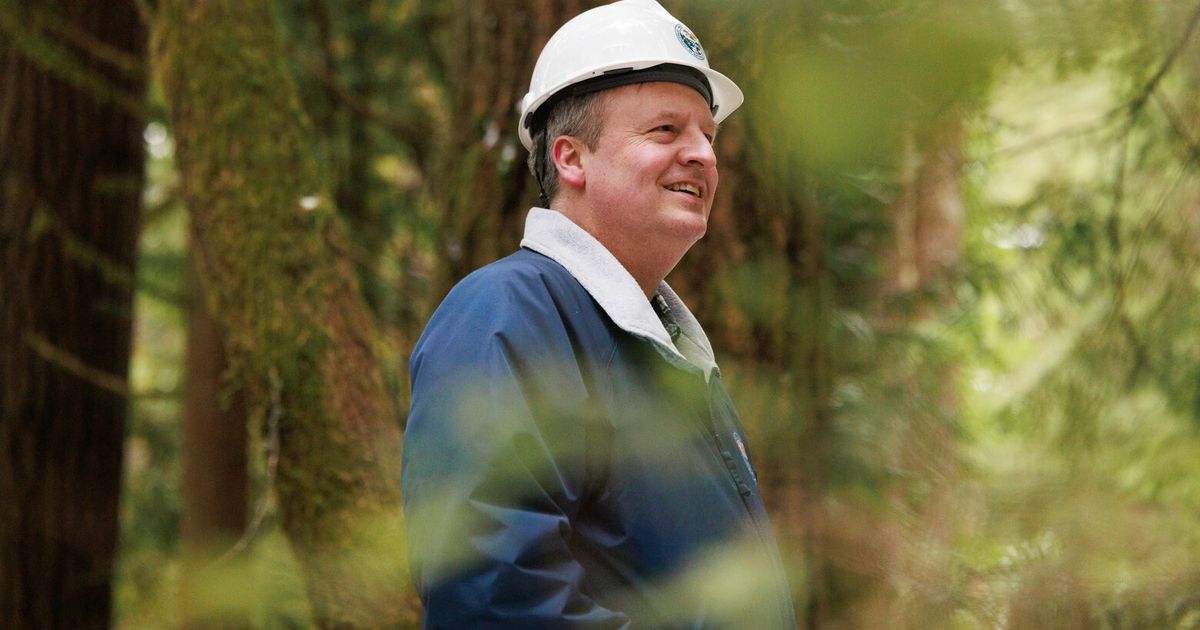
When State Public Lands Commissioner Dave Upthegrove took office in January, his first action was to pause harvests of certain older forests for about half a year. He did so to wait for the completion of a data analysis to determine how rare — or not — those forests are around Western Washington. And he expressed an intention to aggressively pursue a state policy target of a minimum percentage (of 10% to 15%) of maturing state forest land that could be set aside to develop into old growth.
The commissioner says the data effort has yet to be finished, pushing past his self-imposed deadline, somewhat squishy, of “about six months,” that he issued in his inaugural address. He should view the wrapping up of the data work as an urgent task in his leadership of the agency.
That’s because there is a price to the pause. The more than 20 timber sales Upthegrove has put on hold ultimately delay harvest revenues to local school districts, public hospital districts and other governments that depend on those sales. It’s not chump change: Clallam County’s frozen sales are worth an estimated $11.8 million to local governments, according to estimates by the American Forest Resource Council. Mason County, $2.8 million. King County, $1.9 million. And more.
Particularly in rural areas west of the Cascades, these are vital funds that help construct schools, pave roads and treat patients. All at a time when waves of federal and state cuts are already shrinking government budgets at all levels.
The longer the pause continues, the more the commissioner upsets a careful calculation built upon decades of the best science and one that holds together what is left of the only industry that can log and mill the timber.
Freezing harvests of “structurally complex” stands — forests last logged before World War II that have the potential to mature into old growth — was the cornerstone of Upthegrove’s campaign for the office. He should continue to be guided by research that will optimize carbon sequestration and minimize environmental degradation that comes with logging. In an interview with The Times editorial board Thursday, he vowed to do that.
“I’m relying 100% on the science team,” Upthegrove said, while also pledging to publish the data online for all to peruse.
None of this should be read as an invitation to overharvest the Evergreen State’s forests. The Department of Natural Resources has already placed off-limits the harvest of old growth — trees that sprouted more than 175 years ago — as well as riparian areas and habitats of the endangered spotted owl and marbled murrelet. About half of DNR’s holdings in Western Washington have been placed in conservation.
When DNR does harvest, it employs the most environmentally protective practices in the entire logging industry. Its variable retention harvesting methods leave behind pockets of older trees that aid stand regeneration and maintain wildlife habitat, while replanting different species to best imbue a Northwest forest.
“I think we’re the best agency in the world in terms of our environmental standards,” Upthegrove agreed. “We’re an agency that’s always led the way.”
Upthegrove does not intend to reduce existing harvest levels, rather merely to change where the state chooses to log. But if you don’t harvest the older forests, which are larger trees, you must harvest far more in younger stands of skinnier trees. Putting 700 older forest acres in Capitol State Forest off-limits, for instance, would require DNR to log 1,700 acres of younger forest, a DNR analysis found. That is irresponsible to future generations reliant on those timber revenues.
The commissioner says he’s committed to continuing to harvest enough volume and not to shortchange the timber revenue beneficiaries further. He noted to the editorial board that he maintained the agency’s professional staff, and he trusts them to do the work.
If the staff finds the state is meeting its goal in the inventory of biodiverse and mature stands, he should release the paused sales and get back to the business of managing a department with a reputation for the highest standards of timber harvests in the nation, if not the world.
