

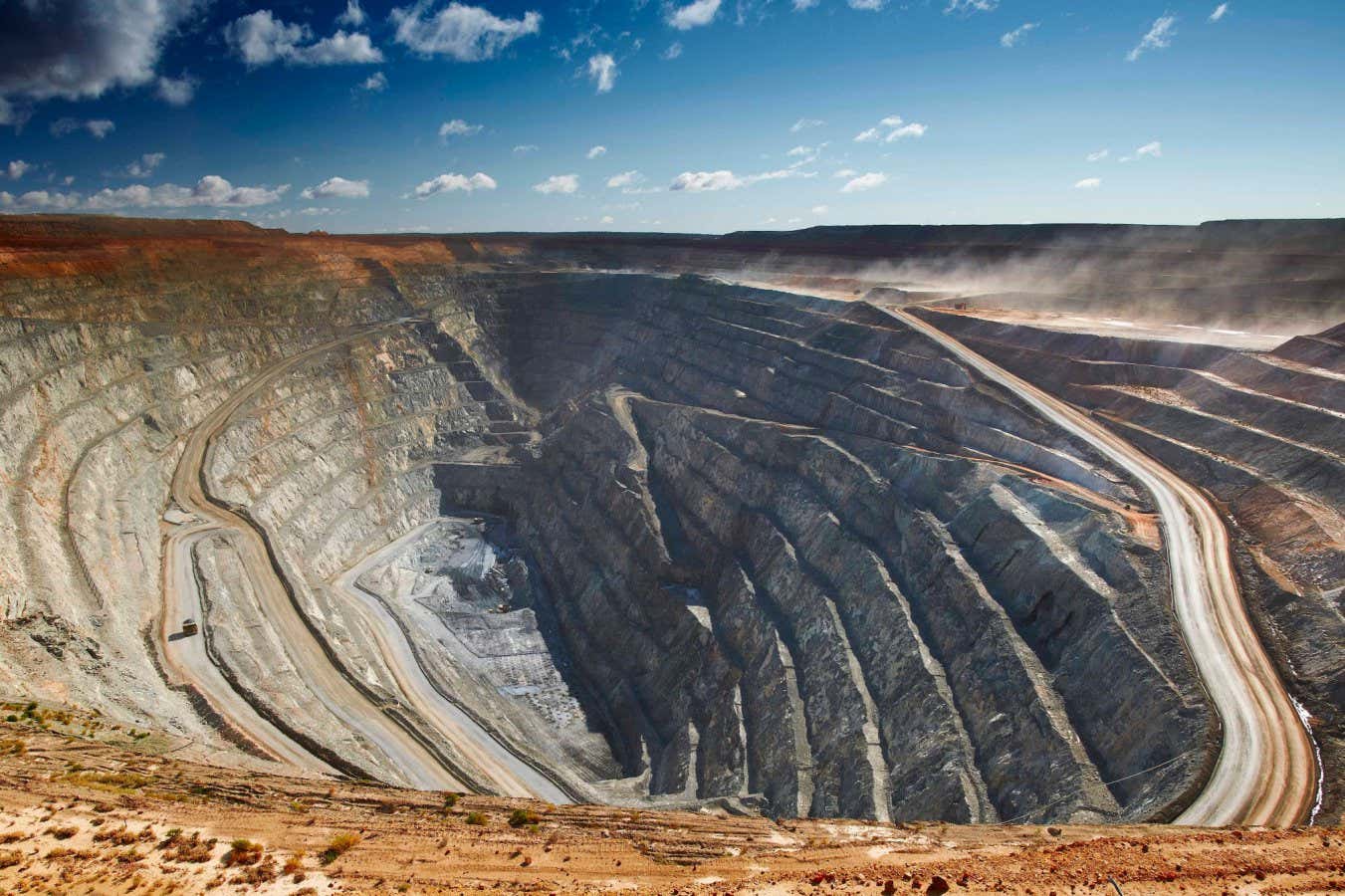
Nickel West in Australia is one of many mines that could use microwaves to store CO2 in waste rock
BHP
Mining generates billions of tonnes of waste rock each year. If those piles of unused rock can be made to react with carbon dioxide, they could help remove large amounts of the greenhouse gas from the atmosphere. However, current methods require burning fossil fuels to cook the rocks at high temperature. A carbon removal start-up has now found microwaving such rocks could make them react with CO2 using less energy.
“It’s like microwave popcorn,” says Sean Lowrie at Arca in Canada, which is developing the technology. Instead of heating the whole rock, the microwaves only heat certain molecules – not unlike how a kitchen microwave pops corn by heating the water inside a kernel.
A growing number of companies are using rocks to remove CO2 from the atmosphere in order to offset emissions from burning fossil fuels. Some of these enhanced rock weathering projects spread crushed volcanic rock on farms where it mineralises CO2 as it dissolves; others inject CO2 into similar rocks underground. A number of companies, including Arca, aim to use mine tailings left over from extracting metals like nickel and chromium.
These metals often occur in ores full of serpentine minerals, which are rich in magnesium that reacts with CO2. According to an analysis by Arca, there are currently about 28 billion tonnes of such tailings around the world, with 3 billion more tonnes produced each year. They estimate existing tailings could store up to 8.7 billion tonnes of CO2, the equivalent of about two years’ worth of US emissions.
But these serpentine rocks don’t rapidly react at normal pressure and temperature on the surface. Heating the rocks to high temperatures makes them more reactive, which speeds up their ability to quickly mineralise CO2. But that usually requires burning fossil fuels to generate the heat.
Using microwaves to heat the rock instead could offer a few advantages, says Peter Scheuermann at Arca. Rather than burning fuels to generate heat, the process could be powered by clean electricity and use less energy than directly treating the rocks with heat. It also wouldn’t take as long to treat the rocks. This means it might be easier for mining companies to add a microwaving step as they process tailings, though it could also work as a standalone system, he says.
According to a patent filing from the company, Scheurmann and his colleagues at Arca found zapping serpentine with microwaves for several minutes enhanced its reactivity to CO2, causing the chemical change at a lower temperature and using less energy than thermal treatments.
“By giving the rock energy, you’re breaking bonds within its structure and freeing up magnesium” to react with CO2, says Scheuermann. They also show the treated serpentine reacts with CO2 much more than untreated rock, mineralising the gas more rapidly.
“The improvement that they’re showing here looks very dramatic,” says Rafael Santos at the University of Guelph in Canada, who reviewed the patent filing. However, he says it is difficult to tell from the document alone how much serpentine is being treated by the microwaves, and how these results would translate to a realistic setting.
Scheurmann didn’t offer more specific numbers on how much they expect the microwave treatment would change the amount of CO2 that could be captured with serpentine, but says “it is a drastic increase. It’s an order of magnitude boost in both rate and capacity”.
The company has only tested the approach in the lab and has not yet delivered any of the nearly 700 tonnes of CO2 removals it has sold so far. But Scheurmann says a scaled-up version would involve feeding rocks through a chute or onto a conveyor belt where they would pass through a microwave field before being deposited on a tailing storage site. The company has also developed an autonomous rover that can churn the tailings to maximise exposure to the air. Once the reaction is complete, a fresh layer of tailings would be laid down.
“With this pretreatment with microwaves you’re unlocking a lot more potential for CO2 storage,” says Quin Miller at the Pacific Northwest National Laboratory in Washington state. “It’s exciting.” He says the treatment could also help extract more nickel, a key metal in batteries, from the rock.
Topics:
