

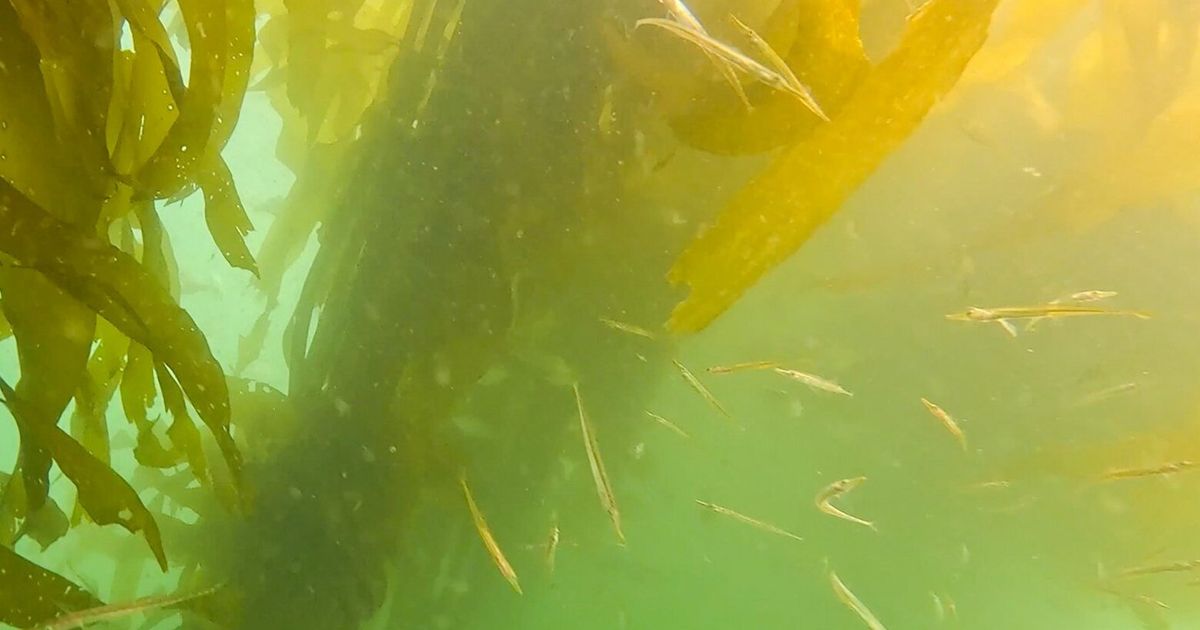
Bull kelp, the whiplike brown algae seen bobbing in Puget Sound this time of year, has a superpower. Capable of growing up to a foot of new foliage each day, it forms vast underwater forests, the scaffolding of an undersea world rich in marine life.
Fish, including young salmon, seek refuge within and dine on the kelp’s gangly leaflike blades. Crab and other crustaceans also feast on its armlike stipes that rise from the seafloor to the water’s surface. Even orcas visit, biting pieces to use for — what else? — back-scratching tools, scientists recently found.
Worryingly, this remarkable kelp species is rapidly vanishing in Puget Sound — and state policymakers must do all they can to reverse this continuing trend. Funding efforts to research the problem, protect remaining kelp beds and investigate methods to restore the species are urgently needed.
Lawmakers have rightly elevated the bull kelp’s relevance. A bill sponsored by Rep. Greg Nance, D-Bainbridge Island, made it the official state marine forest this year, with just one lawmaker — state Sen. Marko Liias, D-Edmonds — voting against it. But in a year of budget cuts, lawmakers failed to fund additional bull kelp research. Even a modest amount in subsequent years will help the cause. Other local governments, including King County, have and should continue to pitch in.
What can be done with such funds? For a start, more scientific research is needed to identify the root cause of its free fall. Eighty percent of it has disappeared from Puget Sound, a 2023 report from Washington’s Kelp Forest Monitoring Alliance found. Theories of its demise include warming sea waters. Even short exposure to warmer surface temperatures causes bull kelp to stop growing and reproducing, and can kill it. Higher seasonal temperatures resulting from human-caused climate change are likely to exacerbate this trend.
Preserving valuable sites where bull kelp survives will aid the recovery. On Aug. 8, state Public Lands Commissioner Dave Upthegrove signed an agreement with Squaxin Island Tribal Chairman Kristopher Peters that makes off-limits the tidelands surrounding the tribe’s namesake island, where one of the last vestiges of bull kelp remains in the South Sound. The state and tribe can work together to sustain this struggling species, and the Department of Natural Resources should follow through on a plan passed by the Legislature in 2022 to identify up to 10,000 acres to similarly place in conservation around the Salish Sea.
“We can’t allow it to die,” Peters said at a news conference at the signing.
Finally, it will take the help of scientists to try and reestablish the species. The Puget Sound Restoration Fund, a Bainbridge Island-based nonprofit, believes bull kelp can come back in the places it has faded away. Using aquaculture techniques, its scientists have taken its spore-like reproductive sori and embedded it within ropes attached to the seafloor at Jefferson Point near Indianola — traditional fishing grounds for the Suquamish Tribe, which calls the area Doe Kag Wats.
For five years running, the Restoration Fund has “seeded” the point in the hope the bull kelp will repopulate a new generation on its own. So far, the results of offspring in the following year have been meager — only a fraction are reproducing the next year — but that’s better than no kelp at all, Jodie Toft, the fund’s executive director, points out.
The nonprofit’s hope is developing a kind of “living paint” that can be more easily and quickly applied to help reestablish the species with minimal intervention in the sound, Toft said. Its work is critical toward resuscitating this crucial marine species.
Given how intricately tied it is to so many marine species, the restoration of bull kelp cannot fail. Lawmakers have helped shine a spotlight on their struggle. Even in tough financial times, they must act with alacrity to ensure a reversal of bull kelp’s demise. The health of Puget Sound, and all the creatures in it, depends on it.
