

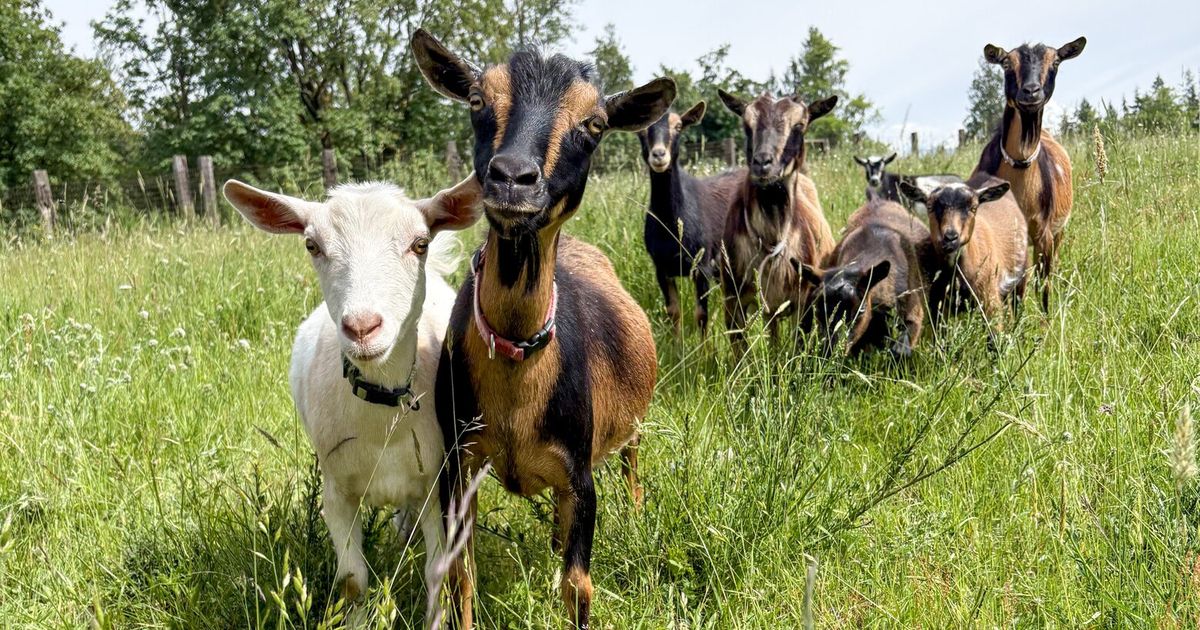
It is early morning at our house near Enumclaw, and walking out into the brisk air I am greeted with a barnyard symphony, as from across adjacent pastures come the harmonizing sounds of different animals. First a rooster with his hoarse crow, followed by the bellow of a cow and finally the surprisingly humanlike bray of a baby goat calling for its mother. Young goats are one of the most comical creatures; the sound they make has a pitch that is very close to that of a yelling child and I cannot help but think that is how they got the designation of “kids.”
But even though our house is situated on 5 acres, the place cannot really be called the “country” any more, because automotive white noise is constantly in the background, louder and closer than one would wish, reminding me that this plot of land is merely an extension of the now-urban space we call Western Washington. With nearly 5 million people in the Puget Sound basin, it is becoming increasingly difficult to describe it as anything other than a sprawling metropolis, steadily encroaching on and consuming what was once farm and field and woodland.
When I was growing up here during the 1960s, the areas on the fringes of each city and town transitioned quickly into a carpet of small and medium-sized farms, most of them operated by families, collectively producing a substantial portion of the food and leather and lumber needed by a growing population. There was an abundance of small dairy farms that produced all the milk needed by the region (no dairy products had to be trucked in), and for many adolescents, it was expected that during the summer months you would make your spending money picking raspberries, strawberries and rhubarb at one of the numerous patches dedicated to producing those desirable foods. Everywhere one looked, there grew daffodils and cucumbers and plums and hay and onions and cabbage, and if you needed something from a store that had to be transported in from far away it was something of an oddity. How this landscape has changed!
Now, nearly 100% of our essentials are transported from all over the nation and globe, most of it encased in clear plastic airtight packages. These days, our Western Washington civilization is, in a very real and non-hyperbolic sense, on direct life support because we now produce locally only the merest fraction of the stuff that feeds and clothes us. We are all urbanites now.
But I wonder if this fact is not lost on many people. I wonder if there is a subliminal sense in folks that life is weirdly and uncomfortably artificial now. That even if it is difficult to articulate, there is increasingly an inchoate longing for what could be termed reality, in the sense of having direct contact and involvement with the ancient rituals of interacting with the natural world in order to sustain ourselves and our children.
Hence, I think, the goats.
When I was in high school, goats were something of a puzzle. Why would anyone want such an animal? Holsteins and Herefords and appaloosas were easy to understand, but goats? The families that had them seemed a bit odd, and the rest of us would laugh at the quirky creatures and wonder what they were for. Do you eat them? Milk them? Nobody knew.
But now, in 2026, I am beginning to sense that the potbellied creatures may be serving a different function from whatever the original intention may have been. These days, the goats are here for urbanites to have a relatively convenient way to possess something real. To have something organic, and to connect with an impulse to retake a measure of independence from the life support machine that modern corporate America has become, however symbolic that small amount of independence might be. And, to give us pleasure. I suspect many of us still crave the feeling that comes from engaging in traditional, grounding activities such as caring for a farm animal, but I also know that ever fewer of us have the means to access these things.
So, the goats and chickens and ducks are no longer as much of a mystery to me. No, these animals are rarely eaten here in modern America, because we still buy 99% of our protein from the store using our little plastic cards, but that doesn’t matter. The goats are there to comfort us. And to eat all the weeds.
