

To quote Depression-era New York Mayor Fiorello LaGuardia: There is no Democratic or Republican way of cleaning the streets.
Municipal services — trash, police, water, housing — defy ideology.
Except, apparently, in Seattle.
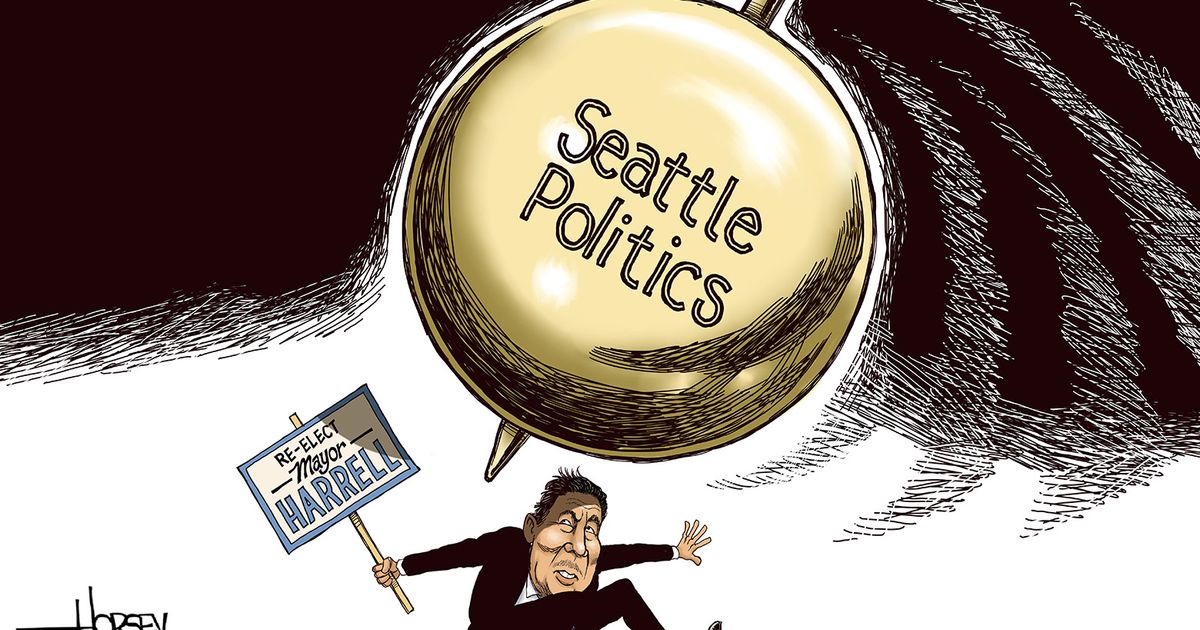
The Aug. 5 primary was uniformly regarded as a triumph for those identified with the left edge of the political spectrum, despite the fact that mayor, city attorney and council members are nonpartisan positions.
“Great Primary Election Night for the Left, Moderate Dems Are in Deep Trouble …” ran an online headline in The Stranger. “Wilson leads Harrell for mayor on a promising night for the left,” intoned The Seattle Times news pages.
This could very well end up a tidal wave carrying through November. Or perhaps not. We don’t know what the majority of residents think. Only about 39% of registered voters cast a ballot.
Here’s to hoping for more substantive and nuanced debate in the upcoming general election — along with greater voter participation — than what we just witnessed.
Public safety, substance abuse, the health of small business, empty storefronts downtown, empty storefronts in neighborhood business districts, traffic, utility rates — those issues got little traction this summer. Housing took center stage, and for good reason, if you’re in the market to buy a home or trying to afford rent.
Did voters hear plans that resonated? Mayor Bruce Harrell touted that he spent $1 billion on housing in four years — though Council President Sara Nelson questions whether the Office of Housing was able to move that much money through the bureaucracy without carrying over millions of dollars in unspent funds.
Harrell’s opponent, Katie Wilson, says she entered the race because she was so enthused by the new Seattle Social Housing developer, which is set to be funded with an estimated $65 million in tax money next year to maybe buy its first property.
The political left was undoubtedly helped by antipathy toward President Donald Trump, which opinion polls show is even more powerful around here than the desire for good government or effective programs.
None of the major candidates on the local Seattle ballot — and the editorial board talked to all of them — expressed any support for the policies emanating from Washington, D.C. But some of the incumbents fostered good relationships with the Seattle business community.
Given the dynamic of corporate titans such as Elon Musk and Mark Zuckerberg currying favor with the White House, that was enough to drag down candidates perceived as too establishment. Talk about painting with too broad a brush.
To shorthand the primary results: Voters wanted to strike a blow against Trump. They rejected incrementalism and narrow thinking. They wanted something big. They wanted something different.
But the funny thing about politics, the ideological spectrum is shaped more like a horseshoe than a straight line. The far left and the far right have more in common than either would like to admit.
Take the political mailer against Nelson paid for by the Progressive People Power PAC, which includes several unions. The piece alleged that Nelson “Failed to renew Seattle’s Comprehensive Plan for housing.”
This is not a half-truth or spin. This is a whopper. The Seattle City Council has not voted on the Comprehensive Plan, which outlines growth for the next 20 years. That’s expected in September.
Nelson is in the fight of her political life against Dionne Foster for council Position 9.
In the Seattle City Attorney’s race, challenger Erika Evans told the editorial board she would not enforce legislation passed by the Seattle City Council on street disorder (Stay Out of Drug Area) and human trafficking (Stay Out of Area of Prostitution). Evans claimed her evidence showed the laws were ineffective, even though the council held briefings before passing the measures 8-1.
You know who else told the editorial board they would not enforce laws passed by the legislative branch?
Republican Pete Serrano, when he was a candidate for state Attorney General in 2024, primarily because he didn’t agree with Democrats’ positions on gun control. That was considered disqualifying and one of several reasons why Serrano did not receive The Times’ endorsement.
Trump recently named Serrano to be U.S. attorney for the Eastern District of Washington.
Evans is about 22 percentage points ahead of the incumbent, City Attorney Ann Davison.
The Stay Out of Drug Area legislation — or SODA — was intended to buttress local and state laws that made public drug use and possession a misdemeanor, with treatment the primary goal. But convictions necessitate narcotic testing, to make sure drugs confiscated by police are truly fentanyl or methamphetamine or whatever. That can take months from the state crime lab.
SODA enables the city attorney to ask a judge to ban someone from, say, Little Saigon, who has repeatedly been arrested. It’s an attempt to bring some immediate relief to the businesses and residents coping with ongoing street disorder.
If SODA isn’t the plan, what is? What do all the Seattle candidates heading into the general election propose for folks living and working around Little Saigon and other areas in desperate need of help?
The same could be asked about housing. Saying tenants’ rights ought to be tantamount sounds pretty good. But what about developers who build apartments and condos? How can the city guarantee a housing market where they can earn a predictable return for their investments and thus build more housing?
These are the kind of questions local candidates ought to be fielding as summer turns to fall. Residents deserve a substantive campaign.
Primaries are tough. So many candidates saying basically the same things while trying to distinguish themselves. But now the choices are binary. We can go one way or the other.
Against this backdrop, the economy is blinking red. Local employment dropped 0.1% in the first half of the year compared to 2024, while the pace of national jobs grew at 1.1%.
The business and occupation tax cut that the Seattle City Council recently placed on the November ballot would shrink the number of businesses that have to file B&O taxes from 21,000 to around 5,200. The city is becoming increasingly reliant on fewer taxpayers.
All it takes is for one flagship Seattle business to leave town and the civic conversation changes immediately.
Finally, it’s worth a look at our fellow West Coast cities.
In San Francisco, Mayor Daniel Lurie won election last year on a platform of taking care of the basics and avoiding ideological dramas.
That same year saw businessman Keith Wilson become mayor of Portland, with the support of the Rose City’s business, labor and environmental communities.
This was B.T.: Before Trump.
Who, as we’ve seen, has the uncanny ability to bring out the worst in both sides of the political divide.
I hope Seattle breaks that mold. Governing a major U.S. city is hard. In the spirit of LaGuardia, the privilege ought to be awarded to those who can articulate what services they would deliver and how, because the best way to take out the garbage is to not get stuck in the muck.
