

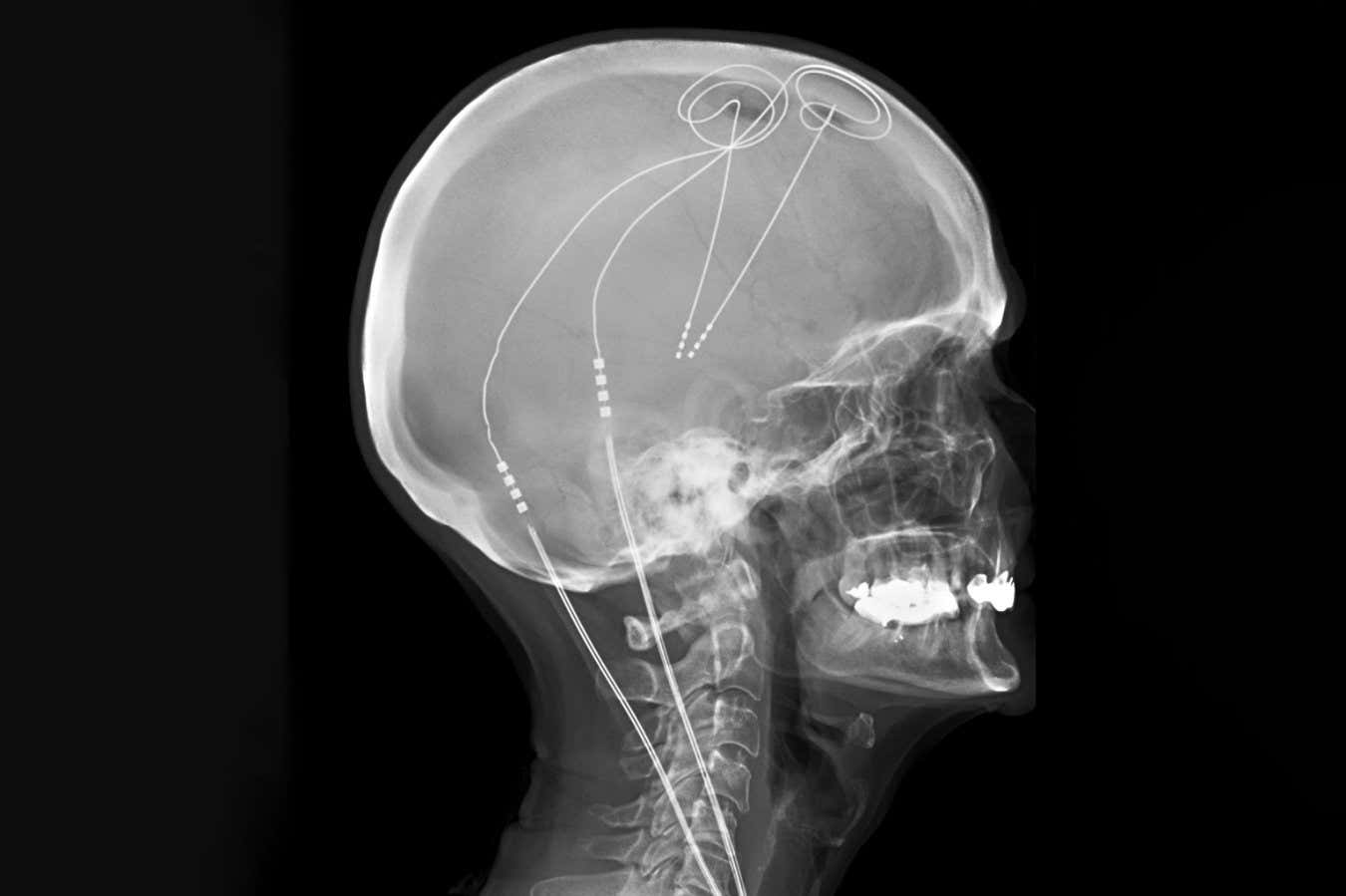
Deep brain stimulation is already used to treat Parkinson’s disease
Living Art Enterprises/SCIENCE PHOTO LIBRARY
A brain implant that detects when someone is in pain and responds with deep brain stimulation has helped relieve people from previously untreatable chronic pain – with one participant even becoming able to hug his wife for the first time in years.
Chronic pain affects up to 20 per cent of people in the US, many of whom experience little relief from traditional pain therapies. This may be because it can result from fundamental changes to brain circuitry, which are challenging to target and remodel with standard therapies.
Deep brain stimulation (DBS), which involves stimulating the brain using tiny electrodes, has shown promise but has inconsistent results. Traditionally, the same brain areas are targeted in a one-size-fits-all approach, despite evidence suggesting that pain arises from different circuits in different people.
So Prasad Shirvalkar at the University of California, San Francisco, and his colleagues wondered whether a personalised system would be more effective. To find out, six people with previously untreatable chronic pain underwent intracranial electroencephalography, in which electrodes recorded activity from and stimulated 14 sites across their brain over 10 days.
For five of the participants, the researchers were able to identify which sites to target and which stimulation frequency provided the greatest relief. Although one of the five didn’t report significant pain relief, he did experience improved physical function and was able to hug his wife for the first time in years, which was considered meaningful enough to have him advance to the next stage of the trial.
The researchers next used machine learning to identify and distinguish between the electrical activity that occurred when the individuals experienced high or low levels of pain. They then implanted permanent DBS electrodes into each participant, which were personalised to monitor their brain activity and deliver optimal stimulation whenever pain-related activity was detected, and to deactivate when they were asleep.
After six months of fine-tuning, each device was put to the test in a trial in which participants received either their real, personalised stimulation for three months, followed by a sham for three months, or vice versa, with the participants not being told which form of stimulation they were receiving. The sham stimulated the brain at a very low frequency in areas outside of the ideal location, and assessments of pain were collected multiple times a day throughout the trial.
On average, real stimulation reduced daily pain intensity by 50 per cent, compared with an 11 per cent pain increase with the sham. Daily step counts rose by 18 per cent during the real stimulation compared with 1 per cent during the sham. The participants also reported fewer symptoms of depression and expressed less pain that interfered with their daily lives during the real stimulation. These benefits persisted over a follow-up of 3.5 years.
“This is an important study leveraging the latest tools,” says Tim Denison at the University of Oxford.
A previous problem for DBS technology has been habituation, in which the brain adapts to consistent stimulation and efficacy declines. Denison says the persistent benefits might be linked to the participants only receiving stimulation when their pain levels increased, rather than it being constant. The next step would be to compare adaptive versus constant stimulation to measure differences in outcomes, he says.
“Another challenge will be economics and scaling of this technique,” says Denison, which “motivates continued research in less invasive methods of neuromodulation”.
Topics:
