

Feedback is New Scientist’s popular sideways look at the latest science and technology news. You can submit items you believe may amuse readers to Feedback by emailing feedback@newscientist.com
Computer versus dog
Sometimes Feedback gets an email with such a punchy opening line, we basically have to include it. Hence, we perked up when Elliot Baptist emailed to say: “I thought Feedback might like to know, if Feedback doesn’t already, that a well-trained New Zealand dog has surpassed quantum computers.”
Elliot was highlighting a preprint paper by two cryptographers, Peter Gutmann at the University of Auckland and Stephan Neuhaus at the Zurich University of Applied Sciences, on the Cryptology ePrint Archive. It is about the long-running effort to create a quantum computer that can factorise an extremely large number – that is to say, identifying two numbers that can be multiplied together to get the target number.
This is an important challenge because a lot of encryption methods rely on huge numbers that are difficult to factorise. If somebody ever builds a quantum computer that can factorise big numbers quickly, a lot of seemingly secure servers and transactions will suddenly become insecure. There have been some milestones towards this: in 2001, IBM built a computer that could factorise 15 (5×3, if you weren’t sure), and in 2012 they upgraded to 21 (7×3). By 2019, a start-up called Zapata claimed it could factorise 1,099,551,473,989.
Gutmann and Neuhaus, however, are relaxed about the future of encryption. They argue that many of the quantum factorisations are sleights of hand. “Similar to stage magic, the exercise when responding to a new quantum factorisation announcement is not only to marvel at the trick but to try and figure out where the sleight-of-hand occurred,” they write.
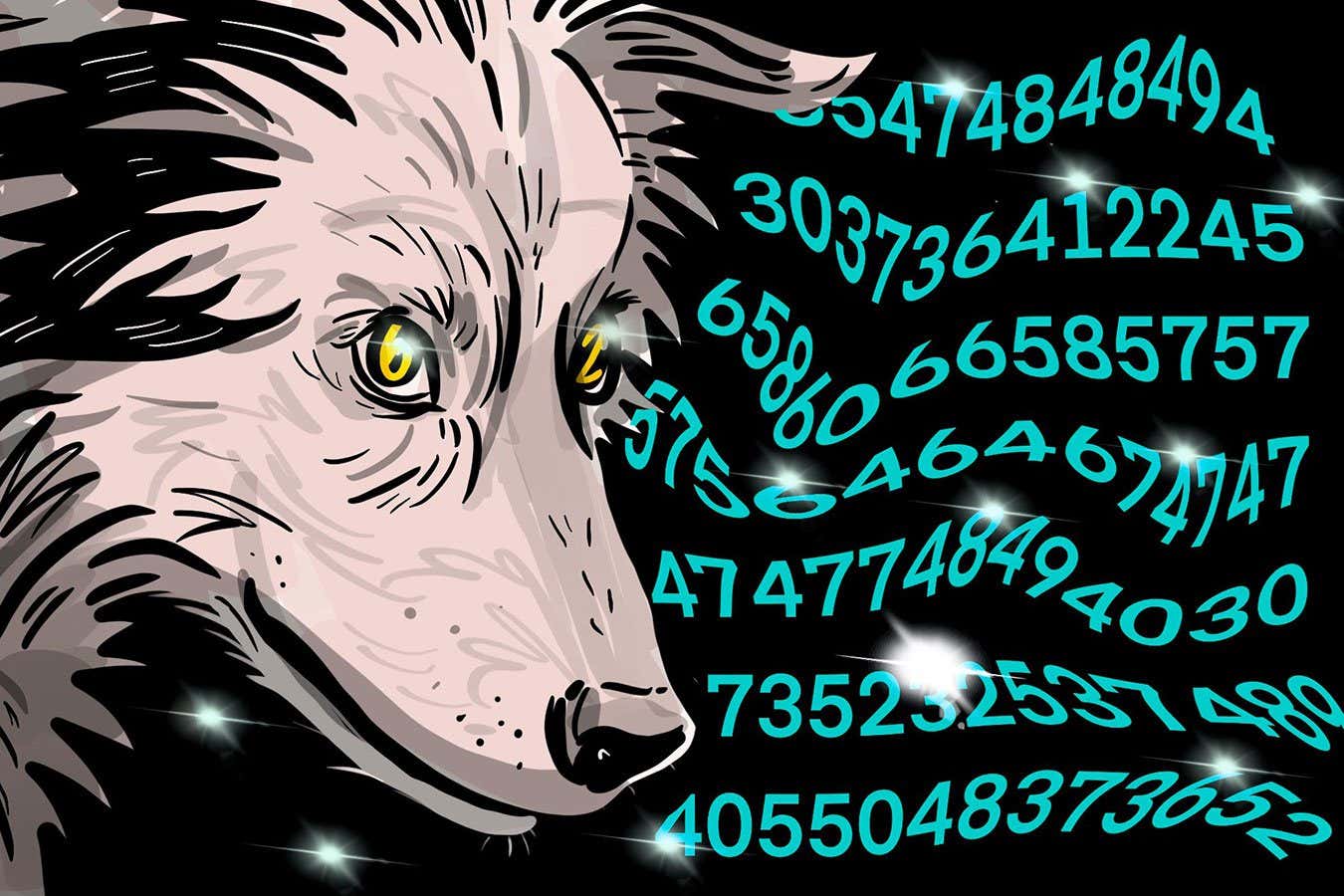
Which is why they decided to replicate the quantum factorisations using less advanced forms of technology: specifically, “an 8-bit home computer, an abacus, and a dog”. The method using the home computer took them two pages to describe, so we will leave it as an exercise for the reader. The abacus method is simpler, although it does require one abacus with 616 columns for the bigger numbers.
Let us now proceed to the dog-based method. To replicate the original factorisations of 15 and 21, the researchers simply trained a dog to bark three times. “We verified this by taking a recently-calibrated reference dog, Scribble, depicted in Figure 6, and having him bark three times, thus simultaneously factorising both 15 and 21,” they write. “This process wasn’t as simple as it first appeared because Scribble is very well behaved and almost never barks. Having him perform the quantum factorisation required having his owner play with him with a ball in order to encourage him to bark.”
Elliot says he is “not qualified to comment on the validity of the argument”, and Feedback would like to add that we may be even less qualified. Any readers that actually understand quantum computing and encryption are invited to write in and explain what on Earth is going on. Feedback probably won’t understand the answer, but we will run the explanations past one of Feedback’s Felines and see what they meow.
Robotic responses
Feedback’s account of next year’s “electrifying” Love and Sex With Robots conference, due to be held in Zhejiang, China, drew a few emails, some of which got through our filters.
Tim Stevenson pointed out that we had neglected to mention a key detail, which “would have been most revealing… the fee for attending”. Feedback is nothing if not diligent, so we revisited the conference website and discovered that it costs $105.98 to “reserve a spot”. We have a suspicion that actual tickets may retail for rather more, but we didn’t want to register to find out.
Meanwhile, Pamela Manfield cut to the chase: “Any university or other government-funded organisation that pays to send anyone on its staff… should have their funding cut.” Feedback doesn’t disagree, but, on the other hand, Donald Trump’s administration is cutting all the research funding anyway, so perhaps the point is moot.
Seasonal injuries
Nicole Rogowski writes in to highlight a study from 2023 that had somehow escaped our attention. She suggested it was an example of “no shit, Sherlock” – a study that goes to enormous lengths to demonstrate something obvious – but Feedback doesn’t agree, because you could have forced us under extreme duress to spout obvious-sounding statements for 100 years and we would never have come up with this. The study is called “Penile fractures: the price of a merry Christmas“, which, as Nicole says, “speaks for itself”.
The researchers explored whether penile fractures – technically “the rupture of the tunica albuginea surrounding the corpora cavernosa”, as “heralded by an audible crack” – were more common at certain times of year, using data from 2005 to 2021 from Germany. Apparently, the Christmas period (24 to 26 December) and the summer show higher rates of penile fractures, but curiously not the New Year period (31 December to 2 January). The authors suggest that “Christmas might be a risk factor for penile fractures due to the ‘Christmas spirit’ related to the intimacy and euphoria of these holly jolly days.”
The paper concludes: “Last Christmas penile fractures occurred more often. This year to save us from tears, we will NOT do something special.”
Apologies for any typos: Feedback wrote this entire section curled up in the fetal position.
Got a story for Feedback?
You can send stories to Feedback by email at feedback@newscientist.com. Please include your home address. This week’s and past Feedbacks can be seen on our website.
