

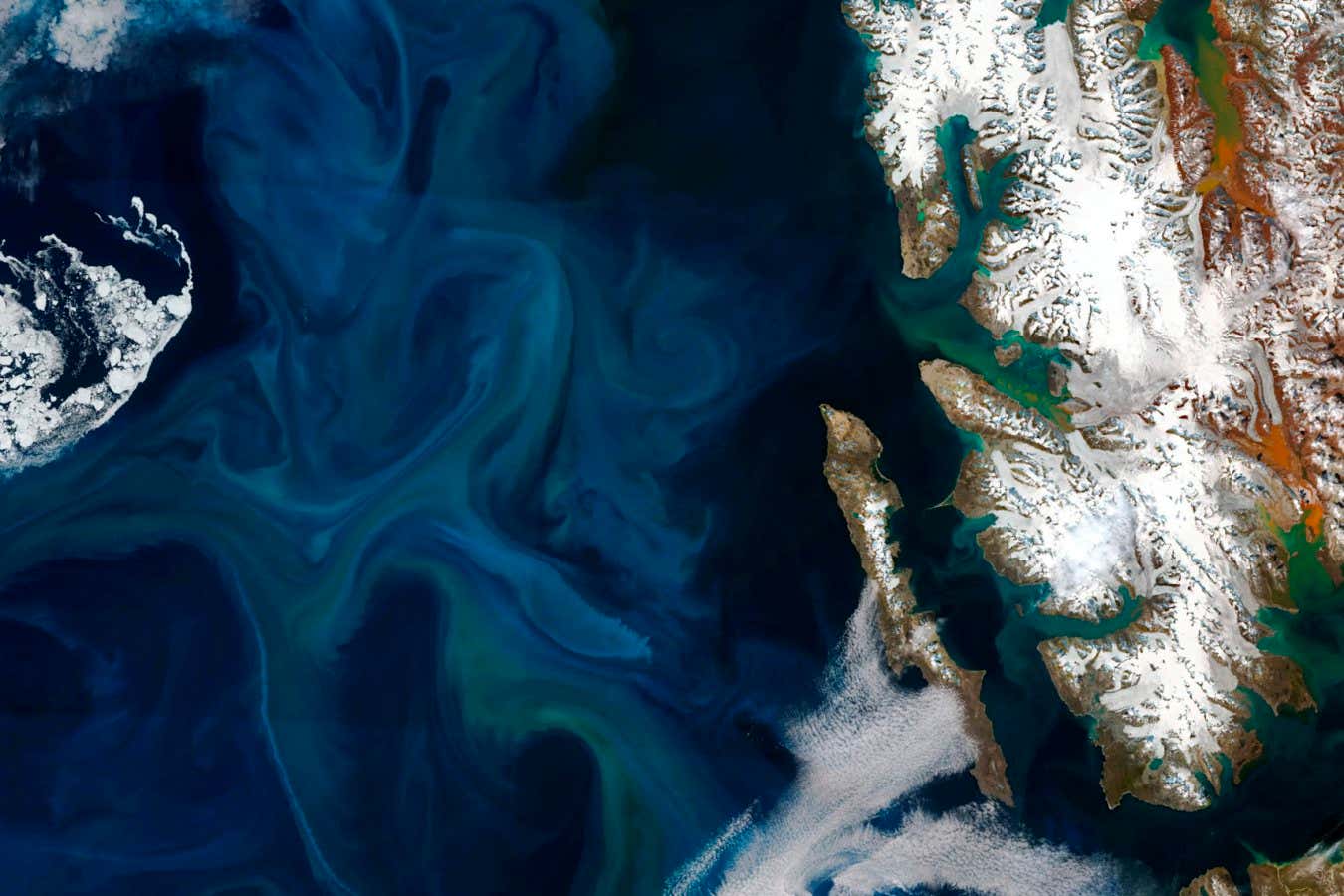
A phytoplankton bloom in the Arctic Ocean near Svalbard gives the sea a green hue visible in satellite images
European Union, Copernicus Sentinel-2 imagery
As sea ice melts, more light will infiltrate the Arctic Ocean, allowing phytoplankton and other marine life to flourish – or so we thought. In fact, phytoplankton growth in some parts of the Arctic is now starving other parts of a crucial nutrient, a tipping point that could spell trouble for seals, polar bears and even commercial fish in the north Atlantic.
Phytoplankton, the tiny photosynthesising organisms that form the basis of the marine food chain, have been increasing across the Arctic, according to satellite measurements of the green pigment chlorophyll. Algal blooms there have broken records.
But since 2009, overall phytoplankton growth has slowed in many areas and has even begun decreasing on the Atlantic side of the Arctic. New research by Raja Ganeshram at the University of Edinburgh, UK, and his colleagues suggests blooming phytoplankton on the Pacific side are depriving neighbouring areas of nitrate, a chemical that’s vital for growth.
Arctic warming “is not just a reduction in sea ice and temperature; it is more than that. It’s having an effect on the ecosystem,” says Ganeshram. “This has impacts on our food resources in ways that we don’t fully understand, both within the Arctic as well as in the north Atlantic, at our doorstep.”
Nitrogen is one of the three main nutrients needed for plant life, whether that’s flowers in a garden, crops on a field or phytoplankton in the ocean. Pacific water coursing through the Bering Strait brings this nutrient in the form of nitrate into the Chukchi Sea, which is part of the Arctic Ocean. Currents carry the nitrate around the Arctic and eventually flow into the Atlantic, largely through the Fram Strait between Greenland and Svalbard.
Ganeshram and his colleagues analysed measurements of nutrient levels in the Fram Strait collected by regular icebreaker expeditions from 1998 to 2023. They found that there has been a sharp fall in nitrate levels from 2009 onwards, and the drop coincided with a “regime shift” towards lower sea ice extent. According to the team’s findings, almost all the nitrate arriving from the Pacific is being consumed in the Chukchi Sea now that sea ice retreat has exposed the water to more sunlight.
Greater amounts of phytoplankton have been growing, dying and sinking to the seafloor, where aerobic bacteria and archaea in the sediments decompose them, consuming oxygen. But once the limited amount of oxygen runs out, anaerobic microbes start breaking the dead phytoplankton down, consuming nitrate. By the time these waters reach other parts of the Arctic like the Fram Strait, they are depleted of nitrate.
As a result, diatoms, a kind of algae that thrive when nitrate is available, have ceased to be dominant in the Fram Strait. Now, most phytoplankton there are microplankton, which are more efficient at sourcing their nitrogen from ammonium produced by bacteria and zooplankton in the water column.
That adds more links to the food chain, since smaller phytoplankton must be eaten by smaller zooplankton before that energy makes its way to larger zooplankton and fish. And because some energy is lost at each link, a longer food chain could ultimately mean less food for fish, seals, polar bears and even human communities like the Inuit.
The altered flow of nutrients into the north Atlantic could change the phytoplankton make-up there as well, possibly affecting commercial fishing.
The results demonstrate that phytoplankton are now limited by nutrients rather than sunlight and their growth across the Arctic Ocean as a whole will probably soon stop increasing, says Jean-Éric Tremblay at Laval University in Quebec City, Canada, who was not involved in the research.
“What this is showing is that the Arctic Ocean is not going to become the oasis of the future,” he says. “If you increase [phytoplankton] production, you enhance denitrification, you remove nitrate, and further down the line you reduce productivity.”
The researchers behind the study think the ecosystem has crossed a tipping point. “That sea ice is not going to come back, even if interannually there might be some fluctuations,” says team member Marta Santos-García, also at the University of Edinburgh. “So you can basically imply then that this loss of nitrate will likely not be recovered.”
Topics:
