

Archaeological excavations near Aldborough, UK, are helping us understand life after Roman occupation
R Ferraby & M.J. Millet
When the Roman Empire withdrew from Britain, the result was not chaos and economic collapse. The metals industry in what is now northern England continued and even expanded in the subsequent centuries, according to an archaeological record of pollution from metalworking.
“The argument has been that, with the disappearance of state apparatus and linked state transport systems, the regional economies collapse totally,” says Christopher Loveluck at the University of Nottingham in the UK. But that isn’t what the archaeology revealed. “We’re seeing an increase in metal pollution products.”
Loveluck is part of a team that has excavated Roman remains from Aldborough in North Yorkshire, England. Under Roman rule, this town was called Isurium Brigantum, where metals like iron and lead were mined and processed.
The team found aerosol pollution from these metalworking operations had become trapped in the silt accumulating in an ancient riverbed at the archaeological site. By digging through the layers of sediment, the team was able to reconstruct how pollution levels varied between 345 and 1779 AD.
“They get this long chronology, so you really can trace the ups and the downs,” says Jane Kershaw at the University of Oxford, who wasn’t involved in the research but who has studied early medieval metal mining.
In the late 300s and early 400s, the Roman Empire lost control of Britain and withdrew. “The government apparatus goes, the tax collection apparatus goes, no new coinage arrives in Britain, and they almost certainly withdraw all of the field army units as well,” Loveluck says. The subsequent centuries have few written records, and certain industries – notably wheel-thrown pottery – went into steep decline. This gave rise to a narrative of “the society of 5th century Britain just collapsing”, says Loveluck.
The riverbed record tells a different story. Lead pollution was low during Roman times, and fell only slightly in the late 300s and early 400s. It then rose steadily until the mid-500s. Likewise, pollution from ironworking rose during the first half of the 500s.
This, argues Loveluck, suggests continuity in the large-scale production of essential commodities.
The rise in metal production may have been due to internal fighting, suggests Kershaw. “It’s a period where the various Anglo-Saxon kingdoms are coalescing,” she says. “There’s a lot of fighting between those different kingdoms.” Many men were buried in graves with swords and knives.
Metal production then declined sharply in the mid-500s, and remained low for several decades. The team suggests this might be due to the Justinianic plague, which cut through the lands around the Mediterranean in 541-549 AD. Ancient DNA evidence from a graveyard in east England shows the plague did reach Britain. However, it is not clear how severe or widespread it was. “We don’t have grave pits full of plague victims, for instance, like we do with later plague events,” says Kershaw.

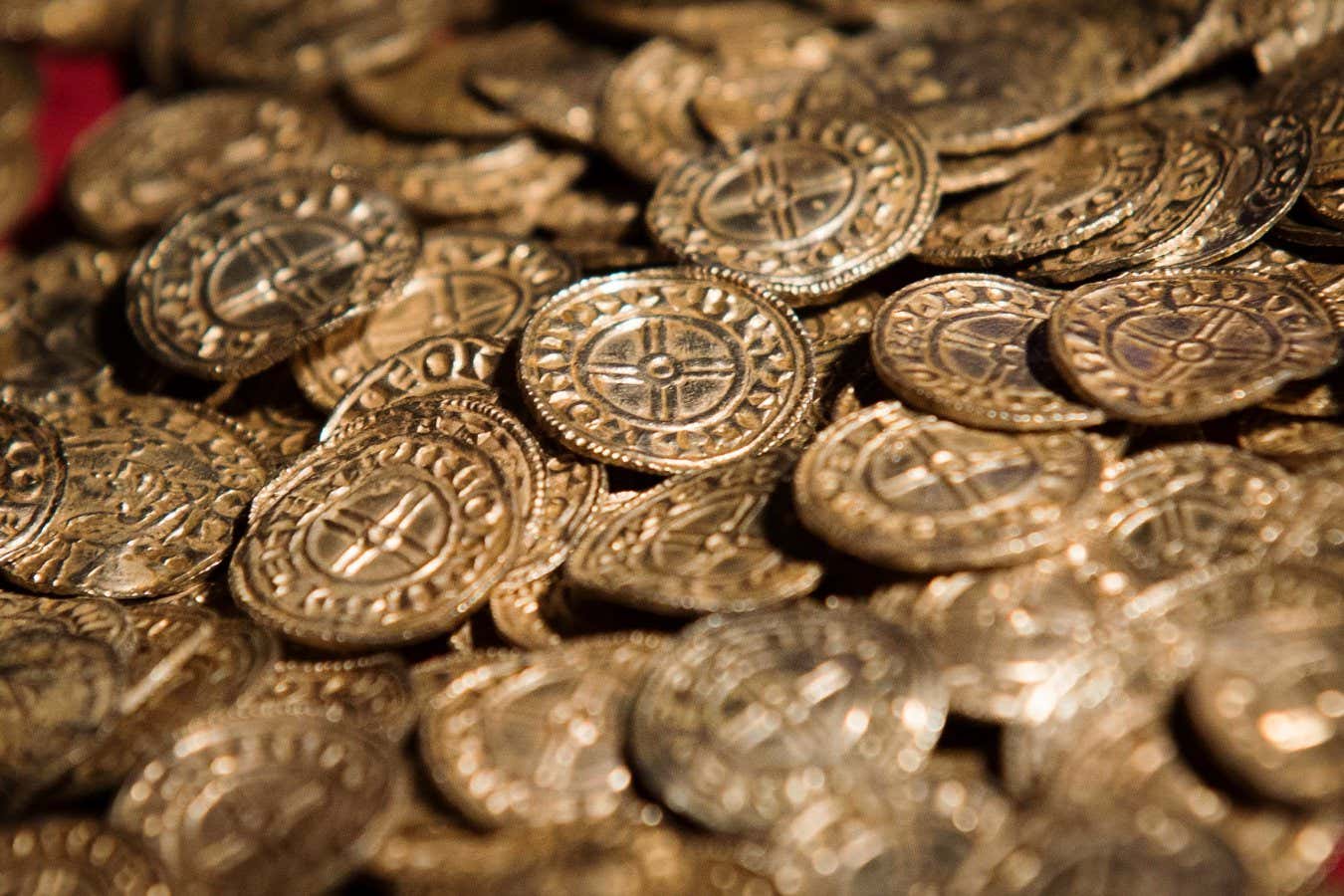
Anglo-Saxon coins dating from the 10th and 11th century
Andrew Cowie/Alamy
The apparent resilience of Aldborough metal production in the face of the Roman withdrawal fits with other evidence of economic and political continuity. “Droitwich in Worcestershire [in western England] has an unbroken sequence of salt production from the Roman period to the modern period,” says Loveluck.
The period after the Roman withdrawal has been dubbed the Dark Ages, due to a lack of written records and supposed intellectual decline. However, historians say that is at best an oversimplification.
Some practices did cease, like wheel-thrown pottery and building using stone. But this period also saw the production of spectacular metalwork, often using copper. “If everything was so terrible and dark, how come they’re wearing these amazing brooches and they’ve got colourful bead necklaces,” says Kershaw.
Topics:
