

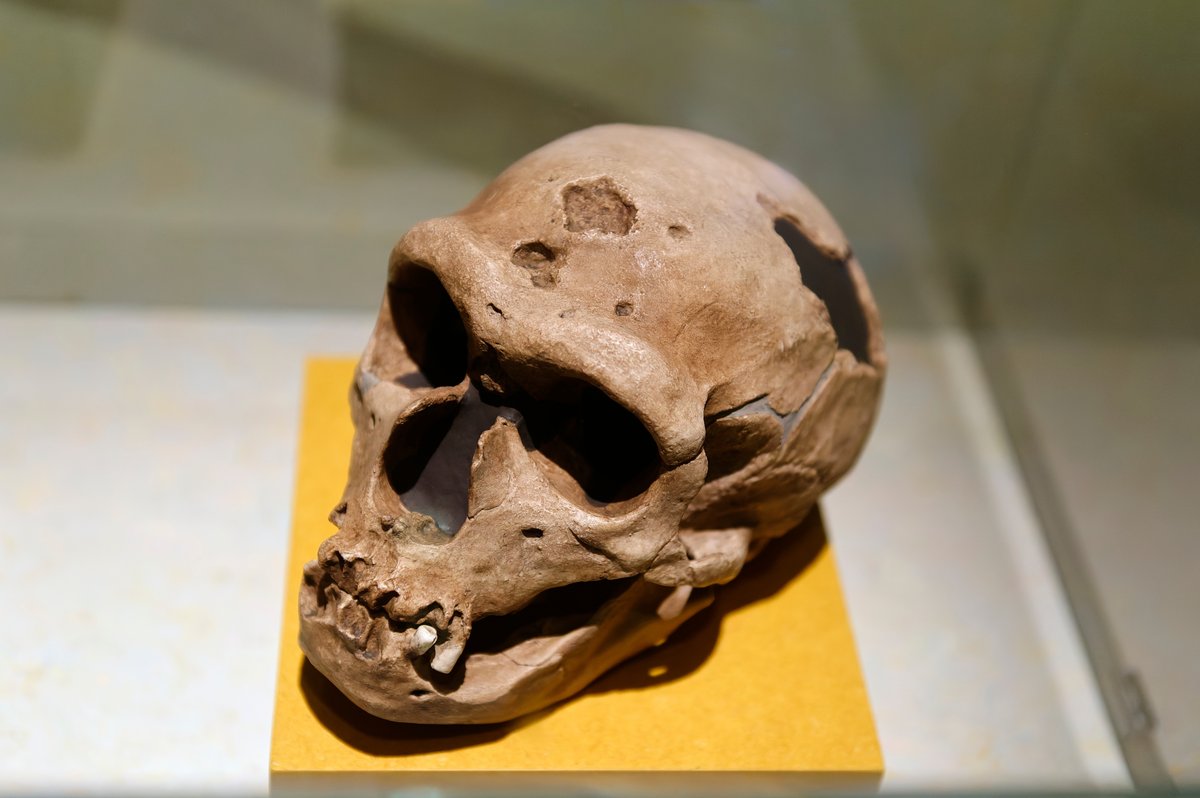
Billions of people alive today carry a trace amount of Neanderthal DNA—the evolutionary legacy of interbreeding between these ancient human relatives and our species, Homo sapiens, tens of thousands of years ago. These genes have been linked to all sorts of health outcomes in modern humans, including changes in muscle mass, immune system function and even risk of dying from COVID.
Now researchers have identified a specific segment of Neanderthal DNA that helps shape the modern human brain and is associated with a lower risk of schizophrenia.
In a new study published in Proceedings of the National Academy of Sciences USA, researchers show that this DNA segment correlates with a nearly 10 percent lower risk of developing schizophrenia in people with two copies of the variant, as well as a small reduction in the size of the occipital lobe—a brain region involved in visual processing.
On supporting science journalism
If you’re enjoying this article, consider supporting our award-winning journalism by subscribing. By purchasing a subscription you are helping to ensure the future of impactful stories about the discoveries and ideas shaping our world today.
Based on data from the UK Biobank, people carrying the Neanderthal genetic variant saw a decrease in occipital lobe size of about 0.85 cubic centimeter per copy—or a decrease of 1.7 cubic centimeters in those with two copies, one from each parent—the study found.
“I find it fascinating that a genetic variant inherited from Neandertals is associated with differences in brain anatomy in people today, particularly reduced occipital lobe volume,” says Nadav Ahituv, director of the Institute for Human Genetics at the University of California, San Francisco. Ahituv reviewed the study for PNAS but was not directly involved in the research.
Researchers believe that most Neanderthal DNA carried by humans today stems from a large interbreeding event that occurred around 47,000 years ago, explains study co-author Svante Pääbo. He is a director at the Max Planck Institute for Evolutionary Anthropology in Leipzig, Germany, and won the Nobel Prize in Physiology or Medicine in 2022. “If you look at the [Neanderthal] contributions that exist in people today, it really seems to come from what looks like one event,” Pääbo explains.
Skull fossils suggest that Neanderthals had a larger occipital lobe than H. sapiens, along with a more elongated brain case. So it’s unclear why humans carrying Neanderthal DNA have smaller occipital lobes today.
One clue might be the DNA segment’s placement—it turns up near a gene called DAAM1, which plays a role in early brain development, says study co-author Hugo Zeberg, an evolutionary geneticist at the Karolinska Institute in Sweden. But exactly how DAAM1 interacts with the newly described segment of Neanderthal DNA is unclear.
The variant was also not linked to any other psychiatric conditions, including depression, bipolar disorder or attention deficit hyperactivity disorder (ADHD), and was not associated with intelligence, the researchers found.
Zeberg and Pääbo plan to continue sifting through the genome for other consequential pieces of Neanderthal DNA. More discoveries are coming, Zeberg says: “You might hear from us again.”
Subscribe to Support Independent Journalism
Great science journalism requires human expertise, time, effort and creativity. And it costs money. That’s why I and the journalists here at Scientific American hope you’ll join our community.
When you subscribe, you are supporting staff and freelance journalists who are passionate about telling science stories that are true, important and compelling. Our editors and reporters are often experts in their fields, which means they understand the nuances of big discoveries and can untangle the breakthroughs from the hype. With a subscription, you are also supporting rigorous fact-checking to ensure the words we publish are precise and accurate. And you’re supporting original illustrations, graphics and photos that bring you closer to an advanced laboratory, an ice sheet in Antarctica or a space mission in orbit. You’re helping us craft other types of high-quality journalism as well: Our newsletters are carefully written, edited and curated by staffers you have or will come to know and love. Our Science Quickly podcast is based on original reporting, collaboration with editors and scientists and exacting production.
Subscriptions keep this engine running so we can continue to deliver thoughtful, rigorous and independent science journalism to you. In an era of viral misinformation, this work is crucial. If you value what we do, I hope you’ll consider joining us as a subscriber
