

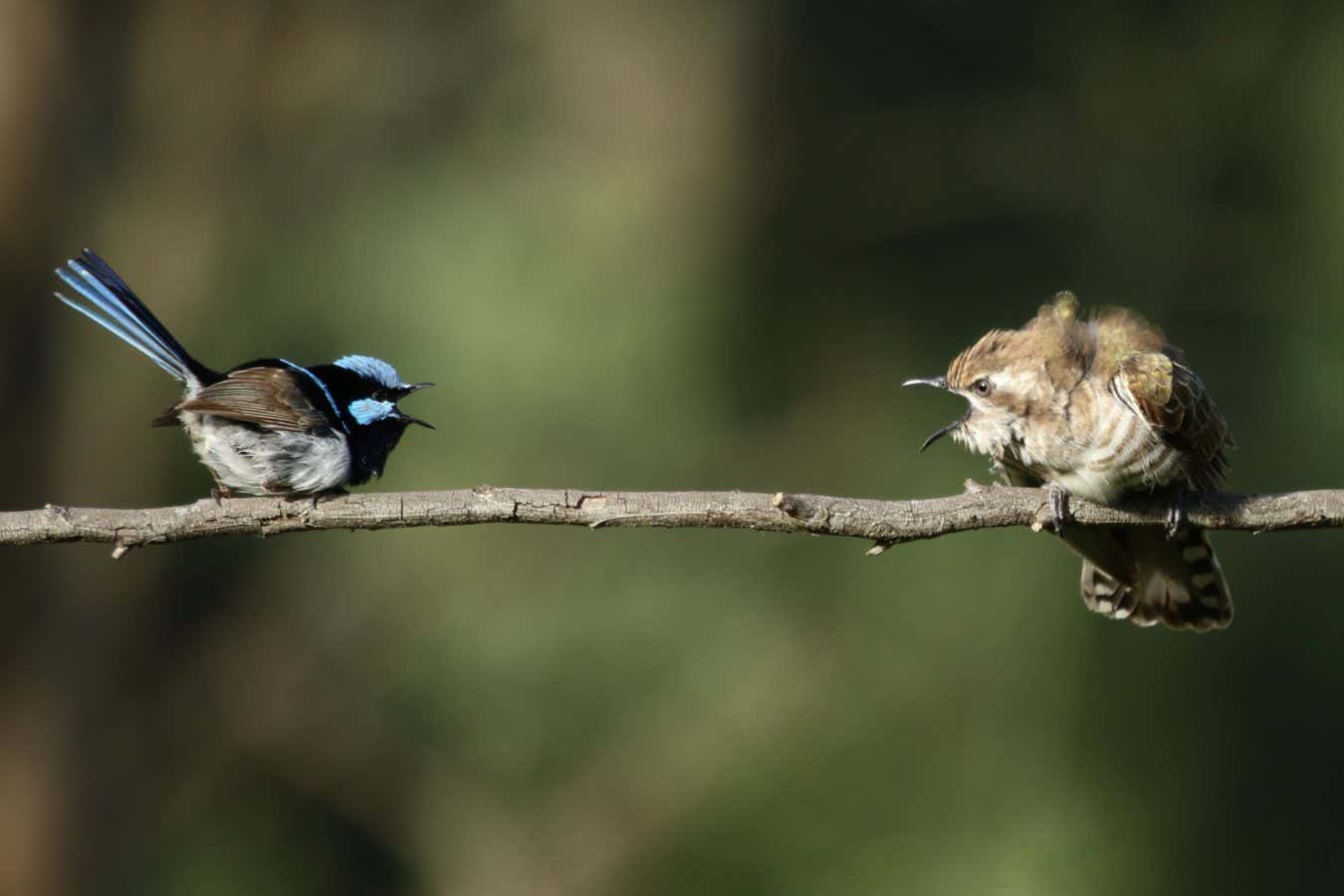
A superb fairy-wren (left) tries to fend off a cuckoo
David Ongley
More than 20 species of bird around the world use a similar “whining” alarm call to warn birds like cuckoos are around. The call seems to be understood across species, and its specific use hints at how language may have originated.
Cuckoos are one of a range of some 100 species known as brood parasites that lay their eggs in the nests of other birds, attempting to con the hosts into incubating and caring for the hatchlings as if they were the hosts’ own offspring.
Will Feeney at the Doñana Biological Station in Spain and his colleagues have now found 21 bird species, which last shared a common ancestor about 53 million years ago, all use structurally similar “whining” vocalisations when they spot a brood parasite.
The species include superb fairy-wrens (Malurus cyaneus) in Australasia, tawny-flanked prinia (Prinia subflava) in Africa, Hume’s leaf warblers (Phylloscopus humei) in Asia and greenish warblers (Phylloscopus trochiloides) in Europe.
“All of these different birds from all around the world seem to have converged on using this same vocalisation to denote their respective brood parasites,” says Feeney.
The researchers found the species that produce this alarm call often inhabit areas where there are lots of brood parasites that make use of many different host species, and when the potential hosts hear the whining call, they attempt to scare away the invader with aggressive physical mobbing.
“Brood parasites represent this very unique kind of threat. They are an enormous threat to your offspring but not at all a threat to you,” says Feeney. “Our data suggests that [the call] is to bring in birds as quickly as possible, potentially to assist.”
“For the superb fairy-wrens, because they’re cooperative breeders, it’s quite possible that the mobbing call is intended to draw in other individuals to participate in the mobbing,” says Rose Thorogood at the University of Helsinki in Finland.
To investigate further, Feeney and his colleagues played recordings of the calls made by brood-parasite hosts from other continents to potential host birds in Australia and China. They discovered hearing the foreign warning calls elicited just as rapid a mobbing response as hearing the calls produced by their own species.
“This indicates that the function of this vocalisation is to facilitate a communication across species rather than just within,” says Feeney.
Thorogood cautions, “It might not be that they have an ancestral, ancient shared alarm towards brood parasites, but rather it might actually just be that there is a specific acoustic feature that seems to be quite successful at driving away brood parasites.”
The team also did a similar playback experiment in territories of yellow warblers (Setophaga petechia) in North America, which are used as egg incubators by brown-headed cowbirds (Molothrus ater), but don’t make the distinctive whining alarm call. When hearing the alarm calls of superb fairy-wrens, the warblers responded with a rapid return to their nests much as they do to other calls indicating distress, rather than by mobbing.
Feeney says this suggests there is an innate component to the alarm calls that many bird species respond to, but birds in areas where brood-parasites are common have tailored the call and response to pass on knowledge of the local risk.
“They’ve taken a distress call vocalisation and repurposed it for use in a novel context, which is a high threat to offspring,” he says. “That would explain why all these birds from all around the world are using a similar sound.”
Charles Darwin speculated in his 1871 book The Descent of Man the origins of spoken language might be traceable to the imitation and modification of instinctive sounds that humans and other animals produce. Examples of these might be a squeak if you are scared or a scream made in response to pain. “The birds adapting these innate calls to another purpose could be the first stepping stone towards language,” says Feeney.
Rob Magrath at the Australian National University says, “Calls often have specific meanings, and in some cases, they refer to external objects or events, rather than merely communicating about internal states like fear, or attributes like sex or species.”
“This referentiality means that such calls are akin to human words, which often refer to external objects or events,” he adds. “So, animal communication and human language appear to be on a continuum, rather than ‘language’ being a uniquely human feature.”
Topics:
