

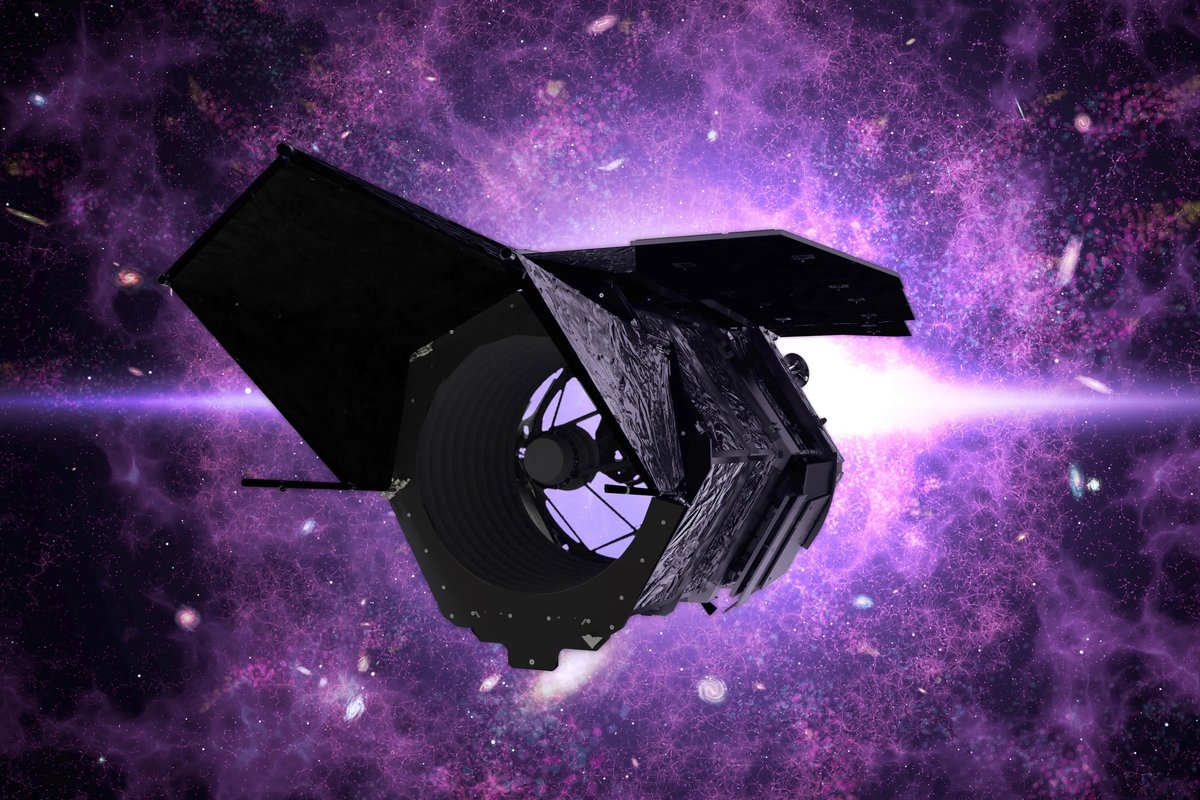
The Nancy Grace Roman Telescope just launched to space Sunday morning. The spacecraft is already more than 600 miles away from our planet—but it has many more miles to go.
NASA’s newest space observatory is winging its way to a special spot in space called the second sun-Earth Lagrange point, or L2. This point is just shy of one million miles from Earth.
From this distance, Roman will get to work: The telescope will be able to capture broad swaths of space in one image, giving astronomers never-before-seen views of stars, galaxies and other massive structures in the universe. Its survey will produce huge amounts of data and could solve several cosmic mysteries, with potential achievements ranging from understanding dark energy to detecting exoplanets—and finding some things astronomers don’t even know about yet.
On supporting science journalism
If you’re enjoying this article, consider supporting our award-winning journalism by subscribing. By purchasing a subscription you are helping to ensure the future of impactful stories about the discoveries and ideas shaping our world today.
It will take Roman about three months to make the journey to L2, but the trek will be well worth it. Lagrange points are crucial for space telescopes because, at these locations, the gravitational forces of Earth and the sun essentially balance each other out, keeping the spacecraft stable with minimal effort on its part. The pulls of our star and planet equal the centripetal force needed for a smaller object to stay in place.
Matthew Twombly (graphic); Heidi B. Hammel/Shari Lifson/Association of Universities for Research in Astronomy (content consultants)
From L2, Roman and its soon-to-be neighbor, the James Webb Space Telescope, can orbit the sun without disproportionate pull from one direction or the other. In other words, they will stay put. Each of the observatories orbit a point in their halos.
There are five sun-Earth Lagrange points. They are named after Italian-French mathematician Joseph-Louis Lagrange, who proved their existence in a paper entitled “Essay on the Three-Body Problem,” which was published in 1772.
L2 is particularly ideal for telescopes because it’s close enough to communicate easily with Earth but far enough to get a clear, deep view of space. The first Lagrange point (L1) also hosts spacecraft, including solar and weather observatories; the other three points are uninhabited. Of the five Lagrange points, three are unstable, and two are stable. What that means is that spacecraft at the unstable points—L1, L2 and the third Lagrange point (L3)—need regular course corrections to keep them from drifting off into space.
L2 offers a clear view of deep space and keeps the sun, the moon and Earth out of an observatory’s field of view. That means Roman will have the benefit of solar power and a lack of obstructions—giving it an unfettered look into the cosmos.
It’s Time to Stand Up for Science
If you enjoyed this article, I’d like to ask for your support. Scientific American has served as an advocate for science and industry for 180 years, and right now may be the most critical moment in that two-century history.
SciAm always educates and delights me, and inspires a sense of awe for our vast, beautiful universe. I hope it does that for you, too.
If you subscribe to Scientific American, you help ensure that our coverage is centered on meaningful research and discovery; that we have the resources to report on the decisions that threaten labs across the U.S.; and that we support both budding and working scientists at a time when the value of science itself too often goes unrecognized.
In return, you get essential news, captivating podcasts, brilliant infographics, can’t-miss newsletters, must-watch videos, challenging games, and the science world’s best writing and reporting. You can even gift someone a subscription.
There has never been a more important time for us to stand up and show why science matters. I hope you’ll support us in that mission.
