
Close Menu
    National News Brief
    Monday, June 15
    • Home
    • Business
    • Lifestyle
    • Science
    • Technology
    • International
    • Arts & Entertainment
    • Sports
    National News Brief
    Home » The Martian permafrost may be hiding veins of habitable liquid water

    The Martian permafrost may be hiding veins of habitable liquid water

    Team_NationalNewsBriefBy Team_NationalNewsBriefOctober 24, 2025 Science No Comments3 Mins Read
    Share
    Facebook Twitter LinkedIn Pinterest Email


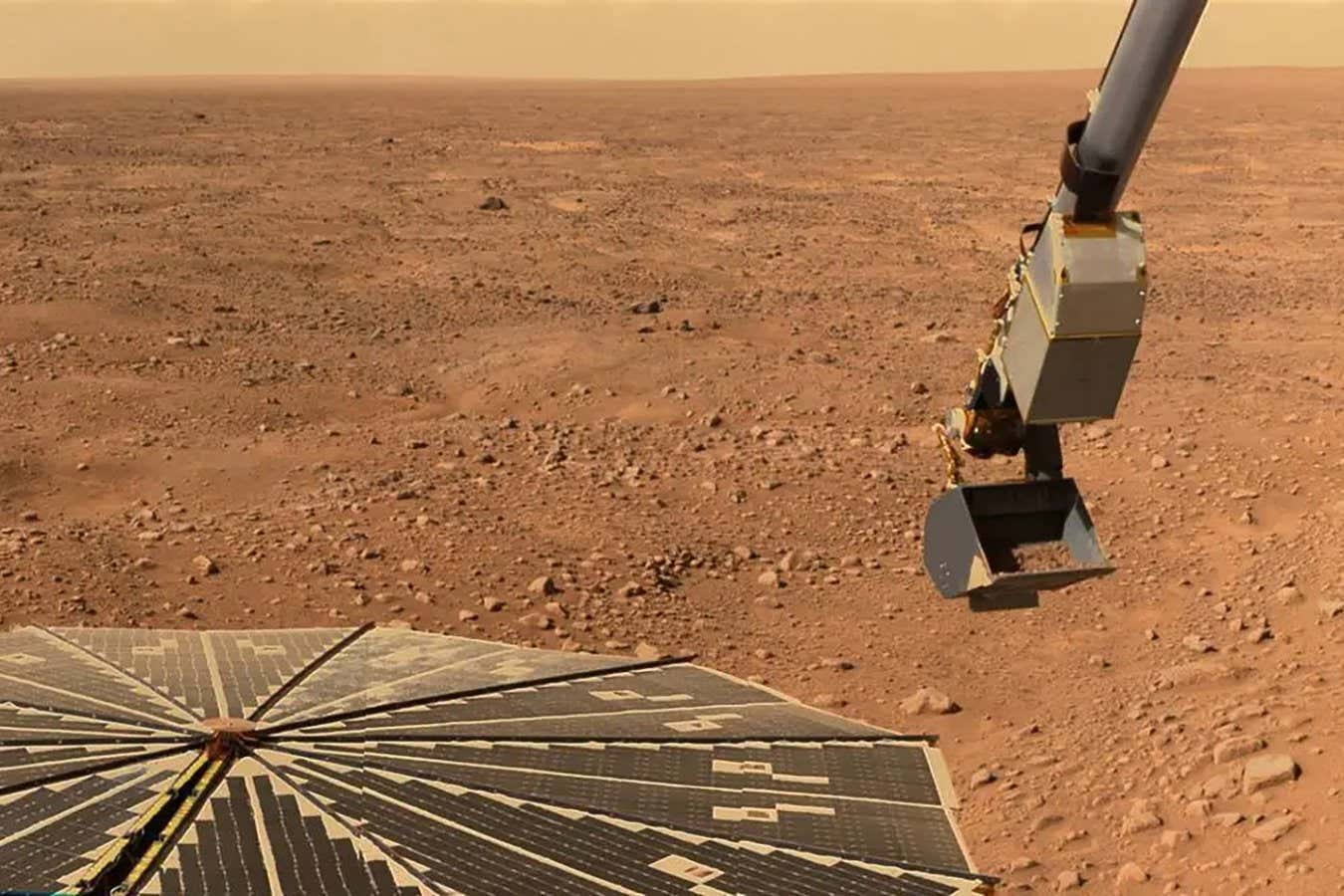
    NASA’s Phoenix Lander’s solar panel and robotic arm with a sample in the scoop

    NASA/JPL-Caltech/University of Arizona/Texas A&M University

    Mars may have a network of liquid water flowing through the frozen ground. All buried permafrost, on Earth and beyond, is expected to host narrow veins of liquid, and new calculations show on Mars, they could be big enough to support living organisms.

    “For Mars we always live on the edge of maybe habitable, maybe not, so I set out to do this research thinking maybe I can close this loop and say that it’s very unlikely to have enough water and have it be arranged so that it’s habitable for microbes,” says Hanna Sizemore at the Planetary Science Institute in Arizona. “I proved myself wrong.”

    She and her colleagues used measurements of the soil composition on Mars to calculate how much of the icy soil could actually be liquid water and the size of the channels that water would run through. It is tricky to keep water liquid on Mars, because temperatures can get as low as -150°C (-240°F) on the planet. While pure water freezes at 0°C, the abundant salts on Mars can dissolve in the water there and lower its freezing point significantly.

    The researchers found that it was “surprisingly easy” to get soil with more than 5 per cent liquid, running through channels at least 5 microns in diameter – the requirements they set for the veins to be considered habitable. “The largest veins we’re talking about are 10 times narrower than very fine human hair,” says Sizemore. “But it’s a large enough environment to submerge a microbe, and [they are] connected enough to move food and waste through the environment.”

    Based on soil measurements from NASA’s Phoenix spacecraft, which landed on Mars in 2008, these networks of channels could be abundant at latitudes higher than 50 degrees. If there is life on Mars, the liquid veins would be the easiest place to look for it, says Sizemore: “This is an environment where we can land and dig down like 30 centimetres and sample this.”

    The main potential problem with these veins as habitable environments is their temperature, which can be much colder than most known lifeforms can tolerate. “We have to be careful, though, about using the limits in which terrestrial life can grow and metabolise, as they do not necessarily represent the limits in which any life, anywhere, could function,” says Bruce Jakosky at the University of Colorado Boulder. “The bottom line is that, based on this and related work in particular, it’s not impossible that life could exist in the Martian near surface.”

    Topics:

    • Mars/
    • extraterrestrial life


    Source link

    Team_NationalNewsBrief
    • Website

    Keep Reading

    Former U.S. health official explains why the Trump administration ‘ignored’ a key alcohol study

    Inside the race to develop a new Ebola vaccine

    Ancient ground squirrels feasted on carcasses like ‘zombies of the Pleistocene’

    NASA’s experimental quiet supersonic plane passes another critical milestone

    World Cup camera coverage poses a moving math puzzle

    World-first: therapy to make cells young again given to a person

    Add A Comment

    Comments are closed.

    Editors Picks

    Nvidia CEO: AI Will Change Everyone’s Jobs, Including My Own

    July 14, 2025

    US Seeks To Boost Semiconductor Chip Manufacturing

    January 29, 2025

    A welcome change as voters, Supreme Court challenge Trump’s falsehoods

    November 11, 2025

    The Comments Keep Coming

    November 6, 2024

    Blue Origin vs SpaceX: Who is winning the battle of the rockets?

    January 18, 2025
    Categories
    • Arts & Entertainment
    • Business
    • International
    • Latest News
    • Lifestyle
    • Opinions
    • Politics
    • Science
    • Sports
    • Technology
    • Top Stories
    • Trending News
    • World Economy
    About us

    Welcome to National News Brief, your one-stop destination for staying informed on the latest developments from around the globe. Our mission is to provide readers with up-to-the-minute coverage across a wide range of topics, ensuring you never miss out on the stories that matter most.

    At National News Brief, we cover World News, delivering accurate and insightful reports on global events and issues shaping the future. Our Tech News section keeps you informed about cutting-edge technologies, trends in AI, and innovations transforming industries. Stay ahead of the curve with updates on the World Economy, including financial markets, economic policies, and international trade.

    Editors Picks

    las aficiones se adueñan de las gradas del Mundial

    June 15, 2026

    ‘Princess Diaries 3’ Takes Major Step Forward With New Update

    June 15, 2026

    Shares jump, oil skids in Asia on news of US-Iran deal

    June 15, 2026

    World Cup nations slam UEFA chief for ‘disappointing’ 48-team criticism | World Cup 2026 News

    June 15, 2026
    Categories
    • Arts & Entertainment
    • Business
    • International
    • Latest News
    • Lifestyle
    • Opinions
    • Politics
    • Science
    • Sports
    • Technology
    • Top Stories
    • Trending News
    • World Economy
    • Privacy Policy
    • Disclaimer
    • Terms and Conditions
    • About us
    • Contact us
    Copyright © 2024 Nationalnewsbrief.com All Rights Reserved.

    Type above and press Enter to search. Press Esc to cancel.