

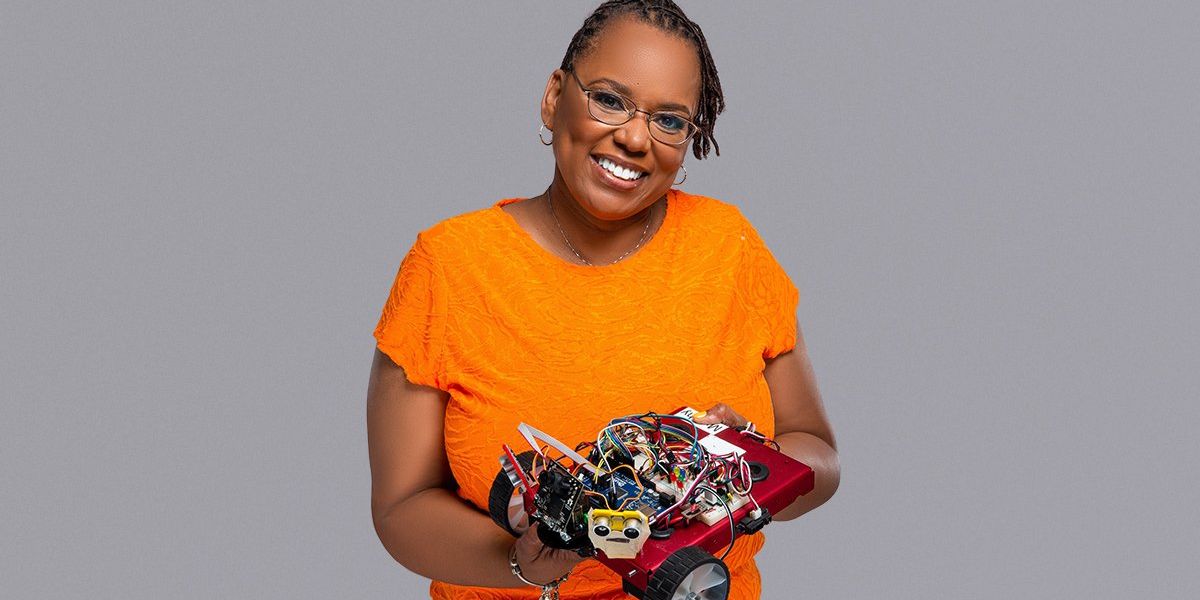
As an electrical engineering student in the 1980s and ‘90s, Carlotta Berry had two experiences that helped shape her future as an educator.
First, while she studied robots, she wasn’t allowed to interact with them. “The robots were too expensive, so the undergrads did not get to touch them,” Berry recalls. “I said to myself, I’m going to teach engineering someday, but in a way that the students will get to touch and program the robot.”
This led Berry to work toward overcoming the economic exclusivity of robotics. But her second formative undergrad experience involved a different type of exclusion: Berry was one of only a few engineering students who were female or Black. “It sometimes could be a lonely experience,” says Berry. “Representation does matter.”
Now, Berry is a professor in the electrical and computer engineering department at Rose-Hulman Institute of Technology, where her students learn about human-robot interactions and mobile robotics by using actual robots.
Berry works on her first open-source modular 3D-printed robot, the LilyBot, with Rose-Hulman engineering students Murari Srinivasan (left) and Josiah McGee (right). Bryan Cantwell/Rose-Hulman Institute of Technology
She also works to support people of color in engineering. Almost three decades after she graduated, Berry realized little progress had been made when she heard Black women grad students describe feeling isolated and marginalized during an online engineering conference in 2020. “This was exactly how I felt 30 years ago,” says Berry, noting that today only about 8 percent of electronics engineers are women and about 5 percent are Black. “It was time for something to change.”
Berry’s Path to Teaching
As a child in Nashville, Berry excelled at school—especially math—and thought she’d become a math teacher. But in high school, a mentor suggested that Berry consider engineering, given her strong grades in both math and science. “I didn’t really know what an engineer was,” she recalls. “I didn’t know anyone who was an engineer.” After learning about the profession at a library, Berry decided to study both engineering and math in college. In 1993, Berry earned a bachelor’s in electrical engineering at the Georgia Institute of Technology as part of a dual degree program with Spelman College, where she earned a bachelor’s in mathematics in 1992.
After her bachelor’s degrees, Berry worked as a control engineer for Ford Motor Company, where she programmed assembly-line industrial robots, but she found herself yearning to answer her true calling as an educator. So, she returned to academia and got a master’s in electrical engineering and control systems at Wayne State University in 1996. Saddled with student loan debt, however, Berry then accepted a position as a control engineer for Detroit Edison. “I really enjoyed the work but once again realized I was not doing what I was meant to do,” she says.
After a year at Detroit Edison, she left in pursuit of her Ph.D. in electrical and computer engineering, which she earned at Vanderbilt University in 2003. As a grad student, Berry taught at a technical school—and at last found herself on the right career path: “I always wanted to be an educator,” she says.
A Turn Toward Outreach
Berry traces her community-outreach work to two more pivotal moments in her career: In 2018, she became a full professor at Rose-Hulman, and in 2020, she became an endowed chair in the Electrical and Computer Engineering department. Berry says her tenure and position at Rose-Hulman enabled her to pursue work that brings her research, teaching, and service interests together.
 Berry hopes to support women of color in STEM through public events. Here, she sits with students Liz Francois and Janae Gillus, both members of Rose-Hulman’s chapter of the National Society of Black Engineers.Griffin Museum of Science and Industry
“As a full professor, I don’t have to worry that someone might consider the [outreach] work I do not as important as my technical robotics work,” she says. “When I provide education for students and for the community, that’s also part of my research and service.” For Berry, research and service are not separate but intertwined subject areas: Her research involves designing open-source, low-cost mobile robots to promote more inclusive robotics education.
Since 2020, Berry has helped transform how electrical and computer engineering is taught and perceived. She has been teaching hands-on, interactive robotics not only to her students at Rose-Hulman but also to kids and adults across the nation. Berry has been taking her robots, as she says, “to the streets.”
Berry demonstrates and discusses her open-source, 3D-printed wheeled robots at schools, libraries, museums, and other community venues. Her audiences range from kids just a few years old to adult educators who learn about robotics from Berry so they can teach the subject to their own students. To spread the word about robotics and STEM, Berry also has become active on social media, overcoming her innate introversion because, she explains, “visibility matters.”
With any audience, Berry is always “very approachable and very engaging,” says Nicki Manion, a program manager for Rose-Hulman’s educational outreach who collaborates with Berry on professional development workshops for teachers.
“I have to go where people are,” Berry says. “I get robots in front of people who are historically marginalized and would normally not have access to these technologies.”
This past summer, for example, Berry shared her robots with children from about three to 10 years old at all of the dozens of branches of the Indianapolis Public Library. To understand the three main pillars of robotics—sense, plan, act—the kids learned how the robots use a sonar, microphone, and speaker in order to see, hear, and talk. Notably, at the end of each presentation, the kids got to play and interact with the robots.
Last year, as part of an IEEE Education Society Initiative, Berry brought her robots to the streets globally. After grad students in countries such as Costa Rica, Niger, and Uganda received parts in the mail, Berry showed them the basics of building and programming robots.
Online Community and Writing
Berry hasn’t set out on her pedagogic journey all on her own, she says. In 2020, she cofounded Black in Engineering and Black in Robotics—part of the Black in X network comprising more than 80 organizations that support the work of Black professionals in STEM. For Berry, it’s no coincidence that Black in X emerged early in the pandemic. “There were a lot of bad things about the pandemic, but because we were all home and on social media, we were able to connect and find each other and form these organizations that, five years later, are still going,” she says.
Her professional turning point toward more community-oriented service has led to several accolades, she says: “That was when I started to earn these awards I had never been considered for before.” In 2023, the IEEE Robotics and Automation Society awarded Berry the prestigious Undergraduate Teaching Award for her contributions to multidisciplinary robotics education and leadership in diversifying STEM. She has also been recognized by the Society of Women Engineers and AnitaB.org.
 Children’s books like the series Berry wrote help get kids interested in STEM.Rebellion LIT
On top of her outreach and community work, Berry finds time to write children’s books—work that also has its roots in the pandemic. During that time, Berry woke up from a dream and remembered only the title of a children’s book she knew she had to write: There’s a Robot in My Closet. The book spawned a series, which features kid protagonists learning how to program robots and developing their problem-solving skills. (Berry also writes STEM-centered romance novels for adults under the pseudonym Carlotta Ardell. The heroine of her book Elevated Inferno, Berry says, struggles with the expectation to flawlessly juggle work and life—an expectation that falls more heavily on women, she finds.)
While balancing her many personal and professional interests, Berry says, she maintains a clear-eyed pursuit of her professional mission: helping people of diverse backgrounds “see themselves as not just consumers of technology but creators of technology.”
From Your Site Articles
Related Articles Around the Web
