

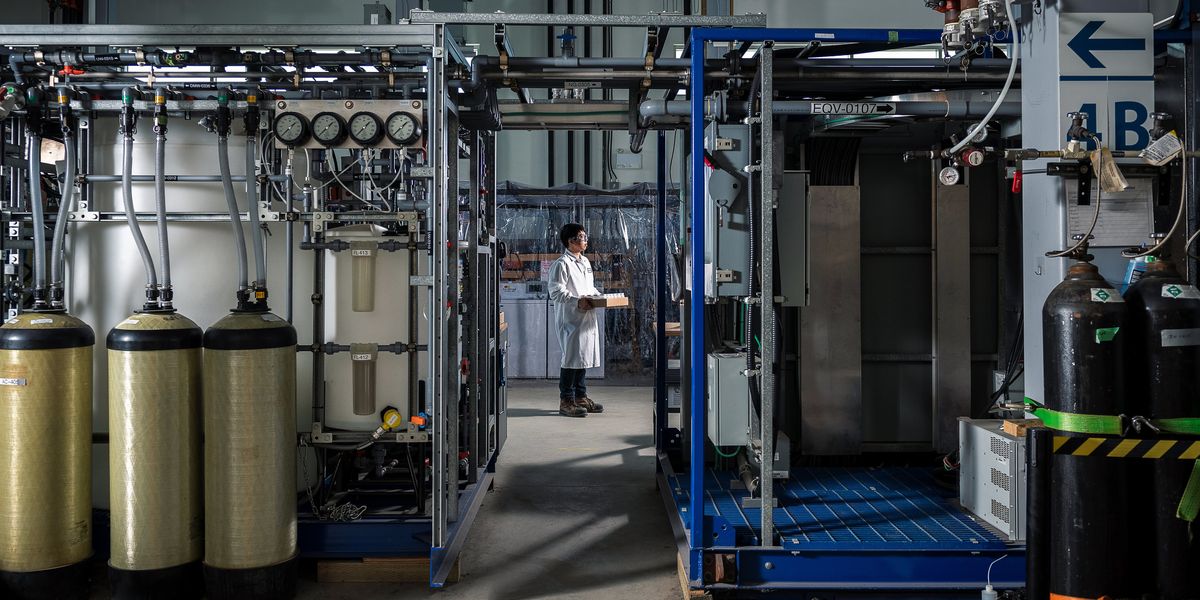
As electric vehicles roll off assembly lines, a bottleneck sits upstream: lithium refinement. Turning raw lithium into the compounds needed for batteries is expensive, messy, and energy-intensive, but Mangrove Lithium, a Vancouver-based startup, has a better way. The company has developed an electrochemical refining process that converts lithium feedstocks into battery-grade lithium hydroxide.
Converting raw lithium to lithium hydroxide typically requires roasting spodumene—a mineral from which lithium is derived—at high temperatures, and then leaching it with acid to convert it to lithium sulfate. That compound then needs to be converted to lithium hydroxide. “It’s a thermochemical reaction that uses heavy amounts of reagent chemicals, and generates a sodium sulfate waste stream,” says Ryan Day, Mangrove Lithium’s director of operations.
Further tightening the bottleneck, the majority of the world’s lithium—60 to 70 percent—is now refined in China, and export restrictions and geopolitical tensions have disrupted supply chains in recent years. Shipping raw lithium overseas to be refined also adds to batteries’ total carbon footprint. A new model for lithium refining could reshape not just the economics of electric vehicles, but the geography and environmental footprint of the global battery supply chain.
Mangrove’s demo plant in British Columbia is scheduled to start production in the second half of 2026.
How Does Mangrove’s Refinement Work?
Mangrove replaces the conventional, resource-intensive reaction with a process that uses electricity, water, and oxygen. In an electrochemical cell, they flow brine through an electrolyzer, which consists of a metal box with three compartments between the cathode and anode. The compartments are separated by ion exchange membranes, semipermeable barriers that only allow certain ions to pass. Lithium sulfate flows through the central compartment, and the cell’s electric field splits the salt apart. “Lithium, which is a positive ion, will move across a membrane toward the cathode,” says Day. There, “we are reacting oxygen and water to create hydroxide ions, which join with the lithium from the salt to make lithium hydroxide.”
Meanwhile, on the opposite side of the cell, the sulfate—a negative ion—moves towards the anode, where water is being split to produce protons and oxygen gas. The protons combine with sulfate ions to make sulfuric acid.
“You run that process continuously, and over time you’re generating lithium hydroxide, which you can send to a crystallizer,” Day says. “There’s no significant waste product and all you’re feeding in is brine, water, oxygen, and electricity.” The sulfuric acid is recovered and can be circulated back upstream to leach more brine from the raw feed material.
In general, keeping the ion exchange membrane intact is one of the biggest challenges for scaling this type of process, says Feifei Shi, assistant professor of energy engineering at Penn State. Shi, who researches electrochemical-based refinement methods, notes that the approach can more easily activate the necessary reactions, but faces limitations for large-scale applications.
The electrochemical process separates out lithium by passing it through three compartments separated by semipermeable barriers. Mangrove Lithium
Mangrove’s Oxygen-Based Cathode
Mangrove’s key innovation and what enables the process is an oxygen-based cathode. “Driving the reaction requires detailed engineering,” says Day. The company designed an electrode that lets a gas and a liquid react together, using just enough water to make the oxygen reaction work—without adding so much that it floods the system and creates hydrogen gas instead.
The electrodes are made with a proprietary process that combines several dedicated layers which allow for a balanced flow of water and oxygen to access the active catalyst sites. This design favors the oxygen reduction reaction for over 99.5 percent of the total cathode activity. It also reduces the amount of electricity needed to drive the process, because “oxygen reduction requires less voltage than water reduction,” Day says. Demand for battery minerals is surging beyond just lithium, with automakers competing for supplies of nickel, cobalt, graphite, and manganese. Simultaneously, utilities are deploying grid-scale batteries that use the same materials in even larger volumes. Refining capacity—not just mining—could become the critical choke point in this buildout, because battery makers require highly specified, ultra-pure compounds.
While Mangrove is initially targeting lithium, their electrochemical architecture is not inherently lithium-specific, and could be adapted to other battery materials that face similar purification bottlenecks. Nickel and cobalt sulfate production, for example, still rely on multi-step precipitation and solvent-extraction processes that generate significant waste and require large reagent inputs. “It would work immediately in application to other alkali-metal salts,” Day says.
Mangrove’s demo plant in British Columbia will make 1,000 tons per year of lithium hydroxide. If the company can scale its technology as it hopes, it could begin to reshape not just the battery supply chain, but the geopolitics of the energy transition.
From Your Site Articles
Related Articles Around the Web
