

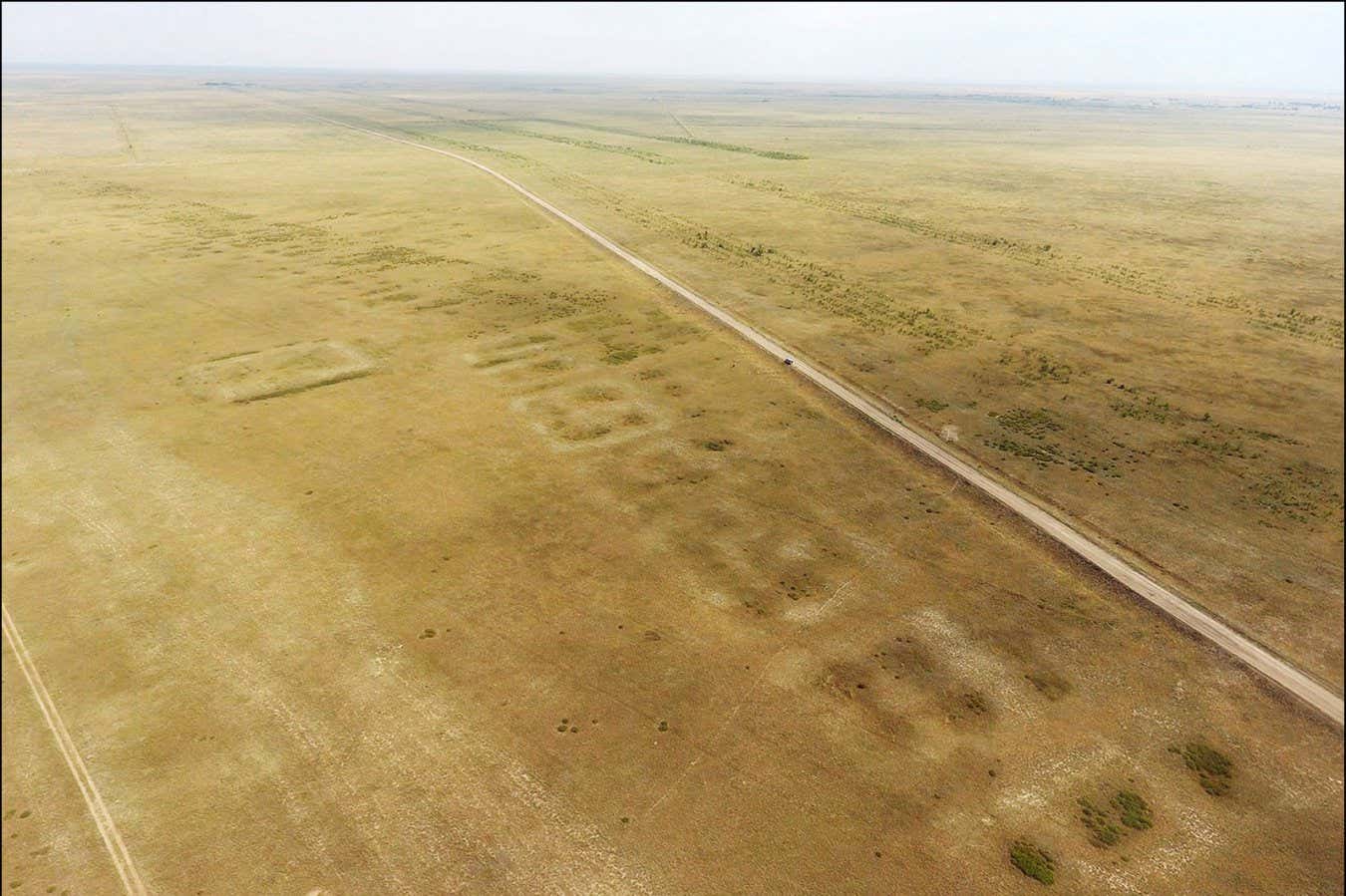
Drone photograph of the archaeological site of Semiyarka
Peter J. Brown
A large 140-hectare settlement dating back 3600 years has been discovered in the plains of north-eastern Kazakhstan, transforming our understanding of life in prehistoric Eurasia. It hints that the open grasslands of Central Asia once held a Bronze Age community as connected and complex as much better-known ancient civilisations.
“It’s not quite a missing piece of the jigsaw; it’s the missing half of the jigsaw,” says Barry Molloy at University College Dublin, Ireland, who wasn’t involved in the work.
The Bronze Age featured many notable civilisations, including the Shang and Zhou dynasties in China; the Babylonians and Sumerians in what is now Iraq; and numerous cultures around the Mediterranean, including the Egyptians, Minoans, Mycenaeans and Hittites.
The Central Asian steppes, however, were thought to be the domain of highly mobile communities living in tents or yurts. Semiyarka, or the “City of Seven Ravines”, seems very different and could have played a crucial role in the spread of bronze items between civilisations.
This is because the site – first identified in the early 2000s – overlooks the Irtysh river, which rises up in the Altai mountains in China, comes down onto the plains of Kazakhstan and goes all the way to the Arctic through Siberia.
Miljana Radivojević at University College London and her colleagues have been mapping and surveying the site since 2016. They have discovered that Semiyarka featured long banks of earth, conceivably for defence; at least 20 enclosed household compounds, probably built with mud bricks; and a central monumental building, which they suggest might have been used for rituals or governance. The types of pottery they found there indicate the site dates to around 1600 BC.
Crucially, the crucibles, slag and bronze artefacts at the site indicate a large area was dedicated to the production of copper and tin bronze – an alloy that is mainly copper but contains more than 2 per cent tin.
Compositionally, the elements in the slag from the crucibles correspond to tin deposits from part of the Altai mountains in east Kazakhstan about 300 kilometres away, says Radivojević.
The tin may have been brought there by people traversing the steppes or by boat along the Irtysh, or it may have been panned from the water, she says. “The Irtysh is the most important tin-bearing river in the Bronze Age of Eurasia and the flooding of the river’s flood plain that was happening seasonally would have been very helpful for panning the tin.”
The large size and neat lines of Semiyarka are very different from what is seen in the scattered camps and small villages usually associated with the mobile communities of the steppes.
Without detailed excavations – which are planned – we can’t know if the buildings were all there at the same time or were successive constructions over many years, says team member Dan Lawrence at Durham University, UK. “But the layout is very clear, and normally that would mean that it’s all contemporary, because you wouldn’t find these things in a neat line if they have been built one after the other.”
Due to its position on the river near major copper and tin deposits, the researchers suggest Semiyarka wasn’t only a production hub for bronze, but also a centre of exchange and regional power, a key node in the vast Bronze Age metal networks linking Central Asia with the rest of the continent.
“The Irtysh river was a very busy transport corridor,” says Lawrence. “It is basically laying the foundations for the Silk Roads as we know them today, a kind of pre-modern globalisation.”
The site transforms our understanding of Bronze Age steppe societies, says Radivojević, showing that they were just as sophisticated as other contemporaneous civilisations.
“This tells us that they were organised, that they were capable of resourcing and defending,” says Molloy. “Bringing materials like ores and metals to a centralised space speaks of a level of social organisation that goes beyond immediately local, and it fits back into the wider networks that we know were crisscrossing Eurasia, where metals were moving and they’re the key connector in terms of those wider networks.”
Embark on an unforgettable journey through Egypt’s two most iconic cities, Cairo and Alexandria, where ancient history meets modern charm. Topics:
Scientific pioneers of the ancient world, Cairo and Alexandria: Egypt
