

Tesla was first to patent a primitive axial-flux electric motor—Nikola Tesla, that is, way back in 1889. It would be 126 years before the concept found its way to a car, the 1,500-horsepower (1,103 kilowatt), US $1.9 million, Koenigsegg Regera hybrid, in 2015. Even today, nearly all the world’s EVs and hybrids rely on relatively inefficient, easy-to-manufacture radial-flux motors.
Yet the latest electrified revolution is underway, led by YASA. Founded in the U.K. by Tim Woolmer in 2009, a spin-off from his Oxford PhD project, the company’s pioneering axial-flux motors are powering hybrid supercars from a Who’s Who of makers: Ferrari, Lamborghini, McLaren and Koenigsegg. Those include the Ferrari 296 Speciale and Lamborghini Temerario that I recently drove in Italy.
Boosted by these power-dense electric machines, these racy Italians carved up roads in Emilia-Romagna like hunks of prosciutto di Parma. The Temerario’s gasoline V-8 revs to a stratospheric 10,000 rpm, higher than any production supercar. Still not enough: The Temerario also integrates three YASA motors. A pair on the front axle deliver all-wheel-drive traction and a peak 294 horsepower (216 kilowatts). A total of 907 hybrid horsepower (667 kilowatts) sends the Temerario to a blistering 343 kph (213 mph) top speed. The electric motors ably fill any gaps in gasoline acceleration and finesse the handling with torque-vectoring, the electrified front wheels helping to catapult the Lamborghini out of corners with ridiculous ease.
With their compact design and superior power-to-weight ratio, these motors are setting records on land, sea and air. The world’s fastest electric plane, the Rolls-Royce Spirit of Innovation, integrated three YASA motors for its propeller, sending it to a record 559.9 kph (345.4 mph) top speed. Applying tech from its Formula E racing program, Jaguar used YASA motors to set a maritime electric speed record of 142.6 kph (88 mph) in England’s Lake District in 2018 (that record has since been broken).
Claimed Power Density is Three Times Tesla’s Best
In August, YASA’s motors helped the Mercedes-AMG GT XX prototype set dozens of EV endurance records. Cruising around Italy’s Nardo circuit at a sustained 186 mph (300 kph), the roughly 1,000-kilowatt (1,360 horsepower) Mercedes EV drove about 5,300 kilometers per day. In 7.5 days, it traveled 40,075 kilometers (24,902 miles), the exact equivalent of the earth’s circumference. That time included stops for charging, at 850 kilowatts.
Mercedes F1 driver George Russell stands next to a Mercedes AMG GT XX during its record-setting endurance run this past August. Powered by three YASA axial-flux motors, the concept EV drove the equivalent of the earth’s circumference in 7.5 days, at a near-steady 300 kph. A production version of the car could be a competitor for the Porsche Taycan. Mercedes-Benz
Mercedes bought YASA outright in 2021. Daimler, Mercedes’ corporate parent, is retrofitting a factory in Berlin to build up to 100,000 YASA motors a year, for the next logical step: The motors will power mass-produced EVs for the first time, specifically from AMG, Mercedes’ formidable high-performance division.
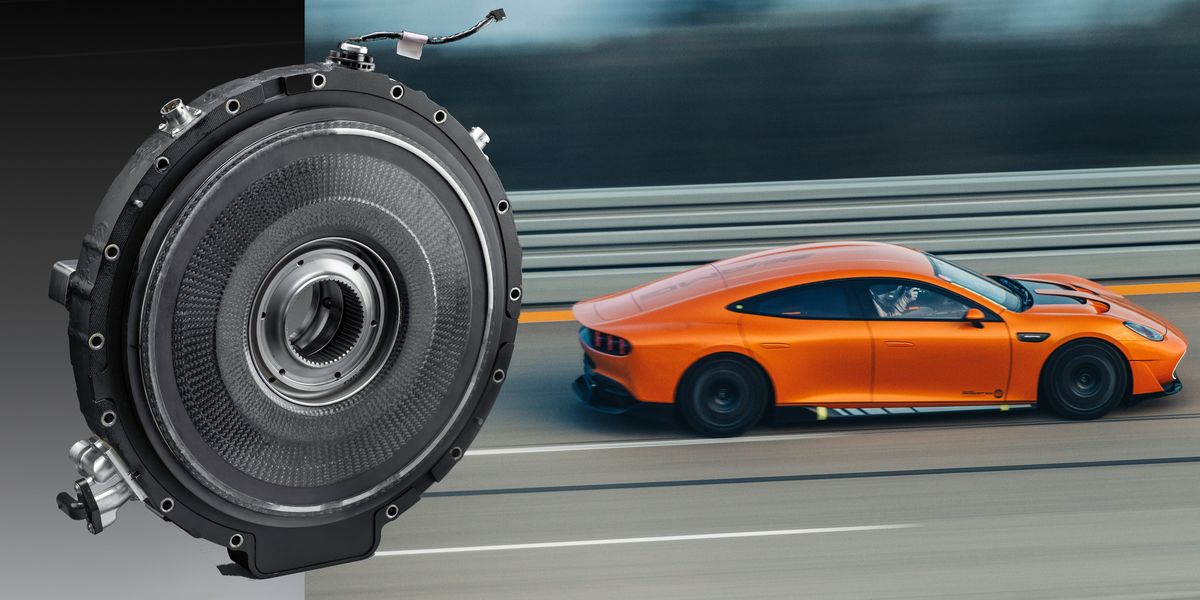
The company recently unveiled its latest motor, and its stats are eye-opening: The axial-flux prototype generates a peak 750 kilowatts, or 1,005 horsepower, as tested on a dynamometer. The motor can output a continuous 350-400 kilowatts (469-536 horsepower). Yet the unit weighs just 12.7 kilograms (27.9 pounds). Woolmer says the resulting power density of 59 kilowatts per kilogram is an unofficial world record for an electric motor, and about three times that of leading radial-flux designs, including Tesla’s.
“And this isn’t a concept on a screen — it’s running, right now, on the dynos,” Woolmer says. “We’ve built an electric motor that’s significantly more power-dense than anything before it, all with scalable materials and processes.”
Simon Odling, YASA’s chief of new technology, walks me through the tech. Conventional, radial-flux motors are shaped like a sausage roll. A spinning rotor is housed within a stationary stator. The lines of magnetic flux are oriented radially, perpendicular to the motor’s central shaft. These flux lines represent the interacting magnetic fields of the permanent magnets in the rotor and electromagnets in the stator. It is that interaction that provides torque.
An axial flux design is more like a pancake. In YASA’s configuration, a pair of much-larger rotors are positioned on either side of the stator, and, notably, all three have roughly the same diameter. Magnetic flux is oriented axially, parallel to the shaft. Because torque is proportional to the rotor diameter squared, an axial-flux design can generate substantially more torque than a comparable radial-flux unit. The dual permanent-magnetic rotors double the key torque-generating components, and ensure a short magnetic path, which enhances efficiency by reducing losses in the magnetic field.
 YASA R&D Engineer Eddie Martin holds a 12.7 kg axial-flux motor that cranks out 750 kilowatts/1,005 horsepower.YASA
Odling says the company’s motors are about one-third the mass and length of a comparable radial-flux machine, with intriguing upsides for vehicle packaging and weight savings. “The motor sits between an engine and gearbox really nicely in a hybrid application, or it makes for a very compact drive unit in an EV,” Odling says. The configuration is also ideal for in-wheel motors, because the flat shape fits easily within the width of car and even motorcycle wheels.
YASA also touts the weight savings. Cascading gains in vehicle architecture could eliminate at least 200 kilograms from today’s EVs, the company says, about half from the motors themselves, the rest from smaller batteries, brakes, and lighter-weight supporting structures.
YASA’s Secret Sauce is a Soft Magnetic Composite
The company’s name offers another clue to its technical edge: YASA stands for “Yokeless and Segmented Architecture.” The motors remove a heavy iron or steel yoke, the structural and magnetic backbone for the copper coils in a conventional stator. Instead, they use a Soft Magnetic Composite (SMC)—a material that has very high magnetic permeability. That characteristic means the material is a very effective conductor of magnetic flux, so it can be used to concentrate and direct the field in the motor. In a typical application, the stator’s coils are wrapped around structures made of SMC.
Woolmer began studying SMCs in the mid 2000s before there were potential paying customers for his nascent motor designs: The first Tesla Roadster didn’t hit the road until 2008, and suppliers and tooling for these motors didn’t exist then. Woolmer’s early axial-flux designs finally made their way into the Jaguar C-X75 in 2010, a concept that was cancelled prior to production. By 2019, Ferrari was integrating one of Woolmer’s motors in its first hybrid, the SF90.
SMC became a key innovation, because axial-flux motors couldn’t be manufactured with the stacked-steel laminations of radial-flux machines. Woolmer segmented the stator into individual “pole pieces” made from SMC, which can be formed under pressure into a huge variety of 3D shapes. That flexibility greatly reduces weight and eddy-current losses, and lessens the cooling burden. Where a conventional motor might have 30 kilograms of iron, a comparable YASA design would need only 5 kilograms to generate the same power and torque.
YASA’s stators also integrate flat copper windings with direct oil cooling, Odling says, with no “buried copper” that the oil can’t reach. That greatly improves thermal performance and recovery in stressful conditions, a potential boon for high-performance EVs.
YASA designs and develops its motors at its Oxford Innovation Center. In May, it opened a new axial-motor “super factory” in nearby Yarnton, with capacity for more than 25,000 motors each year. The company also credits the British Advanced Propulsion Center (APC) as a linchpin of its expansion. The collaboration between the U.K. government, industry and academia looks to accelerate homegrown development of zero-emissionstransportation to meet Net Zero targets.
YASA intends to release more specifics on its latest prototype motor in December. But company executives say the motor is ready for customers, with no exotic materials or manufacturing techniques required.
From Your Site Articles
Related Articles Around the Web
