

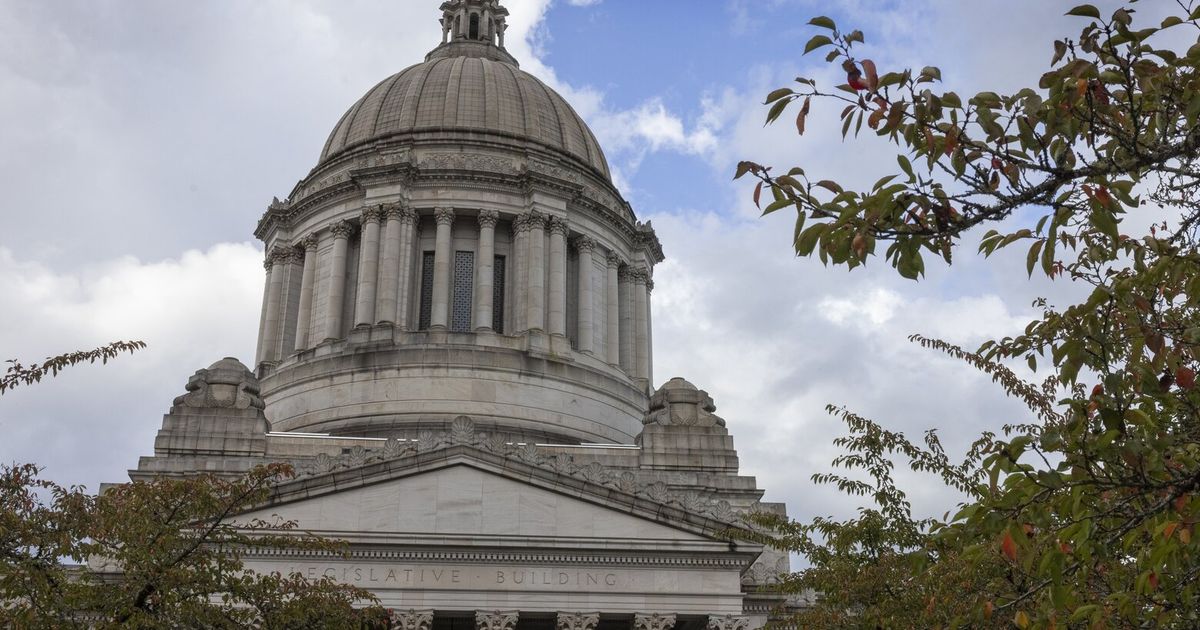
In closing the 2025 Washington legislative session, House Speaker Laurie Jinkins stressed the difficulty lawmakers faced in threading a needle of passing tax hikes and slashing budgets.
“It was a really challenging session to try and walk a very narrow path to do that,” she said.
In reality, the Tacoma Democrat made substantial headway in fulfilling the political agenda of Washington’s long-ruling majority party. Though tax revenues had been increasing, Democrats passed new spending this year, including a record $12 billion in new taxes. They also sent an across-the-board slate of progressive policies to Gov. Bob Ferguson’s desk.
But there are indications that their constituents are skeptical about how the far left ran the table. In a July poll, more than 52% of likely voters said they are not well-represented by the state Legislature. More about that later.
Jinkins and her counterpart, Senate Majority Leader Jamie Pedersen, D-Seattle, largely got ideological alignment from a legislative supermajority. With few exceptions, Democrats from even the more purple districts — where the party enjoys just-over 50% voter majorities — voted the same way as those from landslide districts, or places where there’s far less Republican opposition.
For example: Pedersen represents the 43rd Legislative District, including the University of Washington, among the furthest left politically in the state. In 2024, Gov. Ferguson beat Republican challenger Dave Reichert with a whopping 89% of the vote there.
Democrats also won the 5th District, encompassing Issaquah. Ferguson won by a much smaller margin there — just 52% to Reichert’s 48%, reflecting a less homogeneous political makeup among constituents. Republicans even controlled two of its three legislative seats less than a decade ago.
Nevertheless, the lawmakers from the 43rd and 5th voted nearly identically on raising new taxes and passing the most progressive policies in the 2025 session.
Washington became just the third state, for example, to provide jobless benefits to workers who choose to go on strike and establish a statewide cap on rents. The state is now one of about 11 that requires a permit to buy a firearm; one of six creating new regulatory framework for producers of packaging to encourage more recyclable materials; and one of just four requiring fuel suppliers to reduce their carbon intensity or face penalties.
The results reflect a long-debated philosophy: Do legislators go to Olympia to serve their constituents, or their party?
Sen. Victoria Hunt, D-Issaquah, who represents the 5th, acknowledged to the editorial board that she got an earful from many constituents that her vote for business and occupation tax increases were harmful to the economy.
“It was certainly not perfect and … we made decisions we need to revise,” she said.
Hunt isn’t alone among Democrats. In the 47th District, including parts of Auburn and Kent, Sen. Claudia Kauffman voted for the same slate of legislation, in a district carried by Ferguson with 53% of the vote. In the 44th, near Everett, Sen. Jon Lovick did the same, as did Senate Ways and Means Chair June Robinson in the 38th, though their districts, too, are much closer to the center politically than the 43rd.
In such politically purple-tinged districts, 13 of 23 Democratic lawmakers voted the same way, according to the editorial board’s analysis. Republicans, for their part, acted the same way in such districts, with 12 of 15 voting against all tax increases and progressive proposals.
Perhaps this partisan purity isn’t surprising given the current political environment, where national politics holds the attention of the local electorate. Democrats have enjoyed widening support in a state where President Donald Trump is largely not popular. Hunt, by example, won easily this fall, with 56% of the vote, over moderate Republican Chad Magendanz, who had previously represented the district in the House.
Still, Washington voters aren’t happy with what they are getting from their state lawmakers. Seventy percent of likely state voters polled in July said things are looking worse for Washington. That’s the lowest result since 1992, according to polling conducted by Stuart Elway in a Cascade PBS/Elway Poll. What’s more, roughly 52% of voters said they do not feel well-represented by state government.
Less than one-quarter of voters were positive on the Legislature’s performance — and just under 1 in 3 were positive of that of Gov. Ferguson.
Something is broken. Many Washington voters aren’t feeling heard by their legislators.
Reassuringly, the rush to vote the party line isn’t pervasive everywhere in the state. Perhaps most surprisingly, within the Vancouver metropolitan area bordering the Columbia River, state senators in neighboring districts cast opposite votes on raising gas taxes. Sen. Paul Harris, R-Vancouver, supported a compromise brokered to hike the tax, while Sen. Adrian Cortes, D-Battle Ground, opted against it.
Both represent balanced districts where Ferguson and Reichert were neck-and-neck for governor.
Even at the national level, there’s acknowledgment that for an elected official, being true to their district is a noble characteristic. Rep. Suzanne DelBene, D-Medina, recently defended Rep. Marie Gluesenkamp Perez, D-Skamania, who has voted with Republicans more often than any other member of Washington’s Democratic delegation.
“The reason we win is because we have representatives who are authentic to their communities,” DelBene told the Washington State Standard. “Unlike Republicans who are blindly loyal to Donald Trump, we have representatives who are going to make the decisions they think are best for their community.”
But in Olympia, the trend toward partisanship even among legislators in more purple districts is worrying. The more entrenched partisanship becomes, the more drastic the partisans behave. Wide majorities in Olympia might embolden Democrats’ attempts to solidify their power beyond the will of the people.
The 2026 legislative session will be full of further partisan priorities, including a possible income tax Senate Democrats have proposed on incomes over $1 million. Debates rage over how to address a budget shortfall. But even in a time of hyper-partisanship, Democrats and Republicans should remember where they come from in casting their votes. They should reflect not just their partisan aims but the needs of every constituent.
Geography matters every bit as much as ideology, and Washingtonians across the state should have a voice in Olympia.
Next year, half of the state’s 49 senators and all of its 98 representatives will be up for reelection. This is a good opportunity for voters to keep an eye on their elected lawmakers during the session that begins in January and ask them about their voting records, come the fall.
