

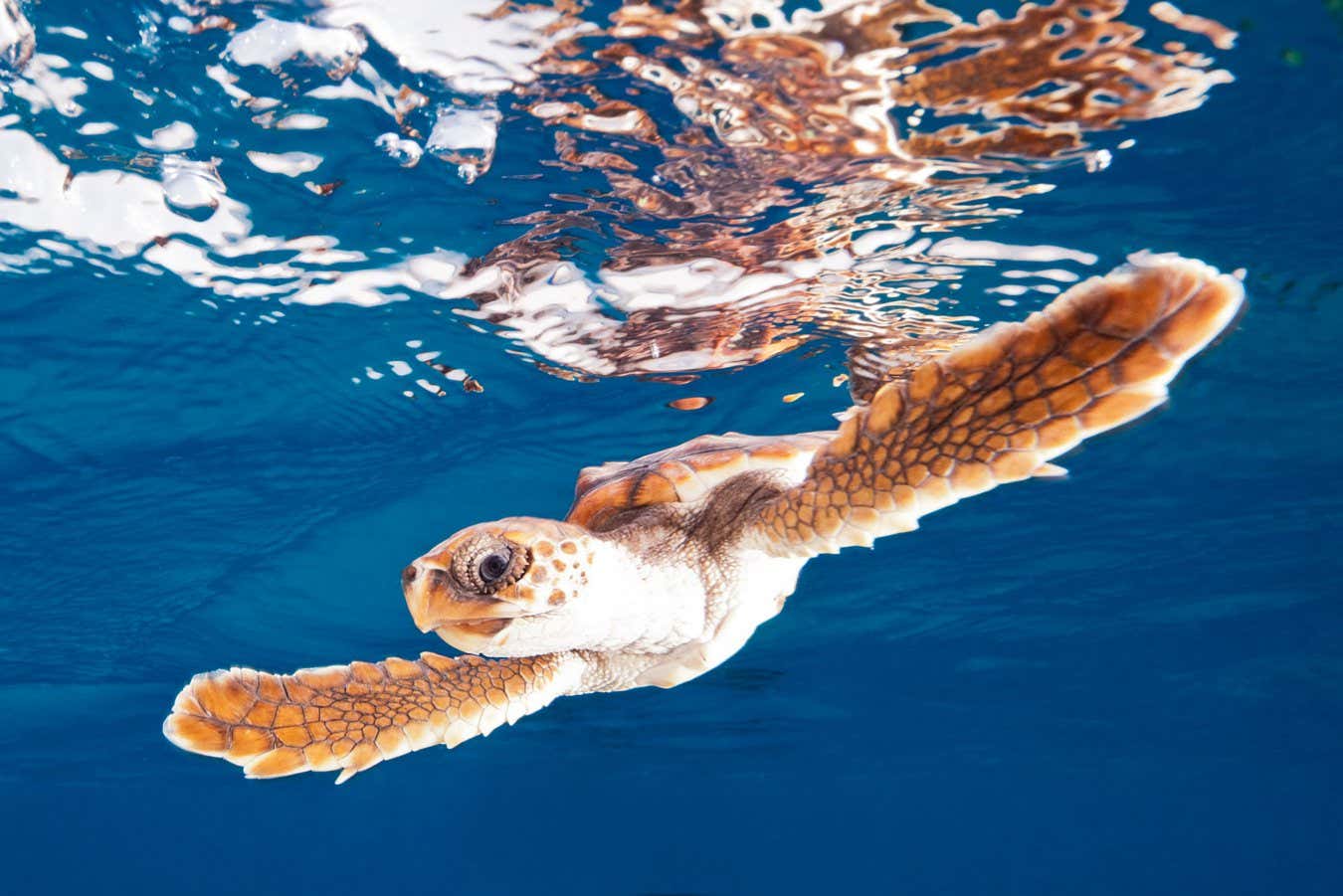
A young loggerhead turtle in the Caribbean Sea near the Bahamas
WaterFrame/Alamy
Sea turtles may be better able to cope with climate change than we had thought. Biologists are concerned that the reptiles might face extinction because warmer conditions will encourage most turtle eggs to develop into females. But it turns out the animals have a genetic safety net that could help them retain a more even balance between sexes even as temperatures rise.
“We believe we have uncovered the capacity of turtles to adjust to the environment they are in,” says Chris Eizaguirre at Queen Mary University of London.
The sex of baby sea turtles isn’t set by a sex-determining chromosome – as happens in many animals, including humans – but by the temperature inside the nest. Lab studies have shown that, at lower nest temperatures, more hatchlings will be male and at higher ones, more will be female, leading to fears that global warming will cause ever more turtles to hatch as female.
For example, a 2018 genetic study found that about 99 per cent of young green turtles (Chelonia mydas) aged between about 4 and 20 originating from warmer Great Barrier Reef nesting sites in Australia were female. Modelling based on such results has led to concerns that, without enough males, sea turtle populations will collapse.
Yet the actual state of affairs upon hatching is a mystery because you can’t tell what sex a turtle is until it is several months old unless you kill it to check, so field data on hatchling sex is scant.
To get around this, Eizaguirre and his colleagues have run lab and field experiments with loggerhead turtles (Caretta caretta).
In the first part of their work, they collected a total of 240 eggs from seven loggerhead nests on beaches in Palm Beach county, Florida. They put the eggs in artificial incubators at one of three temperatures: 27°C (81°F), a male-promoting temperature; 30°C (86°F), a “pivotal temperature for equal numbers of males and females; and 32°C (90°F), which should result in females.
When the hatchlings were between 1 and 3 days old, the team collected blood samples and then reared the turtles in captivity for months until they were large enough for sex verification via keyhole surgery and a laparoscopic camera.
Comparing genome sequencing data gleaned from the blood samples with the sex identification revealed that, regardless of the temperature at which the eggs had been incubated, male and female turtles each had different patterns in the activity of hundreds of genes because of an epigenetic process known as DNA methylation. Some 383 genes were hypermethylated in females – meaning they were less active than expected – and 394 were hypermethylated in males. Many of these genes have documented roles in sex development. This meant the researchers could tell the sex of a baby turtle just from a blood sample.
The team used this knowledge in a field study by collecting 29 newly laid loggerhead turtle egg clutches on the beaches of Sal Island in Cape Verde off the coast of West Africa. They divided each clutch, burying one half in a protected area at a depth of 55 centimetres – where it would be cooler – and the other 35 centimetres down, where it would be warmer, and monitored the temperatures.
When the researchers sequenced blood cell samples from 116 hatchlings, half from the “cool” depths and half from the “warm” ones, they found more males than expected given the temperatures that the eggs had experienced. In fact, models based on the incubation temperature overestimated female hatchling production by between 50 and 60 per cent.
This suggests that, in addition to providing a tool for sexing baby turtles, the work shows there are molecular mechanisms that help turtles cope with changes in climate by altering how sensitive the development of their sex organs is to temperature, says Eizaguirre.
“We are not saying that there is no feminisation because there is, and we’re not saying that climate change does not exist because it is there and it’s accelerating,” he says. “What we are saying is that when the populations are large enough, when there is sufficient diversity, then it looks like the species [can] evolve in response to the climate they live in.”
The work backs up recent evidence by a team including Graeme Hays at Deakin University in Australia showing that more male sea turtles are hatching than predicted if it is assumed that temperature is the only driver of sex determination. These results indicate how the pivotal temperature at which the turtle sex ratio is 50:50 can be adapted to local conditions, says Hays.
Turtles also have other mechanisms to mitigate the impacts of warming, he says. These include nesting earlier in the year and patterns of migration to breeding areas reducing the impact of feminisation. “Female turtles generally do not breed every year, but males travel to breeding grounds more often than females,” says Hays. “So, the breeding sex ratio is more balanced than the actual adult sex ratio.”
Such behavioural adaptations are good, says Eizaguirre, but the hatchlings are still exposed to extreme heat, which leaves lasting DNA methylation changes, so signs of molecular adaptation are even better news for these vulnerable reptiles.
Topics:
