

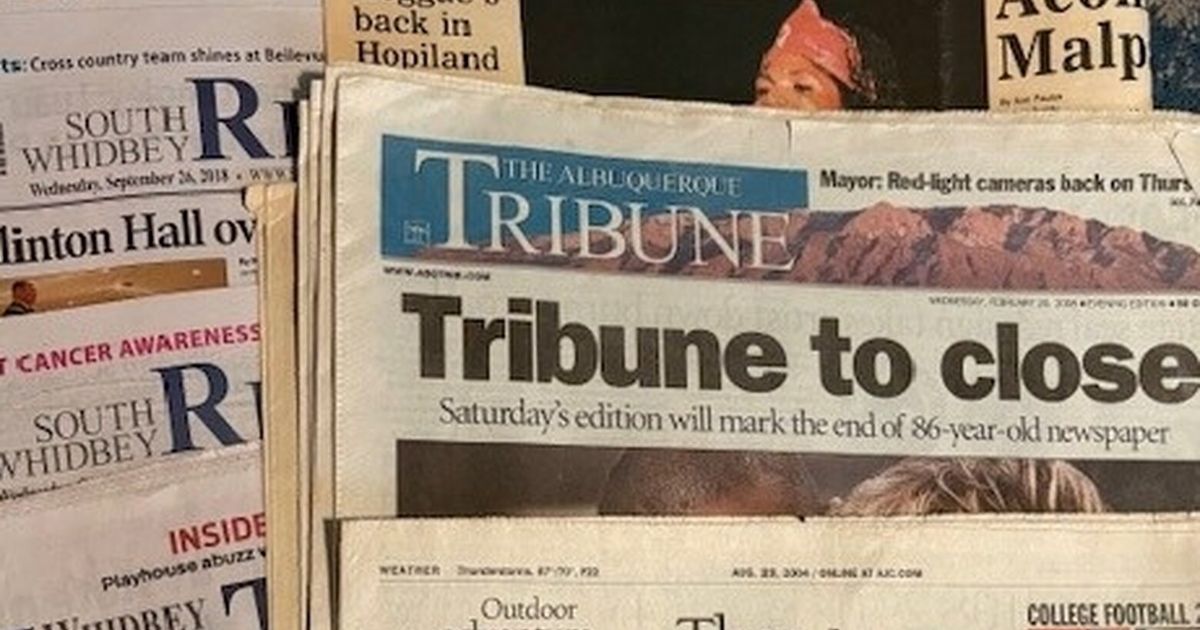
The first newspaper where I ever worked, The Gallup Independent, shut down Jan. 31. The Atlanta Journal-Constitution, where I was a health reporter 20 years ago, stopped its presses Dec. 31 and is now only available online. The small but mighty news staff of The Albuquerque Tribune attended its funeral in 2008, but its lessons and impressions live on in the hearts of “Tribunistas,” including mine. I can’t count the number of newspapers that have closed or been cut to skeletal crews where I’ve lived and where my friends worked: The Rocky Mountain News, The Oregonian, Seattle Post-Intelligencer, Anchorage Times, Tampa Tribune. The Everett Daily Herald, where my freelance articles appear, cut half its staff last year; it now has one full-time photographer.
When the Newseum in Washington, D.C., dedicated to the First Amendment and its impact, closed in 2019, I should have stopped yearning for the old, inky black-and-white days. I should have stopped reminiscing about newsrooms bursting with creativity and conversations, and I should have tossed the faded, tattered testaments to the impacts I made, large and small. But I didn’t. Throwing out this pile of the past would mean I’d raised the white flag; I surrender, I give up, I give in. But I haven’t. Not yet.
I recently sat down with The New York Times, marveling at the sections and stories spread out on my kitchen counter. It was miraculous; one, that it finally managed to get delivered to my rural location on an island, and two, that it still exists in print. I know its website is a sensory lasagna of photos, videos and interviews, but I still prefer holding newspapers in my hand. It reminds me of the mess and miracle it takes to put out a daily publication. When layoffs were announced at The Washington Post — one-third of staff across all departments — I felt close to tears.
I have mourned the hemorrhaging of my chosen profession for two decades while still harboring hope it wouldn’t die altogether before I do. But there are so few signs of life. The once-gleaming rows of news racks are gone from the ferries. When I travel, there are no newsstands on the streets and hotels don’t give away complimentary editions. Newspapers in airports? You’re kidding me, right? I’ve spent days in major cities without seeing a newspaper for sale, left behind at a cafe or in a rack, even on the streets of New York City. I know all the reasons — the economic model, changing societal preferences and the online competition for eyeballs. But logic doesn’t stop me from longing.
A relative once told me “to get over it.” To adapt, like the loggers of the Pacific Northwest. Find another job. At the time, I had just turned 50. My career, my chosen profession, my beloved not-just-a-job-but-a-calling, was bleeding to death in front of my eyes. Stunned, I could barely get out a response about the societal importance of the press, how it holds government and officials accountable, how the press is the linchpin of a democratic society and how it is the only private industry named and protected in the Bill of Rights. That rationale doesn’t seem to be holding up these days, does it? Or maybe what’s happening means the dire predictions of what happens to a reduced and oppressed press are coming true. Are citizens, armed with cellphones and fueled by indignation, the new Fourth Estate? If so, welcome, but be wary and remember the words of my first journalism professor: If your mother says she loves you, check it out.
I found some solace in the documentary, “Stripped for Parts: American Journalism on The Brink,” because it shows what one questioning, tenacious reporter can uncover. In it, California investigative reporter Julie Reynolds digs into how and why “vulture” hedge fund investors, such as Alden Global Capital, bought struggling newspapers, gutted newsrooms and moved on. In “Stripped,” newspapers announce to their staff that the end has come, that it’s time to bury the lead and everything else. As the camera pans a gathering at The Rocky Mountain News, I see former colleagues of mine gasp, hug and cry.
But we are not crying for ourselves. Or for our jobs or for another newspaper, cut down and driven out. We are crying for our communities. We are crying for our country.
