

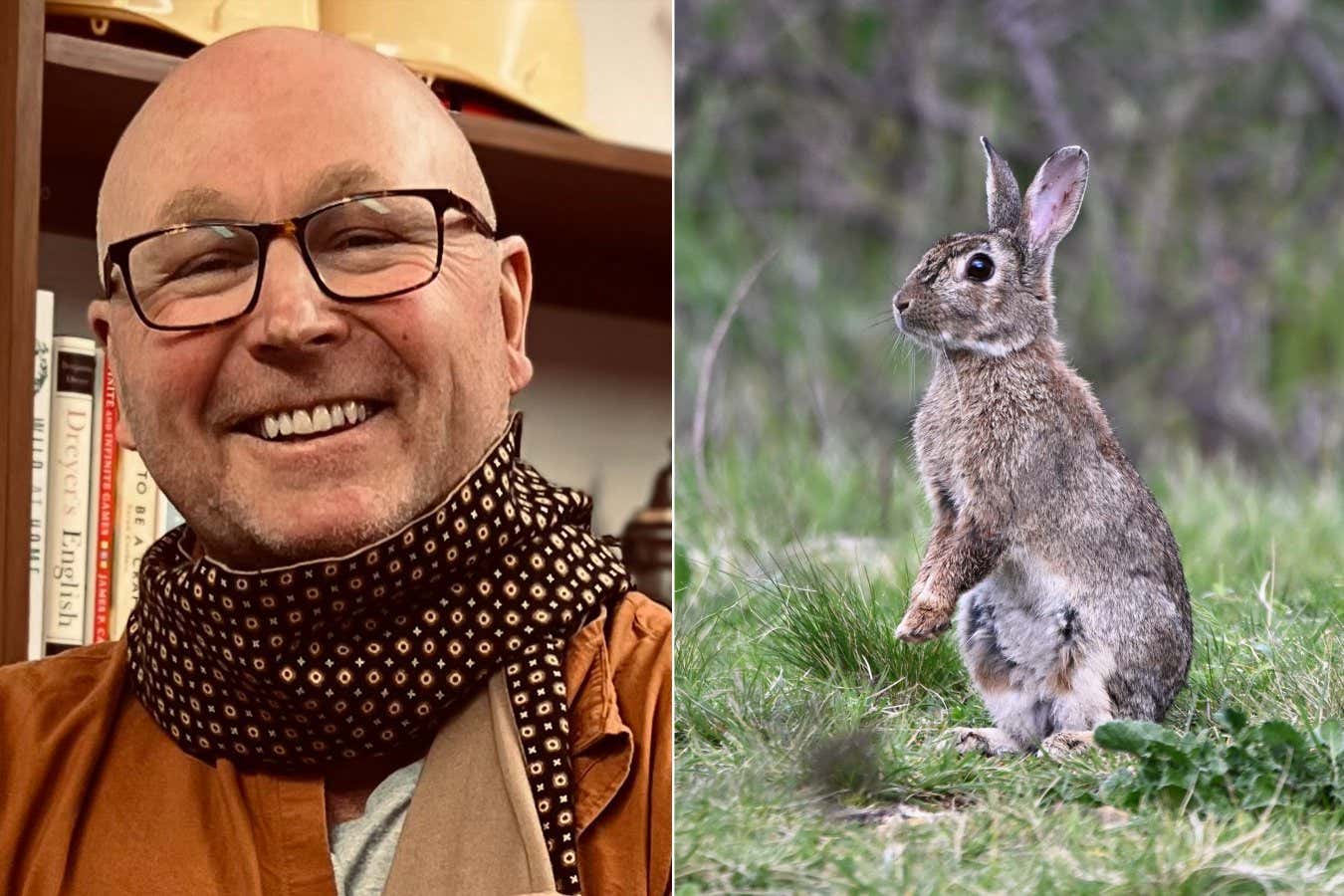
New Scientist reporter James Woodford recalls his run-in with rabbits
D.Cunningham/Shutterstock
I was working a Sunday shift when the news came through, and it gave me an instant sinking feeling – the big kind that you hopefully only get once or twice in a lifetime. A potential biocontrol virus that was being tested to deal with Australia’s immense population of feral rabbits had escaped quarantine, jumping about 250 kilometres from the South Australian coast to Yunta, a place so small it is barely a minuscule freckle on the map. Authorities said they knew of only two people who had been to both the new quarantine area at Point Pearce and Yunta – and I was one of them.
All of this happened in October 1995. I was a cub environment reporter, based in Sydney, for one of Australia’s biggest newspapers. There was a lot going on at that time in my round, but one story in particular caught my eye: news of problems with an ambitious plan to wipe out Australia’s immense population of feral rabbits – an alien species that had been introduced from Europe.
The nation’s lead federal science agency, CSIRO, was managing the project. It was testing a lethal rabbit calicivirus disease at a quarantine facility at Wardang Island, a few kilometres off the South Australian coast. There was still work to do before the virus was ready for full-scale release. In particular, the scientists wanted to establish that native animals and the environment wouldn’t be harmed.
But on 10 October, CSIRO issued a statement saying that the virus had spread to two other locations beyond its quarantine area, although, cryptically, it claimed that the virus hadn’t escaped the island. A week later, as I got to my desk in the morning, news was breaking that the virus had somehow jumped from Wardang Island to Point Pearce on the South Australian mainland. I suggested to my editor that a photographer and I should fly to Adelaide immediately and head to Point Pearce.
By early afternoon, the photographer, Peter Rae, and I were in a hire car driving through the parched landscape to Point Pearce for a meeting with the government researchers coordinating the quarantine effort.
A member of the local Aboriginal community met us as we arrived and escorted us the final few kilometres to meet the quarantine team. We were the only reporters and it was clear that a rabbit apocalypse had begun – their bodies were scattered around the paddocks. We interviewed and photographed the researchers, then accompanied them to a shed where autopsies were being undertaken.
Once the enormity of what we had witnessed became apparent to the editors back in Sydney, they asked me to find a follow-up angle about what it would mean if the virus continued its march out of quarantine control. I rang a rabbit meat wholesaler, who, in turn, put me in touch with a shooter supplying the pelts needed to make the fur felt used to manufacture Australia’s world-famous Akubra hats.
The next morning, we drove to Yunta, over 300 kilometres north of Adelaide. Waiting for us was rabbit shooter Clinton Degenhardt, who looked like a character straight out of a Mad Max movie. We talked to him as he sat in his car with his rifle propped beside him, speaking through the windscreen where glass should have been. He and everyone involved in the rabbit meat and fur industry were fearful for their futures.
The next day, the piece ran as a big, front-page picture story and, as far as I was concerned, I had done my job and was heading home. For the next 10 days, nothing happened. Then came that Sunday, and the gut-wrenching news that the virus had made the massive leap to Yunta.
South Australia’s chief vet at the time told reporters that Peter and I may have been inadvertently responsible for spreading the virus, and a press release to the same effect was distributed. My quiet Sunday shift was suddenly a frenzy of meetings as my editors tried to determine how two of their staff had ended up becoming the story.
In the following days, the then-leader of Australia’s National Party, Tim Fischer, addressed the subject in Parliament. He said that, if our involvement were proved, Peter and I should be “put to work on the dog control fence” – the 5600-kilometre-long pest-exclusion fence that separates south-east Australia from the rest of the country.
Thankfully, the scientists responsible for the quarantine soon suggested that maybe it wasn’t us but blowflies that had carried the virus, and the news cycle moved on. It has always seemed odd to me, though, that of all places the virus first reached after Point Pearce, it turned up in Yunta, the exact location we had interviewed the rabbit shooter. Coincidence, conspiracy, cock-up? I never found out.
Competitor news outlets had a field day with the fact that our big scoop had turned into an embarrassment. My friends and colleagues enjoyed teasing me, too. In the first intense weeks after being accused of spreading the virus, I was given a copy of Watership Down, and countless people thought it was hilarious to call me “bunny killer”.
But on the other hand, it was also confusing because almost everyone hated feral rabbits and most Australians were impatient to see the virus unleashed. Farmers, endangered species researchers and conservationists were delighted that one of Australia’s greatest pests was – at least for a time, until resistance began to build – likely to be all but wiped out. And sure enough, in the first two months after that fateful October, at least 10 million rabbits died. Eventually, hundreds of millions more would perish across the continent.
Nearly four years later, I was at the 3000-square-kilometre Erldunda Station, a cattle farm near Alice Springs in Central Australia. Prior to the calicivirus escape, there had been 20,000 warrens on the property. By the time of my visit, there were almost zero rabbits. When the owner, Bernie Kilgariff, found out I was the reporter who had been accused of spreading the virus, he rushed off to find his visitors’ book. He insisted I sign as an honoured guest, above even the governor general’s entry.
Topics:
