

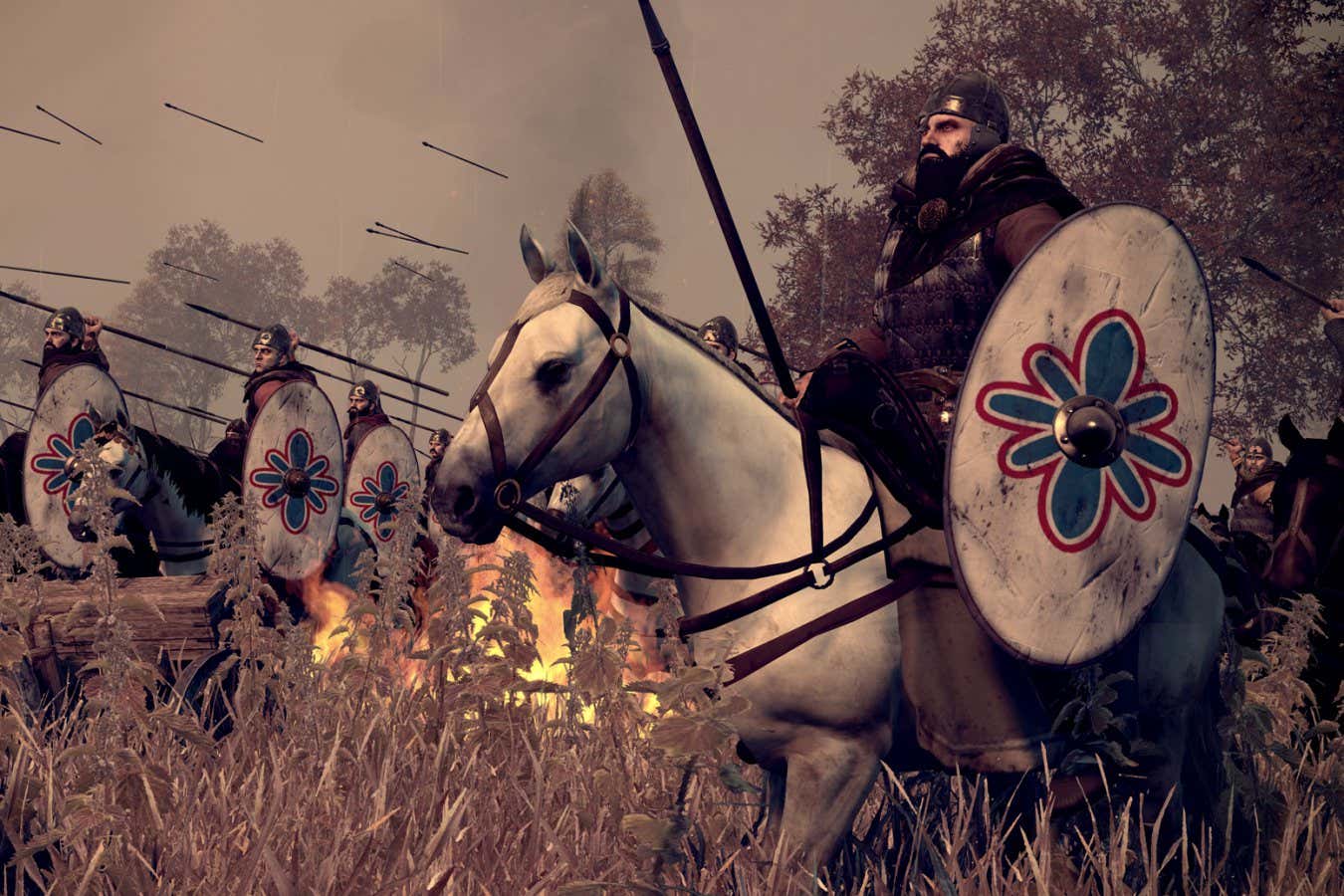
An artist’s impression of how Visigoth warriors may have looked in the 5th century
The Creative Assembly (CC BY-NC-SA 4.0)
The Goths were a multi-ethnic society, according to a study of DNA from Gothic graves. The people buried there had ancestry from places as far afield as Scandinavia, modern-day Turkey and North Africa.
The findings run counter to one long-standing idea about the Goths: that they were Scandinavian peoples who moved south to the eastern Mediterranean. “If Gothic identity were primarily a biological lineage descending from Scandinavia, we would not see this,” says Svetoslav Stamov at the National Museum of History in Bulgaria.
The Goths were living in eastern Europe at least as early as the 3rd century AD and remained there for centuries. Goths often lived near the frontiers of the Roman Empire, sometimes fighting for the empire and sometimes against it. One Goth group, the Visigoths, sacked the city of Rome in AD 410, helping to bring down the Western Roman Empire.
However, Goths are one of history’s least understood groups. Much of our information about them comes from Roman sources, which may not be reliable. Roman writers often used labels such as “Goths”, “Celts” and “Scythians” to describe neighbouring groups about whom they knew little.
To learn more about who the Goths were, Stamov and his colleagues sequenced the genomes of 38 people from two sites in Bulgaria. They say both can be identified as Gothic by characteristic beads and jewellery, burial practices and skull modifications.
Near a palace called the Aul of Khan Omurtag, there was a necropolis that seems to have been part of a Gothic bishop’s ecclesiastical see, dating from about AD 350 to 489. The site has been tentatively linked to an early Gothic Christian bishop called Wulfila or Ulfilas.
They also took samples from an older site, the Aquae Calidae necropolis, from about 320 to 375. This was a Roman healing centre and bath house, not a cemetery, but there were multiple bodies buried there. “One of the samples had artificial skull deformation, which is not typical for Roman times and speaks of a different culture,” says Stamov.
People from the two sites were markedly different genetically, but both groups showed a mix of ancestries. The peoples were descended from populations as far afield as Scandinavia, the Caucasus, the Levant, Anatolia (modern Turkey), East Asia (modern Mongolia), Egypt and sub-Saharan Africa. “It’s an extremely diverse community,” says Stamov.
A key factor may have been the importance of Arianism, an early version of Christianity. “It’s very welcoming to anybody,” says team member Todor Chobanov at the Institute for Balkan Studies and Center of Thracology in Sofia, Bulgaria. “Anybody could be an Arian Christian.”
The ideas that Goths were “complex and diverse” and that “people didn’t have a one-to-one tie between ancestry and ethnic identity” are good ones, says James Harland at the University of Bonn in Germany. However, he says the team has not sequenced enough genomes to have a good sampling. He also argues that you cannot reliably infer a person’s ethnicity from their artefacts, so the presence of seemingly Gothic artefacts doesn’t mean the people in the graves were really Goths.
Harland says the Roman Empire may have been a key factor in the formation of the Goth identity, as peoples variously worked with and against the empire. “It’s that process of engaging with the empire that brings these groups into being as coherent units,” he says.
“The different Gothic tribes lived several centuries on the borders of the Roman Empire, and they were gradually more and more influenced by the Roman Empire in many ways, including the style of their clothing [and] their pottery,” says Chobanov.
Embark on a captivating journey where history and archaeology come to life through Mount Vesuvius and the ruins of Pompeii and Herculaneum. Topics:
Historic Herculaneum – Uncovering Vesuvius, Pompeii and ancient Naples
