

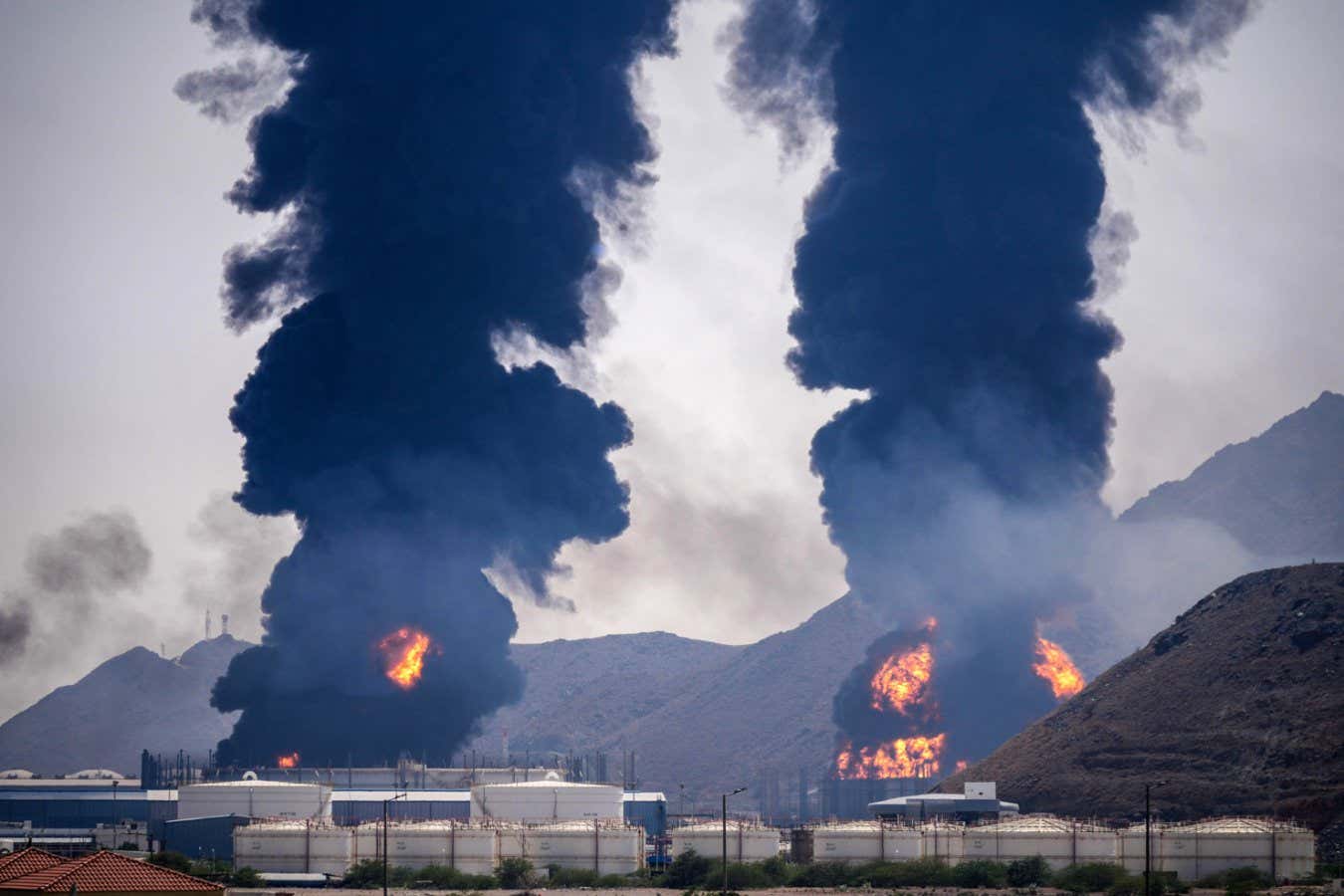
Plumes of smoke and fire at an oil facility in Fujairah, United Arab Emirates
Associated Press/Alamy
Despite Donald Trump’s relentless attacks on climate action, the “drill, baby, drill” president has given the green revolution a huge boost by attacking Iran.
In response, Iran has stopped almost all traffic in the Strait of Hormuz, a waterway through which one-fifth of global oil and one-fifth of seaborne gas supplies pass, and struck oil and gas fields with drones and missiles. Iran’s oil infrastructure and gas fields have also been hit by US and Israeli strikes, respectively.
The cost of oil has jumped from about $70 to more than $100 a barrel, and natural gas prices have also shot up in most regions. While Saudi Arabia and the United Arab Emirates have rerouted as much fuel as possible through pipelines, prices are expected to remain high. Even if oil prices come down to an average of $85 across the entire year, that will cost fossil-fuel importing countries an extra $240 billion, according to the think tank Ember.
But maxing out the deployment of renewable energy, electric vehicles and heat pumps could reduce that cost by 70 per cent, it said.
“The conflict in Iran almost certainly is going to be an accelerant on the energy transition,” says Sam Butler-Sloss at Ember. “As prices go up, as the awareness of the fragility of the fossil system rises, so it becomes ever clearer that nations need to find more secure energy forms, and… everywhere in the world is in a location that receives plentiful solar and wind.”
The impacts of this energy crunch will be even more widespread than when Russia’s 2022 invasion of Ukraine reduced flows of Russian oil and gas to Europe. Since then, the European Union’s annual solar build-out has more than doubled, and the UK’s has increased by about two-thirds, with wind power also continuing to rise. Renewables now make up about 45 per cent of global energy capacity.
Now the most vulnerable region is Asia, which receives four-fifths of the oil and liquefied natural gas (LNG) shipped through the Strait of Hormuz. Japan and South Korea rely on the strait for 70 per cent of their oil, and a third of Taiwan’s natural gas comes from there. Up to half of India’s oil and natural gas imports ship through the strait, and some restaurants there have even had to restrict menu options due to cooking gas shortages. “This is Asia’s Ukraine moment,” says Butler-Sloss.
In the short term, greenhouse gas emissions may actually rise because countries like Japan and South Korea have started generating more power from coal, which is twice as dirty as natural gas. The two countries are also boosting the output of existing nuclear power plants.
But Seoul has also promised to fast-track the financing, permitting and grid access for wind and solar projects, and India’s prime minister, Narendra Modi, said on 11 March that solar and electric vehicles will help reduce the country’s dependence on foreign fuel imports.
“Economies in Asia are getting a wake-up call, just as Europe got its wake-up call four years ago,” says Pavel Molchanov at investment firm Raymond James & Associates. “The wake-up call will be pushing for more renewables within the electricity mix because, again, fossil fuels are subject to disruptions.”
Some analysts expect China, which already installs more solar and wind than the rest of the world combined, to accelerate this even more, since almost half of its crude oil imports pass through the Strait of Hormuz. At the same time, as the world’s biggest coal producer, it is likely to increase coal in its energy mix.
“China will follow its long-standing all-of-the-above energy strategy,” says Li Shuo at the Asia Society Policy Institute. “This is precisely the lesson that many other countries will draw.”
But in nations with poor electricity grids, the rising cost of natural gas and diesel will now make solar more enticing for both utility companies and villages and households. After the invasion of Ukraine largely priced Pakistan out of the LNG market, for instance, solar went from 4 per cent to 25 per cent of electricity production there, thanks in large part to homes and businesses putting up cheap Chinese solar panels.
In the longer term, the biggest winner worldwide may be electric vehicles. Most natural gas is delivered not by ship but by pipeline, so prices may go back down sooner. Oil, on the other hand, is a global market with a global price. Car owners are facing eye-watering prices at the pump even in the US, the world’s top oil producer.
More will consider buying an EV, and governments should encourage them, because the “super-lever” of EV adoption could reduce the bills of fossil-fuel importing countries by a third, says Ember.
But because a car’s average lifetime is almost two decades, it will take years to start seeing significantly more EVs on the road, says Michael Liebreich, an energy consultant at Liebreich Associates. The replacement of natural gas power by renewables will be visible quickly and will continue even if gas prices fall, he says.
“The assumption of a growing demand for gas in a world that has got cheap wind, solar and batteries and is increasingly averse to being dependent on global commodity markets, that narrative is wrong. It’s over,” says Liebreich.
Topics:
