


The Eta Aquarid meteor shower peaks this week—here’s how to get the best view
This annual meteor shower occurs as Earth passes through the dusty debris left behind by Halley’s Comet as it journeys around the sun
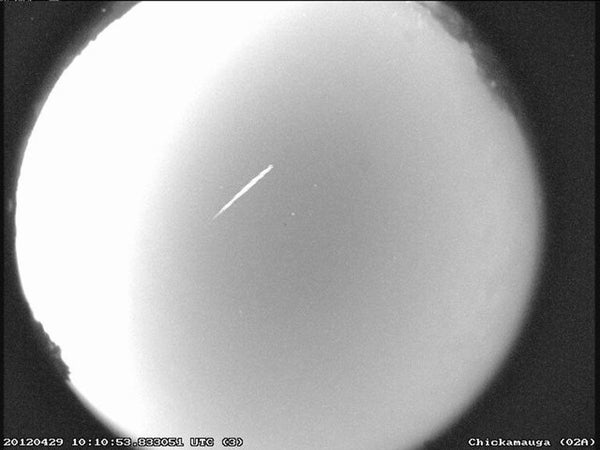
It’s May, which means the trees are greener, the days are longer, and the nights are a little warmer. That’s perfect for spotting a meteor shower—and not just any shower: the Eta Aquarids are hitting their peak this week on May 5 and May 6.
Meteor showers are the beautiful product of cosmic debris. As Earth orbits the sun, it passes through a trail of dust and rocks falling from asteroids and comets as they, too, make their way around the star. When this debris hits Earth’s atmosphere, it burns up, creating bright shooting stars that appear to streak across the sky.
The Eta Aquarids, also called the Eta Aquariids, get their name from the point in the sky that they appear to originate from—an area near Eta Aquarii, the brightest star in the Aquarius constellation. But the meteors are actually generated by Halley’s Comet, which is also known as Comet 1P/Halley. It takes its name from astronomer and mathematician Edmond Halley, a friend of Isaac Newton. In 1705 Halley published a paper using Newton’s theories about gravity to show that the comet was periodic: it returns to the inner solar system every 76 years or so, at which time it can be seen from Earth with the naked eye.
On supporting science journalism
If you’re enjoying this article, consider supporting our award-winning journalism by subscribing. By purchasing a subscription you are helping to ensure the future of impactful stories about the discoveries and ideas shaping our world today.
Halley observed the comet himself in 1682, but it has been seen throughout history; the earliest recorded sighting was by Chinese astronomers in 240 B.C.E. Perhaps one of the most historically famous instances was that of C.E. 1066, when the comet was spotted by sky-gazers in England and interpreted as an omen predicting the subsequent defeat of the Anglo-Saxon king at the Battle of Hastings by William the Conqueror of Normandy—the episode was memorialized in a medieval work of art known as the Bayeux Tapestry.
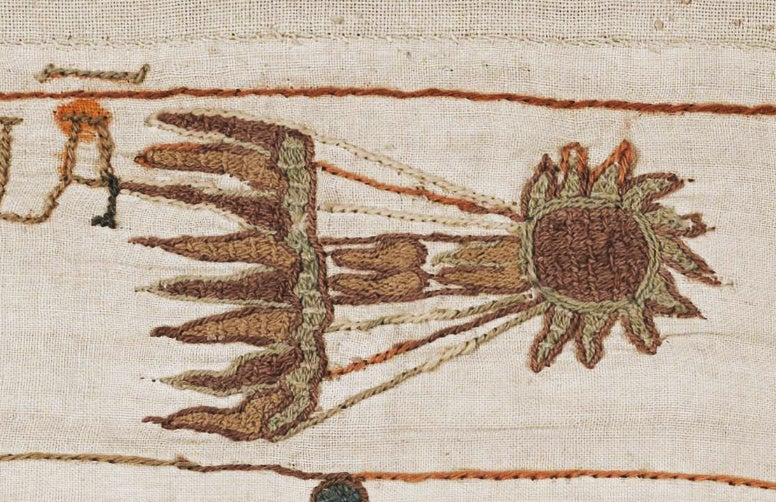
The comet as depicted by the Bayeux Tapestry, which was constructed in the 1070s C.E.
It’s been 40 years since Halley’s Comet passed through the inner solar system, and it won’t do so again until 2061. In 1986 the European Space Agency’s Giotto spacecraft returned images of the comet’s nucleus, and two Soviet Union probes and two Japanese spacecraft also imaged the comet that year.

Comet Halley, as seen by the European Space Agency’s Giotto spacecraft in 1986.
The annual Eta Aquarid shower is best seen each year during early and mid-May. At its zenith, sky-gazers can expect to see as many as 50 meteors an hour under optimal conditions, although NASA warns that fainter meteors may be eclipsed by bright moonlight this year.
These meteors are known for their fast clip, speeding across the sky at 40 miles per second. That makes for particularly spectacular visuals: the meteors leave glowing trails that can be seen for an instant after the initial flash of light.
For the best viewing experience, stake out a spot somewhere dark and far from artificial lights. Allow around 20 minutes to let your eyes adjust to the darkness; that means avoiding bright lights such as your phone screen. The meteors will be most visible from the Northern Hemisphere on May 5 and May 6 in the hours before dawn, so make sure you’re facing east and looking up before sunrise and enjoy the show.
It’s Time to Stand Up for Science
If you enjoyed this article, I’d like to ask for your support. Scientific American has served as an advocate for science and industry for 180 years, and right now may be the most critical moment in that two-century history.
I’ve been a Scientific American subscriber since I was 12 years old, and it helped shape the way I look at the world. SciAm always educates and delights me, and inspires a sense of awe for our vast, beautiful universe. I hope it does that for you, too.
If you subscribe to Scientific American, you help ensure that our coverage is centered on meaningful research and discovery; that we have the resources to report on the decisions that threaten labs across the U.S.; and that we support both budding and working scientists at a time when the value of science itself too often goes unrecognized.
In return, you get essential news, captivating podcasts, brilliant infographics, can’t-miss newsletters, must-watch videos, challenging games, and the science world’s best writing and reporting. You can even gift someone a subscription.
There has never been a more important time for us to stand up and show why science matters. I hope you’ll support us in that mission.
