

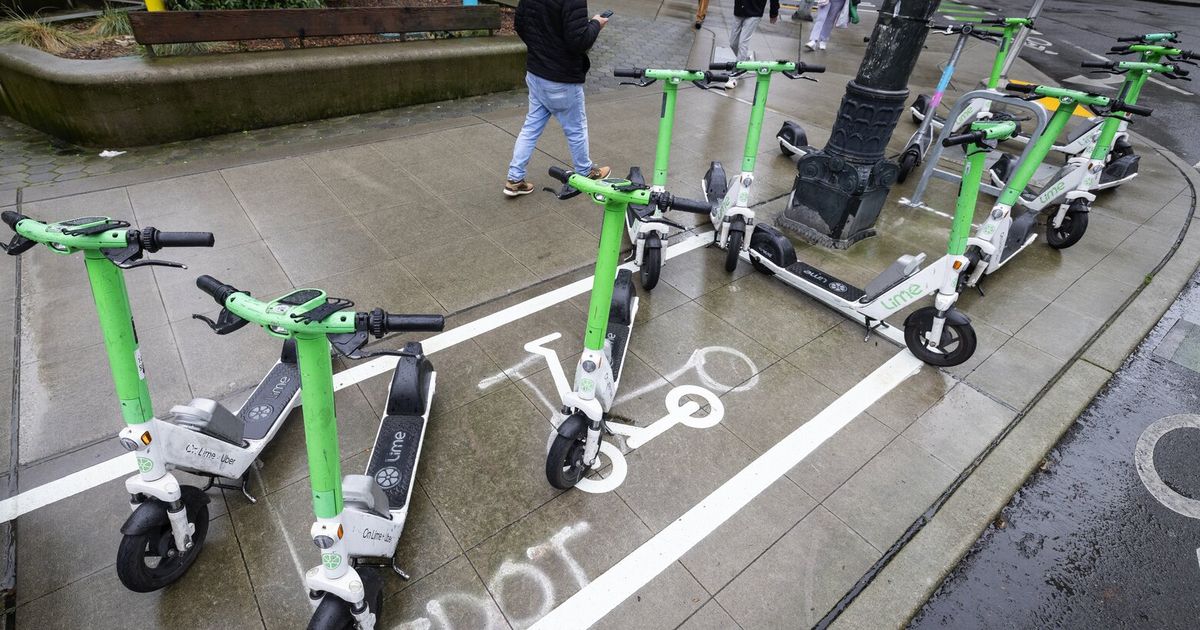
It’s bike season, and you can see two kinds of people around Seattle.
Those with their own ride, who almost invariably wear a helmet and stick to the rules of the road. And those on rented e-scooters and e-bikes with no brain buckets and little regard for niceties such as safe sidewalks.
And that disparity is likely to worsen when thousands of tourists pack the city during the World Cup matches next month. It’s past time Seattle takes stronger steps to ensure rider and pedestrian safety in its micro-mobility program.
In a 2024 report to the Washington Traffic Safety Commission, University of Washington researchers noted that e-scooter-related medical encounters in Seattle increased from nine between 2018 and 2020 (when e-scooter share programs were introduced in the city) to 273 between 2021-2023.
Nearly 90% of all e-scooter injuries were falls, with about 5% coming from collisions with motor vehicles. The study noted that only 9% of accident victims wore a helmet.
Safety concerns have prompted regulations across the country, mostly recently in Utah.
New laws went into effect there earlier this month. All e-bike, e-scooter and e-motorcycle riders under 21 must wear a helmet. Police can impound and temporarily hold an e-bike or motorcycle if a minor is found violating laws or safety standards.
“Anecdotally, a day doesn’t go by that we don’t see an e-scooter accident in the emergency department,” said Jeffrey Robinson, a radiologist at Harborview Medical Center. “We’re seeing increasing numbers of victims because there are increasing numbers of riders.”
There are currently about 26,000 daily trips on bike shares, up from about 9,000 in 2020, according to Seattle Transportation Department data.
Lime is the only vendor in Seattle; Bird ceased operations in March.
Mandating helmets may not be a panacea, said Robinson. Enforcement would be tricky. Instead, Seattle should extract more money from vendors to help offset the costs of emergency response and medical care.
“Once you buy your car, motorcycle, or bicycle, you’re on your own, and there’s no commercial relationship anymore,” he said. “But with these scooters and e-bikes, every time you put one in, Lime makes money. If they were to be held accountable for the costs incurred by the injuries, then I think that we would see a very different environment.”
There is big money involved. Lime’s parent company, Neutron Holdings, filed for an initial public offering this month with the ticker symbol LIME. The San Francisco-based enterprise is hoping to list at a roughly $2 billion valuation, according to the Financial Times.
In its prospectus, Lime touts its growth in Seattle, noting that it is allowed to operate 10,500 vehicles, up from 500 e-scooters permitted to it and two other operators in 2020.
“Looking ahead, we are working with the city to prepare for major global events, including multiple FIFA World Cup matches in 2026,” stated the company.
Dollars will surely flow during the sports bonanza. But Robinson and his medical colleagues will likely be very busy, and residents have a right to ask whether City Hall is doing all it can to mitigate what is increasingly becoming an epidemic of fractures and road rash.
