

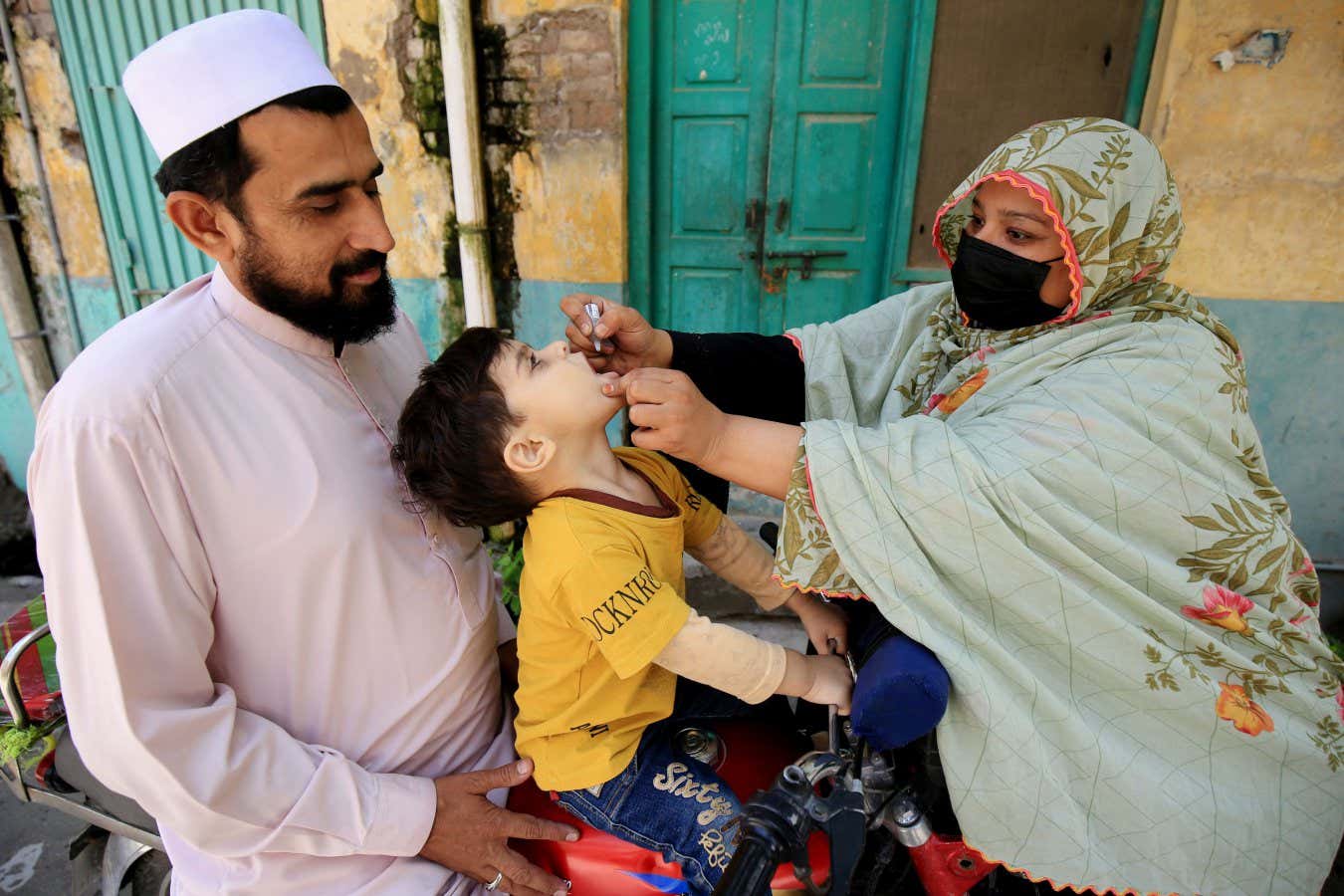
The time of year that a child gets vaccinated against polio could affect the strength of their immune response
BILAWAL ARBAB/EPA-EFE/Shutterstok
Many people have the sense that their health ebbs and flows with the seasons. Now, research suggests that our response to vaccines – and our physiology more generally – varies across the year.
Although humans aren’t usually considered seasonal creatures, many plants and animals follow biological calendars that influence when they flower, breed, migrate or hibernate. Over the past decade, a growing number of studies have indicated that humans, too, may experience subtle seasonal shifts in immune activity, hormone levels and gene expression.
“The really exciting finding of this paper is not about vaccination – it is that human immune function [is] different across the seasons,” says Cathy Wyse at the University of Edinburgh, UK, who wasn’t involved in the study. “This suggests that humans might have inbuilt seasonal timing, as is seen in animals, birds and across biology.”
With research suggesting that our response to influenza vaccines follows 24-hour circadian patterns, Laura Barrero Guevara at New York University and her colleagues were inspired to investigate the seasonality of vaccine outcomes more broadly.
The team pooled data from 96 randomised-controlled trials involving around 48,000 children who had been vaccinated against 14 infections, including measles, polio and chickenpox. These were conducted in different countries at different times of year, which enabled the researchers to compare seasonal and geographical differences in immunogenicity, the strength of the antibody response triggered by vaccination.
“We found that there is indeed a seasonal immune response,” says Barrero Guevara. “I think the most exciting part was seeing this latitudinal gradient. In temperate regions, the stronger immune response was during the winter, both in the northern and southern hemispheres, which is what you’d expect if it was being influenced by seasonal changes in day length, or photoperiod.”
Closer to the equator, the immune system appeared to follow a less predictable seasonal pattern. There were still strong annual fluctuations in vaccine responses in the tropics, with larger seasonal swings for some vaccines, including rotavirus and polio. However, unlike the relatively consistent winter-linked peaks observed in temperate regions, peak responses in the tropics occurred at different times depending on the vaccine.
The researchers excluded children who already had antibodies against the pathogens prior to vaccination, making it unlikely that recent exposure to those infections explained the findings.
But it is still unclear what is driving them. “Our initial hypothesis was a seasonal extension of circadian rhythms driven by photoperiodic cues. However, this would have implied a lower seasonality amplitude in tropical regions than in temperate regions,” says team member Matthieu Domenech de Cellès at the Max Planck Institute for Infection Biology in Berlin. “This is not what we found, so other mechanisms – or maybe a combination of photoperiodism and other mechanisms – may be at play.”
Previous studies have also suggested seasonal rhythms in immune activity. In 2020, Wyse and her colleagues reported seasonal fluctuations in inflammatory markers and several types of immune cell, with some peaking in winter and others in spring.
Another study by Manuel Irima at the Centre for Genomic Regulation in Barcelona and his team identified seasonal shifts in gene expression across multiple human tissues, including hormone-producing regions of the brain and testes, and many immune-related genes. “I think the new results may be, to some extent, related with our observations, even if I don’t think we’re close to a mechanistic understanding,” says Irima.
Wyse is more convinced that humans may possess an intrinsic seasonal timing system, coordinated by changing day length. “It’s the same mechanism in animals and birds and fish, we just have never shown it in humans,” she says.
This system is thought to reside in the hypothalamus – the same brain region that houses the suprachiasmatic nucleus, which coordinates circadian rhythms. Animals living closer to the equator also possess this machinery, says Wyse, but often show weaker annual rhythms because day length varies less across the year. Instead, their biology may become more strongly entrained to other environmental cues, such as food availability or the onset of rainy seasons.
Evidence for seasonal rhythms in humans may also extend beyond the immune system. Earlier this year, Timothy Hearn at the University of Cambridge and his colleague David Whitmore at University College London reported that births in the UK followed striking seasonal patterns for much of the 20th century, historically peaking in spring, before shifting abruptly in the mid-1970s following the widespread availability of the contraceptive pill.
Hearn says that while evidence for seasonal biology in humans is becoming increasingly difficult to dismiss, it is hard to disentangle whether such rhythms reflect an intrinsic biological calendar, “because season is a term that catches a bundle of correlated environmental exposures, and is further complicated by accompanying changes in infections, diet, activity, sleep and social behaviour”.
If the seasonal rhythms documented by Barrero Guevara and her colleagues are confirmed, researchers may explore whether vaccination schedules could be optimised around them.
However, Wyse emphasises that differences in antibody responses don’t necessarily translate into meaningful differences in vaccine effectiveness, and delaying vaccination in the hope of marginal improvements in immune response could do more harm than good. “If you think, ‘OK, well, I’m going to be vaccinated in the winter because that’s better,’ so you put off getting vaccinated for a month, that actually might be a higher risk than waiting for a tiny improvement, even if there was one.”
“Time will tell whether there is any clinical benefit to vaccination at different times,” she says. “At the moment, there is not enough evidence for that.”
Topics:
