

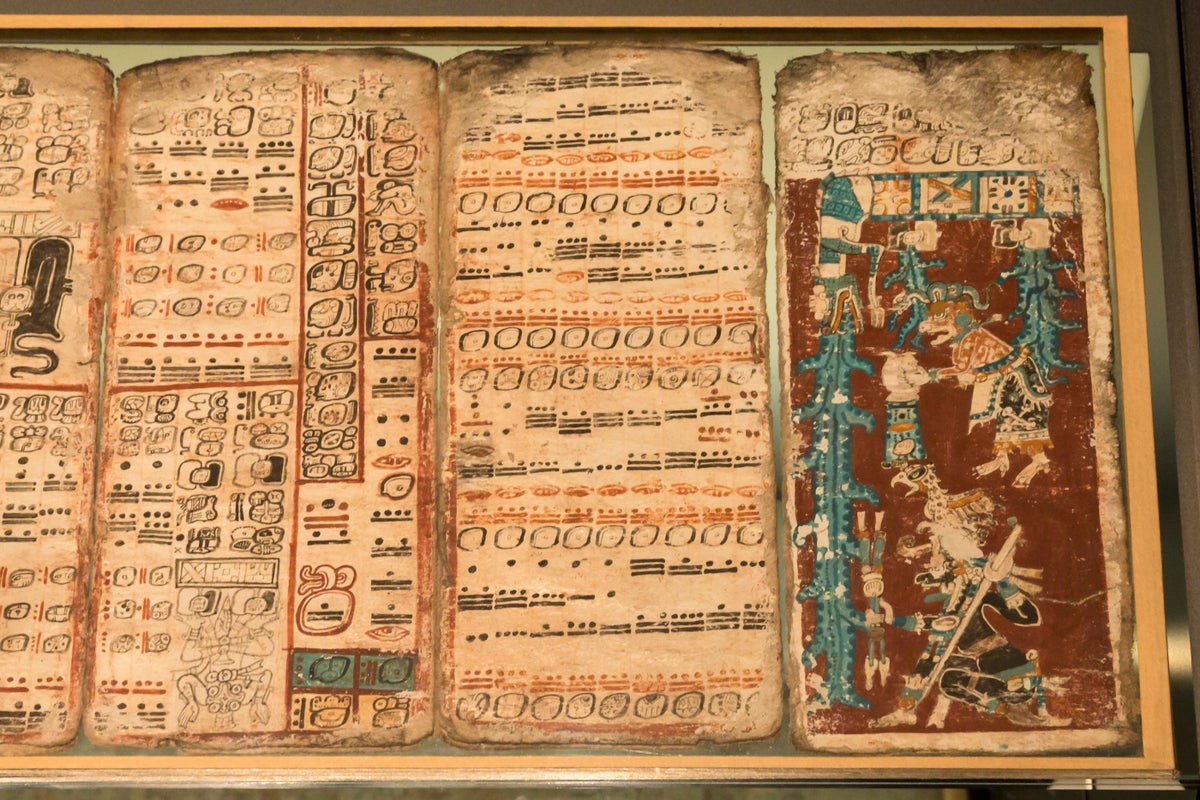
The math world just got a new genius—a prodigy who announced himself by affixing his name to his signature feat of numerical prowess. But he won’t be winning any awards—he died more than 1,000 years ago in the Maya empire that once flourished in Mesoamerica.
We’ve long known that the Maya did math. Their calendars, for instance, encode a sophisticated awareness of astronomical cycles that demands advanced calculations. But like so much Indigenous knowledge that was destroyed or discarded during the European conquest of the Americas, the names of these ancient mathematicians were thought to be lost to history, unlike those of their subsequently more widely recognized counterparts from ancient Greece, Mesopotamia and China.
That changed today. In a new study published in the journal Antiquity, archaeologists have decoded a mysterious scrap of plaster they found preserved from at least 1,100 years ago. Its symbols represent a mathematical formula relating the time periods of celestial bodies’ motions in the sky. Inscribed beside the formula are hieroglyphs that translate to “so says Sak Tahn Waax,” a male Maya name that means “White-Chested Fox.”
On supporting science journalism
If you’re enjoying this article, consider supporting our award-winning journalism by subscribing. By purchasing a subscription you are helping to ensure the future of impactful stories about the discoveries and ideas shaping our world today.
“I think it was his mic-drop moment,” says Heather Hurst, an archaeologist at Skidmore College and senior author of the study. “He was like, ‘Here’s my crazy math—boom!’” Sak Tahn Waax is the first Mesoamerican mathematician whom scientists have identified by name.
The discovery dates back to 2010, when a team was excavating a site in Guatemala called Xultun—a once-bustling city with thousands of buildings that had since been reclaimed by the jungle. One of Hurst’s colleagues happened upon a hole dug by looters. The hole exposed part of a painted mural. The research team finished the work, unearthing a large chamber with mural-covered walls encircling the center.
On one wall, the researchers spied what first appeared to be patches of dirt or debris on a mural; further scrutiny showed these were actually thin scraps of plaster that were inscribed with strange markings. The team couldn’t immediately decipher the scraps’ meaning but couldn’t forget them, either: for more than a decade, Hurst and her co-authors would occasionally puzzle over them in spare moments.
“It just seemed like a bunch of numbers and dates,” she recalls. “It took a little bit to break the code.” It was her co-author, Franco D. Rossi, an archaeologist at the Massachusetts Institute of Technology, who finally cracked the code. Rossi showed how the markings on a particular scrap of plaster could be seen as a sort of celestial chronology; the team then reconstructed how the scraps’ symbols tabulated the time it took for planets such as Mars and Venus to come back to the same position, relative to the sun. The etchings also numerically related all these cycles to one another in a single mathematical formula—next to the author’s signature. “He’s playing with neat coincidences like least common multiples and then mixing that into their existing 260-day ritual calendar,” Hurst says.
“This text is unique in rendering so many cycles together in a single sentence, with beautifully chosen rhetorical symmetries,” says Oswaldo Chinchilla, an anthropologist at Yale University, who was not involved in the study. Those symmetries mixed scientific observations of the planets’ motions with meaningful numbers and dates in Maya culture. Beyond the virtuosity on display in the formula, Chinchilla says, knowing its author is a game changer. “This is not just a mathematical exercise but the exercise of a named individual whose knowledge was worth recording,” he says. “It adds a personal dimension to the calculations.”
Gabrielle Vail, an archaeologist at the University of North Carolina at Chapel Hill, who wasn’t involved in the new study, says the formula resembles material found in the later Dresden Codex, a math-packed book that is among the oldest intact Maya texts. “This could have been the original source for some of the ideas recorded in the Codex,” she says.
Many questions remain. The mural-lined chamber at the Xultun site is thought to have been part of a residence belonging to an artisan family or guild of paper makers and scribes. But it’s not clear if Sak Tahn Waax himself lived there or if someone else was simply quoting his famous formula. Hurst hopes more context can be gleaned by further studies of the many other plaster scraps—which bear different handwriting from at least one other scribe—and by excavating more of the lost city.
“Somewhere down the line, we might just learn more about this astronomer-sage,” Vail says. “I have goosebumps just thinking about it.”
It’s Time to Stand Up for Science
If you enjoyed this article, I’d like to ask for your support. Scientific American has served as an advocate for science and industry for 180 years, and right now may be the most critical moment in that two-century history.
I’ve been a Scientific American subscriber since I was 12 years old, and it helped shape the way I look at the world. SciAm always educates and delights me, and inspires a sense of awe for our vast, beautiful universe. I hope it does that for you, too.
If you subscribe to Scientific American, you help ensure that our coverage is centered on meaningful research and discovery; that we have the resources to report on the decisions that threaten labs across the U.S.; and that we support both budding and working scientists at a time when the value of science itself too often goes unrecognized.
In return, you get essential news, captivating podcasts, brilliant infographics, can’t-miss newsletters, must-watch videos, challenging games, and the science world’s best writing and reporting. You can even gift someone a subscription.
There has never been a more important time for us to stand up and show why science matters. I hope you’ll support us in that mission.
