

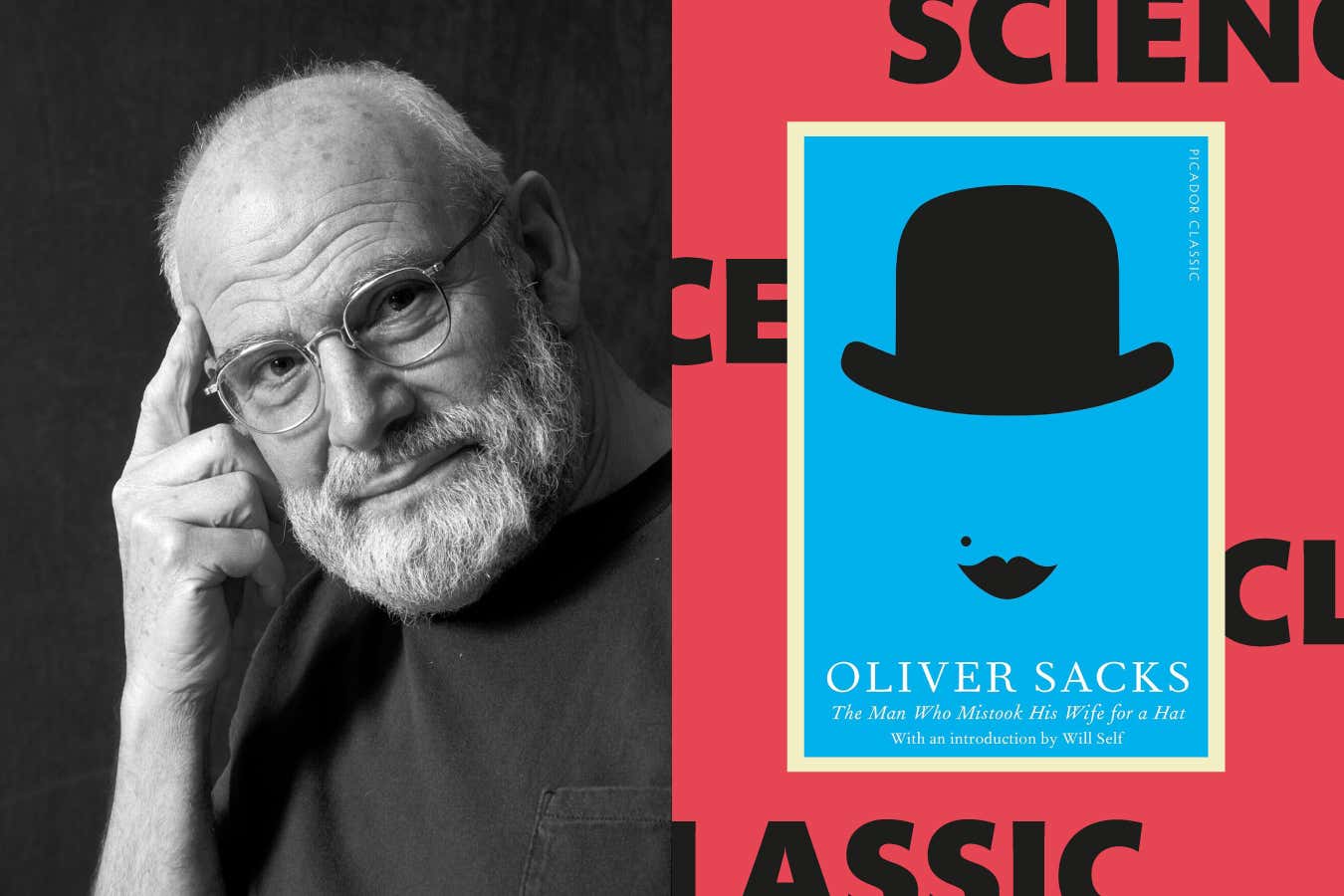
In the wake of revelations about Oliver Sacks, we reread The Man Who Mistook His Wife for a Hat
Sometimes, a popular science book goes out of fashion because new evidence disproves its central thesis, or because it contains outdated attitudes. And sometimes, it gets a metaphorical bomb dropped on it.
The latter is the case with Oliver Sacks’s The Man Who Mistook His Wife for a Hat. It is a seminal work that inspired an entire generation of students and researchers in psychology – including me. But thanks to some shocking revelations about Sacks’s approach to factual accuracy, the book’s reputation has been detonated. Is there anything to be salvaged from the wreckage?
I first read The Man Who Mistook His Wife for a Hat (henceforth Hat) about 25 years ago, when I was an undergraduate studying psychology. It is a collection of case studies of people, mostly Sacks’s own patients, with neuropsychiatric conditions. Sacks brings us into the lives of people with amnesia, neurosyphilis, Tourette’s syndrome and much more. He describes the difficulties these people have with everyday tasks, like having a conversation or getting dressed, explores the neurological basis of their conditions, and considers what they tell us about the nature of the human mind.
Re-reading it now, there are details I don’t like. The book was first published in 1985 and contains language that would not pass muster today, particularly about people with developmental delay. Furthermore, Sacks sometimes ties himself in knots musing on the deeper implications of his patients for the nature of thought.
But for the most part, the re-read reminded me of what I liked about the book in the first place. Sacks’s image in the field of psychology is of a cuddly, humanistic grandpa, and there is a reason for that: the book is profoundly empathetic.
Chapter 3, “The Disembodied Lady”, tells the story of a woman, “Christina”, who had severe nerve damage, leading to the loss of her proprioception – her sense of where her body is in space. Close your eyes and touch your nose with your finger: that’s your proprioception at work. Lacking proprioception, Christina found that simply boarding a bus was a laborious task. Because her movements were so clumsy, people would often accuse her of being drunk.
In telling these stories, Sacks is making an argument that society needs to be more accepting of those whose brains have been damaged, and of those with brains that are simply wired in different ways. He doesn’t use the modern word “neurodiversity”, but the germ of that idea runs throughout Hat.
The main problem with the book is that we do not know how much of it is true. Some of it may be made up. We know this because the journalist Rachel Aviv was given access to Sacks’s correspondence and private journals by the Oliver Sacks Foundation. Aviv wrote about her findings in The New Yorker in 2025. In his journals, Sacks wrote of his “guilt” over “my lies” and “falsification” in Hat.
Aviv established that a handful of the stories in the book are at least partly false. For instance, Sacks describes a patient called “Rebecca” with severe developmental delay, to the point that “she could not confidently open a door with a key”, but who nevertheless blossomed in a theatre group. Aviv found no evidence of this transformation in Sacks’s documents. “Instead of bearing witness to her reality, he [Sacks] reshapes it,” she wrote. Elsewhere, Sacks claims that a pair of identical twins with severe neurological difficulties were nevertheless able to spontaneously identify six-digit primes – something never seen before or since.
The upshot is that it is impossible to know how much of Hat we should trust. Most of the case studies were never published in scientific journals, and there is no independent verification. All we have is Sacks’s word – and in his journals he confessed to lying. My sense is that we should disbelieve the extraordinary one-offs, like the prime-number-calculating twins, but many of the stories – like Christina’s – are far more in line with external evidence.
Aviv made clear that Sacks was wrestling with his own personal demons. He didn’t publicly come out as a gay man until later in life, and was often celibate, wracked with guilt and self-loathing. Unable to fully express this aspect of his identity, Sacks transmuted his own pain into the stories he told about his patients – and then felt guilty for having done so. I find the whole story profoundly sad: when he was young, Sacks internalised society’s homophobia, causing him immense suffering and adversely affecting his work.
Perhaps the biggest problem with Hat is that Sacks wrote it, and his publishers marketed it, as non-fiction. Yet its greatest achievement is something that we normally associate with fiction: putting the reader into the minds of people whose experiences and perceptions are radically different. It isn’t a reliable description of neuropsychiatric facts, but if you read it knowing that, you will nevertheless find that it expresses something true.
Topics:
