
Close Menu
    National News Brief
    Friday, October 16
    • Home
    • Business
    • Lifestyle
    • Science
    • Technology
    • International
    • Arts & Entertainment
    • Sports
    National News Brief
    Home » We may have finally solved an ultra-high-energy cosmic ray puzzle

    We may have finally solved an ultra-high-energy cosmic ray puzzle

    Team_NationalNewsBriefBy Team_NationalNewsBriefJuly 12, 2025 Science No Comments2 Mins Read
    Share
    Facebook Twitter LinkedIn Pinterest Email


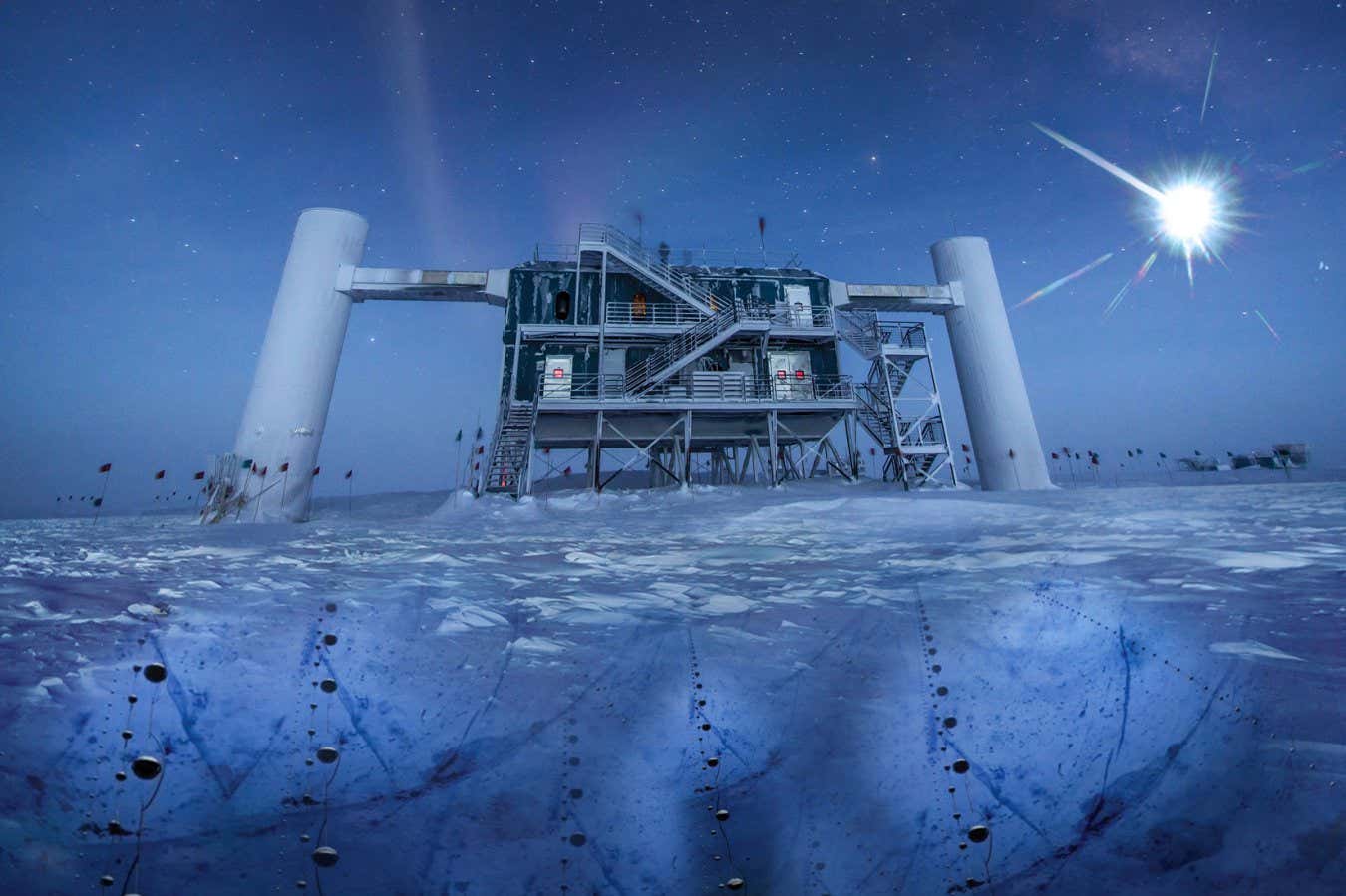
    An artistic rendering based on a real image of the IceCube neutrino detector at the South Pole

    IceCube/NSF

    We are zeroing in on the true composition of the rarest, highest-energy cosmic rays – which could help reveal their unknown origins.

    The universe is constantly showering us with bursts of particles, says Brian Clark at the University of Maryland. The most energetic among them, called ultra-high-energy cosmic rays, have more energy than even the accelerated particles in colliders. They are also rare – researchers don’t know what produces them or where they come from. Even the particles that make them up have been an unresolved question. Now Clark and his colleagues have determined their composition using data collected by the IceCube neutrino detector in Antarctica.

    Previous ultra-high-energy cosmic ray detections – by the Pierre Auger Observatory in Argentina and the Telescope Array in Utah – disagree on whether these rays mostly consist of protons or if other particles are also in the mix, says Clark. IceCube’s data offers some resolution: it suggests protons account for only about 70 per cent of ultra-high-energy cosmic rays, while the rest is made of heavy ions such as iron.

    Team member Maximilian Meier at Chiba University in Japan says IceCube’s data is complementary to other measurements, which detect cosmic rays directly. In contrast, IceCube primarily detects particles called neutrinos, which are byproducts of collisions between energetic cosmic rays and photons left over from the big bang. Neutrinos themselves are challenging to detect and to simulate on a computer, he says.

    The particles in cosmic rays determine how spaceborne magnetic fields affect their path through space. Understanding their composition is therefore an important part of the difficult task of searching for their origins, says Toshihiro Fujii at Osaka Metropolitan University in Japan.

    Those unknown origins have created some dramatic mysteries such as the Amaterasu particle cosmic ray. Strangely, it seems to have emerged from a region of space near the Milky Way where there are “no promising astronomical candidates” for its source, he says.

    Clark says he is optimistic about resolving many such mysteries within a decade because several new observation instruments, including an IceCube upgrade, will come online in the near future. “The field has a really clear vision for how we get to [answering] some of these questions,” he says.

    Topics:


    Source link

    Team_NationalNewsBrief
    • Website

    Keep Reading

    Can AI break encryption? OpenAI’s new math has cryptographers divided

    Scientists discover an ancient shipwreck dating to when the Great Pyramid was built

    Google’s quantum Willow chip may be able to grow ‘magic states’

    Scientists vote to end leap seconds, redefining how the world keeps time

    Microplastics are linked to inflammation—scientists might have finally worked out why

    NIH appears to shut down public comments on science peer-review rule change ahead of schedule

    Add A Comment

    Comments are closed.

    Editors Picks

    Opinion | Three Opinion Writers on the L.A. Protests and Trump’s Spectacle of Control

    June 11, 2025

    Jamie Foxx Recalls Asking Snoop Dogg To ‘Shake Up’ His Daughter’s Boyfriend

    January 23, 2025

    Your flight emissions are way higher than carbon calculators suggest

    October 31, 2025

    Missed signals, lost deal: How India-US trade talks collapsed

    August 6, 2025

    Saving local news and strengthening democracy in Washington

    February 17, 2026
    Categories
    • Arts & Entertainment
    • Business
    • International
    • Latest News
    • Lifestyle
    • Opinions
    • Politics
    • Science
    • Sports
    • Technology
    • Top Stories
    • Trending News
    • World Economy
    About us

    Welcome to National News Brief, your one-stop destination for staying informed on the latest developments from around the globe. Our mission is to provide readers with up-to-the-minute coverage across a wide range of topics, ensuring you never miss out on the stories that matter most.

    At National News Brief, we cover World News, delivering accurate and insightful reports on global events and issues shaping the future. Our Tech News section keeps you informed about cutting-edge technologies, trends in AI, and innovations transforming industries. Stay ahead of the curve with updates on the World Economy, including financial markets, economic policies, and international trade.

    Editors Picks

    Living with a stink? Technology might help

    October 16, 2026

    Iran’s Oil Exports Have Collapsed To ZERO

    October 16, 2026

    Oklahoma Week 7 Football: Washington vs. Anadarko Photos

    October 16, 2026

    Daisy Ridley Wipes Instagram Account, Sparking ‘Star Wars’ Speculation

    October 16, 2026
    Categories
    • Arts & Entertainment
    • Business
    • International
    • Latest News
    • Lifestyle
    • Opinions
    • Politics
    • Science
    • Sports
    • Technology
    • Top Stories
    • Trending News
    • World Economy
    • Privacy Policy
    • Disclaimer
    • Terms and Conditions
    • About us
    • Contact us
    Copyright © 2024 Nationalnewsbrief.com All Rights Reserved.

    Type above and press Enter to search. Press Esc to cancel.