

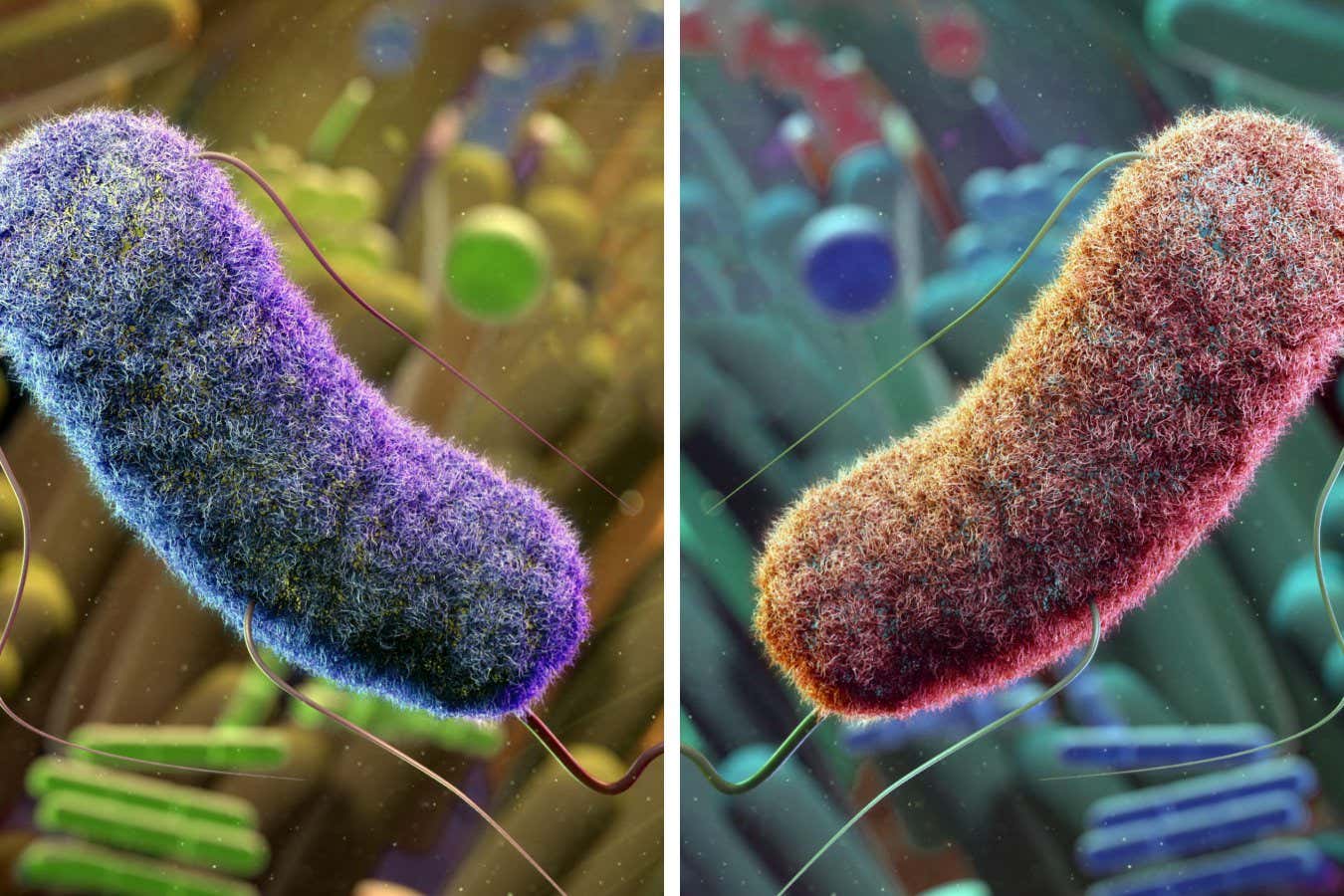
Microbes engineered in the lab could use mirror images of molecules found in nature
THOM LEACH/Science Photo Library / Alamy
Microbes based on mirror images of molecules in the natural world would have a hard time surviving outside the laboratory, according to a modelling study. To do so, they would need a ready supply of “mirror food”, or some novel way to feed themselves.
But the research has drawn a backlash from other experts in the field who warn that it may underestimate the grave risks posed by so-called mirror life.
Many biological molecules, such as DNA and proteins, are chiral, which means they can exist in either left-handed or right-handed forms. Like your left and right hands, they are mirror images of each other, and cannot be superimposed. But all life on Earth uses right-handed DNA molecules and left-handed protein molecules, which enables cellular machinery to fit together properly.
While it is not yet technically feasible, one day it may be possible to manufacture organisms in which the handedness, or chirality, of molecules is reversed. In 2024, 38 scientists published a paper in Science calling for work towards the creation of mirror life to be halted because of the dangers such organisms may pose – for example, immune systems may not be able to recognise and defend against mirror bacteria.
In the new study, Ricard Solé at the Santa Fe Institute, New Mexico, and his colleagues explored what would happen if a tiny population of mirror organisms appeared in Earth’s biosphere. They used computer models to determine what constraints would be placed on mirror life forms in a range of different real-world scenarios.
For mirror life to pose a threat, it must first be able to exist in some kind of self-sustaining way, says Solé. The biggest hurdle mirror organisms would need to overcome is that life forms can only digest food made up of molecules with the same chirality as themselves.
“One could imagine engineering dedicated ‘mirror food’ together with mirror organisms. But that shifts the problem rather than solving it,” says Solé. “A mirror biosphere would require not just isolated nutrients, but a continuous industrial infrastructure capable of producing large quantities of mirror-chiral biomolecules: mirror sugars, mirror amino acids, mirror lipids, and so on.”
The team’s models specifically addressed whether mirror organisms could establish themselves autonomously in real ecological environments, not whether they could temporarily survive under controlled laboratory or industrial conditions with engineered feeding systems.
“Our view is that mirror life would likely face very severe barriers under a broad range of ecological conditions, making successful establishment difficult,” Solé says. “However, there are still important open questions that require further analysis, including long-term evolutionary dynamics and more realistic models of how immune systems might interact with mirror organisms.”
The study has been published on a preprint server before being peer-reviewed. But a group of scientists who study mirror life have already responded with a statement calling for the paper to be revised.
Vaughn Cooper at the University of Pittsburgh, Pennsylvania, one of the authors of the statement, told New Scientist that although mirror microbes would initially grow more slowly than native microbes because of a nutritional mismatch, there are plenty of nutrients that are not chiral which could support their growth. “Further, the mirror cell population would rapidly evolve and adapt to new conditions, creating essentially a second tree of life,” says Cooper.
The study also suggests that existing biodiversity on Earth would act as a “firewall” against invasion, since natural organisms are better adapted to the environment and would outcompete the mirror organisms. In the case of mirror bacteria, immune systems may still recognise them as foreign bodies, Solé and his colleagues argue.
But Cooper is not convinced. “There are countless examples of invasion biology that indicate the vulnerability of biodiverse ecosystems to invaders lacking predators,” he says.
Kate Adamala at the University of Minnesota, one of the authors of the 2024 Science paper, says Solé’s team is correct that the supply of food containing the same chiral molecules would be a constraining factor for mirror organisms. “This is the inherent disadvantage mirror life would face in any natural environment,” she says.
But she points out that there are ways such organisms could make their own food using photosynthesis. They could also be engineered to make use of chiral molecules that are found in nature. “It would be extremely hard to make such an organism, but it’s not impossible to imagine,” says Adamala. “I’m not clear on the reasoning behind labelling widespread establishment as ‘highly unlikely’ then.”
Solé says his team did consider the possibility of mirror organisms exploiting non-chiral nutrients or using photosynthesis, but argues they would still face the same ecological challenges.
“The key question is not whether some nutrients are accessible, but whether access is sufficient to sustain long-term positive growth in competition with the existing biosphere,” he says. “Even if mirror organisms could survive on a limited set of achiral compounds, they would still face severe ecological constraints, including low resource quality, dilution, competition and the inability to efficiently process the vast majority of naturally available chiral biomolecules.”
Filippa Lentzos at King’s College London says mirror life is a plausible future concern, but it should not draw attention from pressing, near-term biological risks. “The right response is not panic and not dismissal. It is careful upstream governance, clear red lines around risky work and a proportionate research agenda that does not crowd out more immediate biosafety and biosecurity priorities,” she says.
“The fact that this paper argues for ecological constraints does not remove the need for governance. If anything, it shows why governance should be evidence-based and adaptive: we need to understand which assumptions drive the risk, where the uncertainties are, and what kinds of work would materially change the picture,” says Lentzos.
Topics:
