

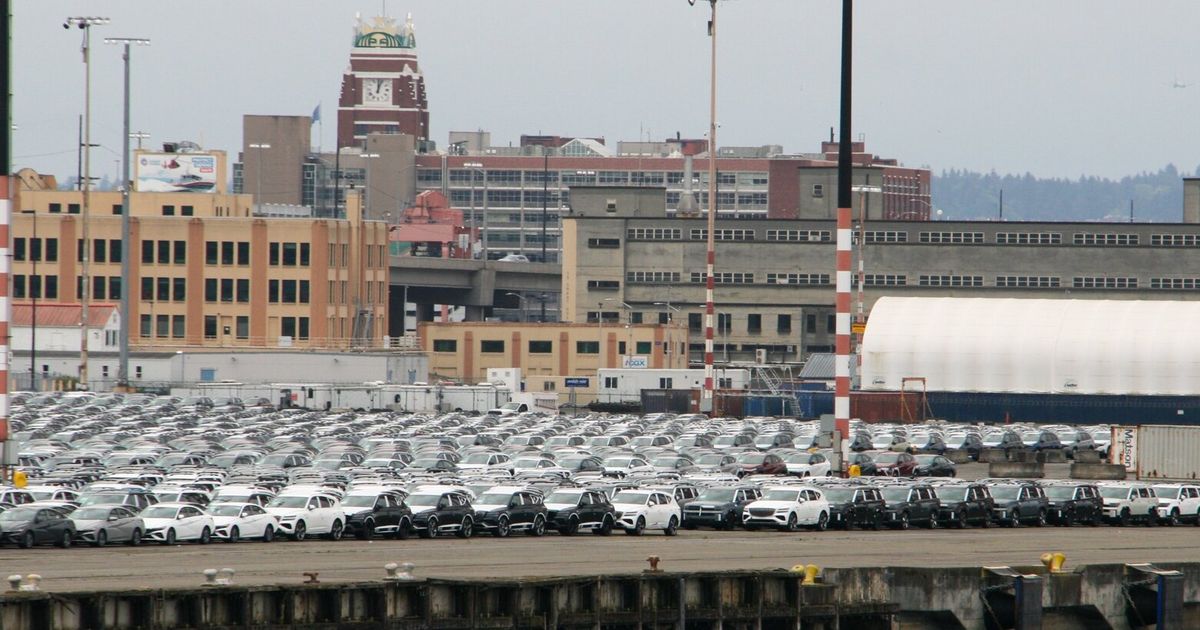
Neat rows of shiny Hyundais, among other foreign vehicles, have lately found a temporary home at the Port of Seattle’s Sodo terminal, lining the wharf for around two weeks at a time. They’re not destined for the American market; no, they’re the result of another port’s success literally spilling over an international border.
A bustling auto terminal in trade-dominant Vancouver, B.C., simply cannot handle the spring rush of cars coming in from Asia. So the Port of Seattle, stung by President Donald Trump’s trade war, has become a makeshift storage locker at its empty Terminal 46 facility.
The situation drips with symbolism, those in the maritime industry tell me. A K-shaped curve shows Vancouver’s seaport continuing to surge with imports and exports, eclipsing $1 billion in trade every day. Meanwhile, many kinds of cargo moving through the combined ports of Seattle and Tacoma, steadily declined.
“Vancouver is choking on (its) own success,” said longtime Port of Seattle Commissioner Fred Felleman. “To the point we’re the recipient of that success spilling over into our port.”
Like the scene in “The Devil Wears Prada,” when domineering boss Miranda Priestly, portrayed by Meryl Streep, enters the office every day and drops her coat and belongings into her assistant Andy’s arms without even looking at her.
Seattle is Andy.
You might wonder why you should care about how much port cargo passes through Puget Sound. I’ll give you two big reasons. First is the direct impact imports have. Tug boat operators, longshore workers and an entire supply chain thrive with Seattle as a storehouse, serving the rest of the country.
“Every container that comes off our docks has an economic multiplier effect on our region,” said Port of Seattle Commissioner Sam Cho. “Every one that goes elsewhere does not. It’s really that simple.”
Second is the critical need to dock cargo ships in Seattle and Tacoma for Washington’s farmers and manufacturers. A third of Washington’s famous apple crop, for example, is exported to other countries — that is, unless those vessels fail to show up. Remember that global trade is basically a kind of giant school bus system, and Washington’s exports depend on Puget Sound ports being a bus stop.
Commercial cargo haulers can take a left turn or a right after they enter the Strait of Juan de Fuca. And lately, it’s been a lot more left turns toward Canada. In the first quarter of 2026, the Port of Vancouver volumes grew year-over-year by 10%; meanwhile, the Northwest Seaport Alliance saw the sharpest decline, losing 18% of its cargo over the same period.
You might be thinking Trump’s trade war is driving the change. No doubt it has. But this is also a bigger 21st century story. Since 2006, cargo flowing through the Port of Vancouver has surged 64%; containers alone have grown from 2.5 million in 2008 to 3.8 million in 2025. The combined ports of Tacoma and Seattle have fallen since 2006 by 21%, according to the Pacific Merchant Shipping Association, a trade advocate.
This result is no accident. Canada’s federal government made purposeful investments in expanding and smoothing the flows of goods through Vancouver. The 2007 creation of a separate intermodal port at Prince Rupert, in northern British Columbia, was another strategic blow. It decreased the time it takes container ships from Asia to arrive in North America along the Great Circle Route.
The Canadians seized on the high cost of U.S. shipping, exacerbated by the American Harbor Maintenance Tax of $1.25 for every $1,000 of cargo value. And they continue to improve port infrastructure, including the development of a massive new terminal at Roberts Bank — less than 1 mile from the U.S. border.
Shipping in the U.S. also is more disjointed and lacks an overall strategy, according to Stephanie Bowman, a maritime consultant and former Port of Seattle commissioner. She’s hopeful state leaders will, at a minimum, form a statewide trade strategy that better integrates its supply chains.
But Bowman warns: “Unless something changes, we will always be a second tier port.”
“We’ll continue to be the bench for Canada,” she added.
Some big ports in Eastern Washington are banding together with the Northwest Seaport Alliance to create an inland logistics hub that could move goods directly from Seattle and Tacoma to optimized distribution networks near Tri-Cities. That’s a start.
A unified federal strategy that matches Canadian efficiency should be the goal; Gov. Bob Ferguson’s government should also be working toward a statewide trade strategy tailored to help Washington’s farms and businesses export their products on the world market.
And as for those Canada-bound cars on Seattle’s waterfront: After their short stay, a vehicle carrier will come scoop them up at Terminal 46 and take them north. In the short term, Cho suggests they could attempt to strike up new business by suggesting the vehicles are already here — why not import them through this gateway? After all, Tacoma continues to see a steady flow of vehicle imports of its own, even in the face of Trump’s stiff auto tariffs.
Over the long haul, the seaport alliance must become more competitive to survive. Anything less is to relegate Seattle to being subservient to a dominant boss like Miranda Priestly for years to come.
