

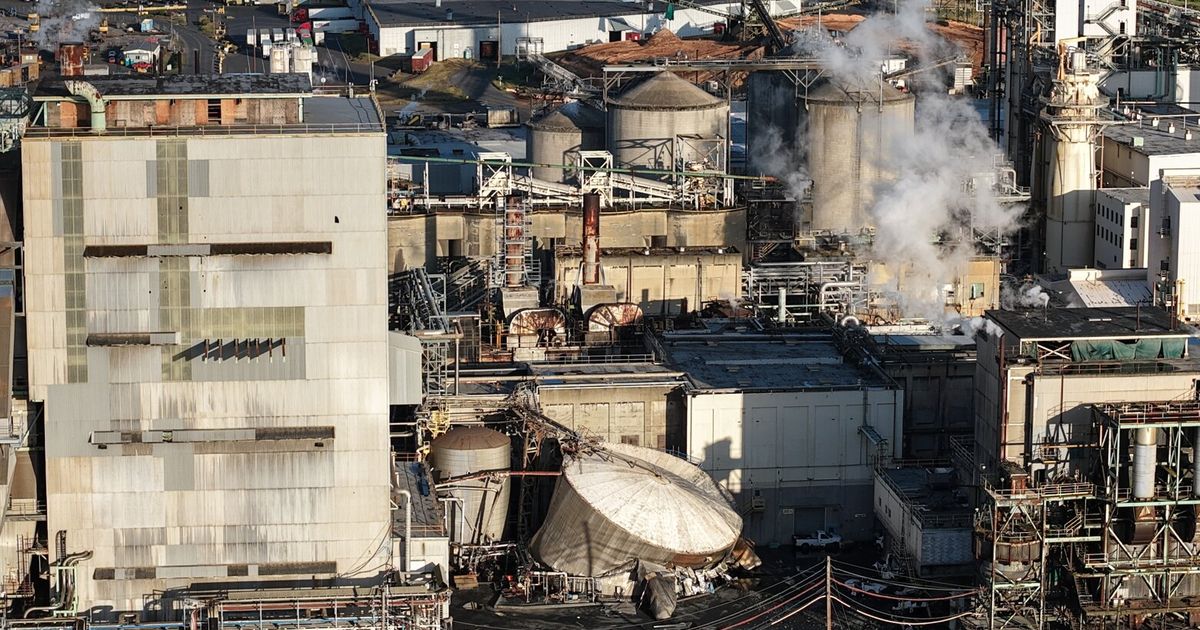
At 7:15 on Tuesday morning, a 900,000-gallon tank of white liquor — a caustic industrial solution of sodium hydroxide and sodium sulfide used in kraft pulp processing — catastrophically imploded at the Nippon Dynawave Packaging Co. mill in Longview.
At least 11 people are dead. Nine more were injured, including a responding firefighter. The spill has reached the Columbia River. As of this writing, three victims remain unrecovered inside a facility so saturated with corrosive chemicals that rescue operations have been suspended.
These are people who went to work on a Tuesday morning and did not come home. Their community is waiting for answers.
Those answers — rigorous, independent and publicly accountable — are exactly what the U.S. Chemical Safety Board exists to provide. On Wednesday, the CSB announced it was opening a formal investigation into the Longview disaster, with a team of investigators dispatched to the site Wednesday.
That is the agency doing precisely what it was created to do — under conditions of existential institutional threat. The question before Congress and the public is whether it will be allowed to exist long enough to finish the job, and to answer the call the next time disaster comes.
This is not the Pacific Northwest’s — or the nation’s — first such reckoning in recent days alone. That same Tuesday evening, as Longview families gathered in vigil, the last of 50,000 evacuated residents in Garden Grove, Cypress, Stanton, Anaheim and Westminster, Calif., were finally cleared to return to their homes. For nearly a week, those families had lived under the shadow of a tank of methyl methacrylate at a GKN Aerospace facility that threatened to explode — an incident the Orange County fire commander had described as potentially “one of the worst chemical incidents in California history.” The tank ultimately cracked and released pressure without igniting.
But throughout that weeklong crisis, the CSB — reduced to only two of its five presidentially appointed board members and consumed by the fight for its own institutional survival — was nowhere to be found. Investigation into its cause remains ongoing without an independent federal voice. Two major industrial chemical disasters, in two states, in a single week: at one, the CSB is now racing to respond; at the other, it was absent throughout. That asymmetry is not accidental. It is the direct consequence of a yearslong campaign to eliminate the agency.
The Trump administration has proposed eliminating the CSB entirely in each of its six budget requests — every year since 2017, and again in both the fiscal year 2026 and fiscal year 2027 proposals — on the grounds that its work “duplicates” the efforts of the Environmental Protection Agency and Occupational Health and Safety Association. Congress has refused each time, most recently in January 2026, when lawmakers approved $14 million in funding — the agency’s full operating budget — over the administration’s explicit objection. At the same time, the EPA has proposed rolling back the hard-won 2024 Safer Communities by Chemical Accident Prevention rule, weakening requirements for safer technology assessments, third-party compliance audits, employee stop-work authority, and hazard evaluations for natural disasters and power loss. In response, the CSB’s two remaining board members — Chairman Owens and Dr. Sylvia E. Johnson — issued a formal statement in May 2026, warning that the proposed revisions represent “a significant step backwards” in preventing catastrophic chemical incidents.
The CSB is an independent, nonregulatory body that does not issue citations or fines, but instead identifies root causes and formulates recommendations to industry, labor groups and regulators alike. Its investigators that arrived in Longview last week carry no enforcement authority — only the authority of evidence, rigor and independence. That is precisely why they cannot be replaced by the agencies that would absorb them.
The Longview disaster illustrates this with painful clarity. Nippon Dynawave had been cited for health and safety violations by state regulators; the Washington State Department of Labor and Industries had inspected the facility three times in five years. Yet a 900,000-gallon vessel of caustic industrial chemicals became a death trap on a routine Tuesday morning. The question is not merely what failed in that tank — it is what systemic conditions allowed it to fail: What warnings went unrecognized, what organizational pressures went unaddressed and what regulatory gaps permitted the accumulation of risk that ended in catastrophe? That is the question the CSB is built to answer. It is a question EPA and OSHA — encumbered by their enforcement roles and institutional interests — are structurally ill-suited to pursue with full independence.
What disappears when the CSB disappears
Twenty years ago, in late March 2005, in a Tyvek suit and steel-toe boots, I walked alongside CSB investigators through the still-smoldering wreckage of the BP Texas City Refinery explosion — the worst American refinery disaster in a generation — that killed 15 workers and injured 180. The CSB’s subsequent report was, in my estimation, the quintessential accident investigation of our era: methodologically rigorous, unflinching in its findings, landmark in its reach. I have taught it at USC ever since. It did not emerge from the EPA. It did not emerge from OSHA. It emerged from an independent agency whose singular mission was to tell the public the unvarnished truth about what went wrong and why — and to make the recommendations that prevent recurrence.
The proposed rollbacks would eliminate much of the infrastructure that makes such truth-telling possible. Safer Technology and Alternatives Analysis requirements — which the CSB has urged for over a decade — would be rescinded for most existing facilities, removing any obligation to ask whether a hazardous process could be made inherently safer. Third-party compliance audits would be weakened or eliminated: At Honeywell’s Geismar, La., facility, one worker was killed in 2021, another seriously injured in 2024 and over 800 pounds of toxic hydrogen fluoride were released in 2023 — all while internal audits across nearly a decade failed to prevent the cascade. Stop-work authority — the right of front-line workers to halt operations they perceive as unsafe — would also be rescinded. Investigation after investigation, from Texas City to Longview, has shown that empowered workers are the last line of defense before catastrophe. Removing that authority is not deregulation. It is an invitation to repeat disasters that have already been documented, studied and paid for in lives.
Congress must act
Congress has refused to eliminate the CSB in six consecutive administration budgets, most recently approving $14 million to fund the agency through Sept. 30, 2026. That is a clear legislative record of bipartisan judgment that this agency is worth preserving. The FY2027 budget now proposes its elimination again. Congress must again refuse — and go further.
I have engaged with the CSB since its earliest years — walking accident sites with its investigators, training its staff in human factors methods, advocating before Senate committees for qualified leadership and teaching its reports to generations of USC engineering students. I have also, on occasion, criticized those reports for insufficient rigor in probing safety culture.
More than 130 million Americans live within three miles of a facility regulated by the Risk Management Program. Thousands work in the pulp and paper mills, refineries, and chemical plants of the Pacific Northwest. The workers who clocked in at Nippon Dynawave on Tuesday morning — and their mourning families — deserve deserve a full, independent accounting of what happened and why. The CSB investigators working in Longview are there to provide exactly that. Congress must ensure they still have an agency to return to when the investigation is done — and when the next disaster calls.
