

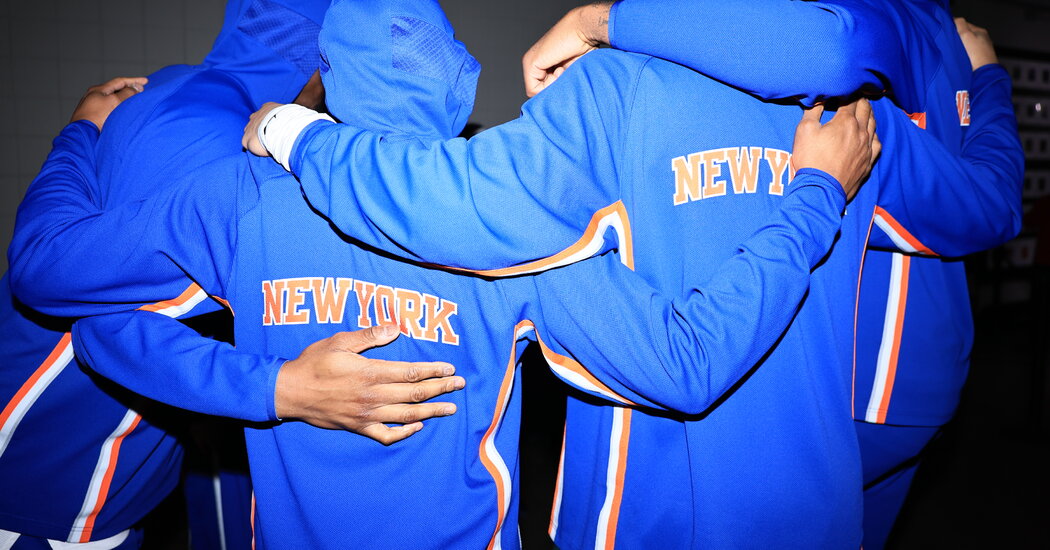
The series, in retrospect, took on the form of an allegory — team versus superstar, underdog versus top dog, band of brothers versus young guns. Three of New York’s starting five had played together in college, at Villanova, before reuniting in New York. Throughout the playoffs, the starters and the bench played as if they were a single human organism.
That harmonious flow produced a transcendent moment in the final game of the first playoff round, against Atlanta, when the team scored 83 points in the first half, and gave up 36. They were also capable of canine ferocity. In the fourth game of the finals, they gave up 76 points in the first half and then only 30 — a number from high-school ball — in the second, coming back from a 29-point deficit to win. Both the means of victory and the author of victory kept changing: Brunson won the finals M.V.P., but earlier in the series the probable candidate was the forward OG Anunoby, and before him, the center Karl-Anthony Towns. What was constant was the alchemy of the team.
Here I must mention a name that has been lost in the euphoria — Tom Thibodeau, the Knicks’ coach for five seasons until he was unceremoniously dumped last year. Thibs is a pudgy basketball lifer from the boondocks of Salem State College who bounced from team to team. He preached defense, self-discipline and relentlessness; the hallmark of his Knicks was never giving up, even when they should have. Thibs’s DNA is in this team. He was the Knicks’ Moses, who could not deliver them to the Promised Land. Coach Mike Brown has proved to be their Joshua. Brown somehow coaxed out of this team a level of play they had never attained in their years under Thibs.
So — improbability, allegory, wonder. But municipal vindication as well. I can tell you, as a fan of over six decades, that New York teams rarely elicit the sense of moral glory that has accompanied the Knicks. Only occasionally, and as if by accident, as with the Knicks of the early 1970s, is the team greater than the sum of its parts. Usually it’s less. This reflects a congenital defect, not in New Yorkers, or at least not only in New Yorkers, but in the megalomaniacs who own some of their teams. As they are superstars in their own minds, so they blindly pursue the superstars of the hardwood and the diamond.
The Yankees of the 1980s kept trading away their gifted young players for over-the-hill sluggers, and losing — until the owner George Steinbrenner was briefly banned from baseball in the early 1990s and his highly capable general manager kept their core together, and fans could rejoice in victory just a few years later. At one point, the Knicks, under their owner, James Dolan, became so dysfunctional that few N.B.A. greats would agree to join the team. Finally Dolan had to defer to the team president, Leon Rose, who assembled this special squad.
