

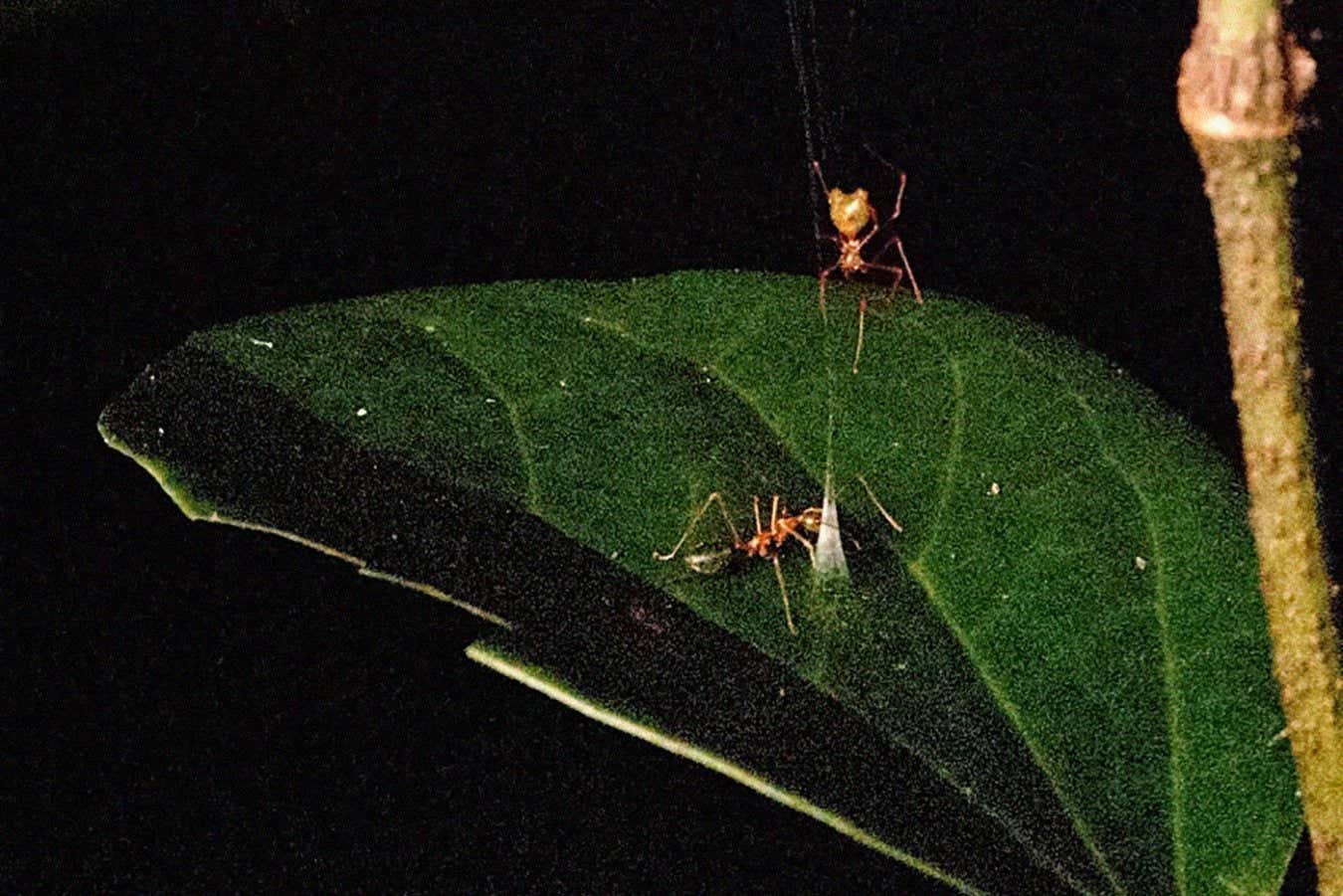
A ballista spider waits for a green tree ant to bite the cone of its web and spring the snare
Professor Ajay Narendra et al. 2026
A newly discovered spider in Australia builds a snare trap designed to catch a single species of ant, which launches the prey into its web with a g-force that would kill a human.
Researchers have measured accelerations of up to 1367 metres per second squared when green tree ants (Oecophylla smaragdina) trigger the web snare trap, equating to 130 times the force of gravity.
“To capture the moment, we had to push the cameras to 5000 to 7000 frames per second, which I honestly have never had to do… when I’ve been filming animals,” says Ajay Narendra at Macquarie University in Sydney.
In 2022, Greg Anderson at QIMR Berghofer Medical Research Institute in Brisbane, Australia, witnessed a green tree ant being catapulted in a spider trap in the far north of Queensland. But without the proper camera equipment, all he was able to observe was the blur of the prey being lifted ballistically by a strange-looking conical web.
Then, in early 2023, Narendra and Pranav Joshi, also at Macquarie University, spent 10 days studying and filming the nocturnal spiders, which do not yet have a scientific name but are in the genus Propostira.
They are nicknamed ballista spiders after a Roman, crossbow-like weapon that could launch large rocks hundreds of metres.
The spiders spend the day hiding on the underside of leaves, then begin building the trap shortly after dusk, a process that can take up to four hours to complete. During this time, the spider sets between 15 and 60 tightly bunched tension lines that are attached to a leaf and form a conical shape.

A fully constructed conical snare of the ballista spider
PRANAV JOSHI
After building the trap, it applies a kind of chemical that triggers the green tree ants, but not any other species, to attack the trap with their mandibles.
“I suspect that there is a lot of stickiness in the silk,” says Narendra. “The mandibles are not able to actually able to open up and let it go and release; they are glued stuck.”
As the ant struggles with the snare, it tries to pull itself free, releasing the trap’s anchor point. At this moment, the tension lines attached to the cone fling the ant nearly 30 centimetres into the air, where it becomes tangled in the spider’s main web.
It is likely that the spiders employ the strategy as a way to lift the prey up off the ants’ path through the forest, avoiding a dangerous counterattack from the colony, says Narendra.
It may seem like a lot of effort to build the trap for each meal, but green tree ants are an extremely reliable source of food, he says. “Whenever the spider needs to eat, it just steps out, builds the web, and it’ll have food coming in.”
Topics:
