

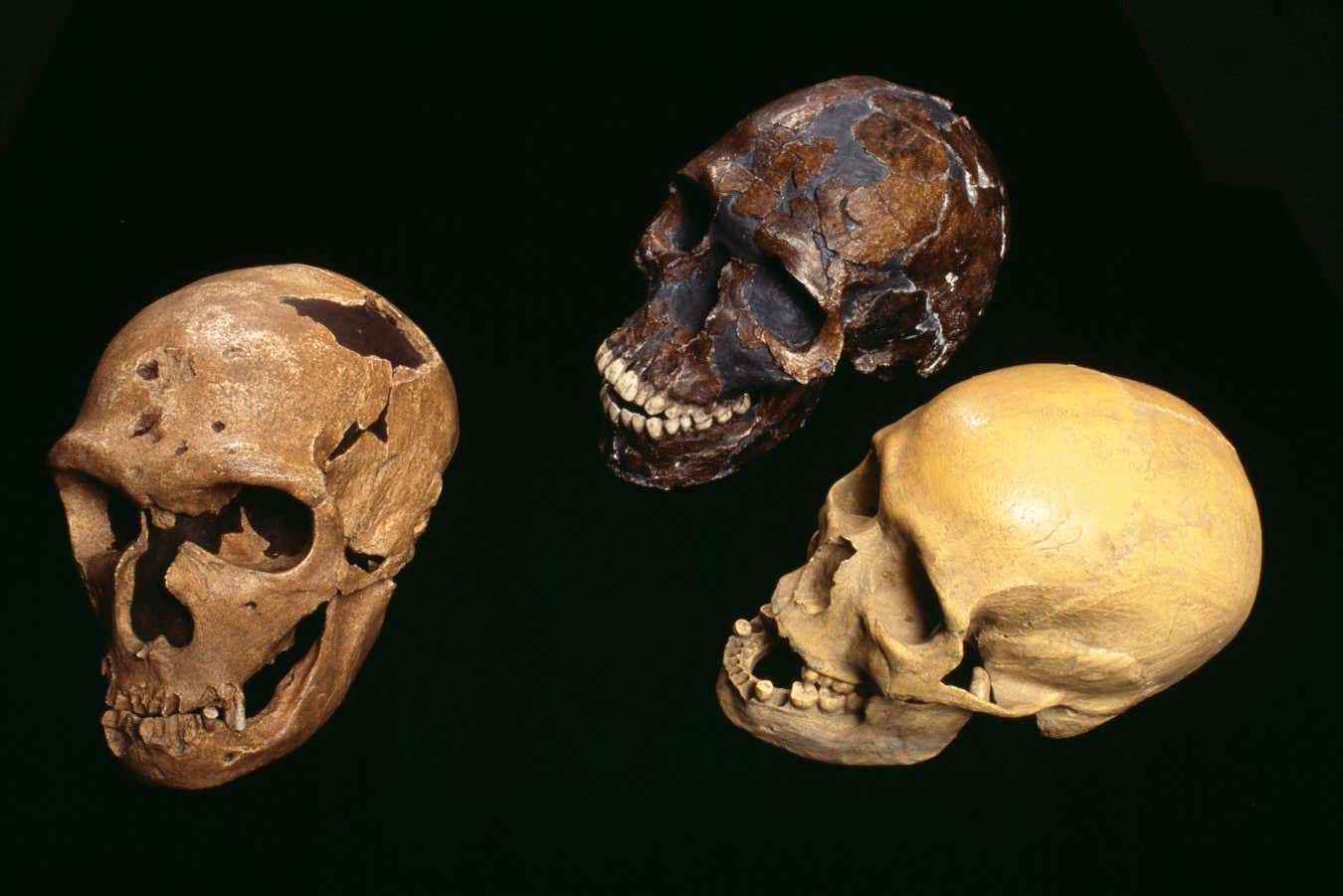
The skulls of Neanderthals (left) and Homo sapiens were larger than those of earlier hominins
PASCAL GOETGHELUCK/SCIENCE PHOTO LIBRARY
Our unusually large brains are one of the defining features of our species. But there is no evidence that evolution strongly favoured big brains in the past 2 million years of human evolution, according to a new analysis of fossil skulls.
“There is indeed an increase in brain size through time, and there is indeed a reduction of facial size with time,” says Katerina Harvati at the University of Tübingen in Germany. However, this doesn’t appear to have been driven by natural selection.
Instead, it seems the evolution of the human brain has been governed by a different evolutionary pressure: one that forced brains to stay the same size. From time to time, this constraint eased for unknown reasons, enabling brains to get larger.
With Mark Hubbe at the University of Tennessee, Knoxville, Harvati studied 87 hominin skulls. Of those, 24 belonged to recent members of our species (Homo sapiens), while the remainder were from extinct human species including Neanderthals (Homo neanderthalensis), Homo erectus and Homo habilis. For each skull, they gathered data on its shape and size, focusing on the braincase and the face.
Between 2 million years ago and the present day, human braincases became much bigger, making room for larger brains. At the same time, human faces became flatter, with less protruding jaws and smaller brow ridges above the eyes.
“The hypothesis has very often been that there’s selection that is driven by increased cognitive abilities,” says Harvati. The idea is that being clever is advantageous for humans, so natural selection favoured the intelligent and our ancestors gradually acquired ever-larger brains as a result.
To find out if this is really what happened, Harvati and Hubbe used a mathematical model to test six different evolutionary scenarios to see which one best described the changing shapes and sizes of the skulls. In one, there was a gradual pressure from natural selection for brains to get bigger. Another “neutral” scenario had the skulls changing more or less at random. Three scenarios had the skulls hovering around an optimum design, with constraints of varying strength that limited their freedom to change. The final scenario was “punctuated equilibrium”, in which there were long periods when evolution favoured no change, interspersed with brief periods when it favoured rapid change.
The changes in size and shape of the braincase were best explained by neutral evolution. This means random mutations affected the size and shape and changes accumulated over time, without the new braincase designs ever being advantageous compared with the old ones. There was also evidence of stasis: evolution pressuring the braincase to stay roughly the same shape and size.
Human faces changed in similar ways, except that the evolutionary pressure to stay the same seems to have been more intense.
The study really drills into the mechanisms by which evolution has shaped our bodies, says Amélie Beaudet at the French National Centre for Scientific Research in Poitiers. “That’s exactly what we need now.”
Because the study uses skulls, it can only tell us about the overall size and shape of the brain, and this is only part of the story, says Beaudet. “It’s not only brain size; it’s also probably reorganisation of the brain.” She studies the imprints brains leave within skulls, which suggest that some key regions – like Broca’s area, known to be involved in language – have changed significantly over the past 2 million years.
The sample size is too small to draw firm conclusions, says Gerhard Weber at the University of Vienna in Austria. Nevertheless, he suspects Harvati and Hubbe are right that evolution often drove our ancestors’ brains to stay roughly the same size. “We are social animals,” he says. That means even prehistoric societies probably had some division of labour, with people focusing on hunting or cooking or other tasks depending on their talents and inclinations. Being exceptionally intelligent may not have been especially advantageous in such a culture.
Weber is intrigued by the idea that our brains grew not because natural selection encouraged it, but because constraints were released. “That is an interesting thought,” he says.
Learning to cook food might have been a key shift, says Harvati. The brain takes a lot of energy to run and cooked food has more calories than raw food, so the invention of cooking may have provided the calorie boost needed to power larger brains.
Topics:
