

Indian authorities are investigating whether a film based on a separatist insurgency in India’s Punjab state in the 1980s and early 1990s is fit for viewers.
Satluj, as the film is titled after a river in Punjab, claims to tell the true story of Jaswant Singh Khalra, a human rights activist who was tortured and killed by the police in 1995 for investigating thousands of disappearances and extrajudicial killings during a brutal government crackdown on the separatist movement.
Recommended Stories
list of 4 itemsend of list
Originally titled Punjab 95, the film was blocked by India’s censor board for three years. The board ordered a change in the film’s name and demanded nearly 130 cuts before allowing a theatrical release.
The filmmakers refused the cuts and instead released Satluj on the ZEE5 streaming platform on July 3, only for it to be removed 48 hours later on security grounds.
Here’s a look at the controversy.
What is Satluj about?
Written and directed by Honey Trehan, the 163-minute biopic is based on the life – and killing – of Khalra, a bank employee in Punjab’s city of Amritsar, who begins to investigate the disappearance of a friend and the friend’s mother, and ends up finding thousands of similar cases.
The disappearances – and presumed killings – were part of a larger crackdown by Indian security forces to crush a separatist movement that aimed to establish Khalistan, an independent, sovereign state for Sikhs in Punjab.
Khalra’s investigation alleged that police secretly cremated nearly 25,000 disappeared people without informing their families or maintaining official records.
He continued his investigations despite threats and warnings, until he was picked up from outside his home on September 6, 1995. He was presumed to be murdered, though his body was never found. He was 42.
After Khalra’s custodial murder, his wife, Paramjit, campaigned for justice, forcing the government to order an investigation by India’s Central Bureau of Investigation (CBI) into the allegations. Five police officials are serving life in prison for Khalra’s killing.
Diljit Dosanjh, one of India’s biggest film stars, plays Khalra. The film is narrated by the actor playing the police officer who led the CBI probe.
The movie has received rave reviews, with critics touting it as one of the most powerful films made in India in recent years.
What is Khalistan and what happened in Punjab?
The Khalistan rebellion was one of independent India’s bloodiest internal conflicts during the 1980s and early 1990s.
The separatist movement was rooted in long-running political and religious grievances over Sikh identity, demands for greater state autonomy, disputes over sharing river water with other states, and excessive federal control over the western state bordering Pakistan.
Armed Sikh fighters carried out bombings, targeted killings, and assassinations, as the police and paramilitary forces launched a sweeping operation to crack down on those involved in the movement. According to human rights groups, the operation included torture, extrajudicial and custodial killings, enforced disappearances, and secret cremations.
In the summer of 1984, Indian troops stormed the Golden Temple in Amritsar, Sikhism’s holiest site, which was occupied by separatist fighters at the time. Operation Blue Star, as it was called, left hundreds dead.

Later that year, Indian Prime Minister Indira Gandhi was shot dead by her Sikh bodyguards, who held her responsible for the Golden Temple bloodshed. Gandhi’s assassination triggered anti-Sikh riots, with thousands of Sikhs killed in Punjab and the Indian capital, New Delhi, in what Sikh groups have described as a genocide.
Sikh fighters responded by killing General Arun Kumar Vaidya, the army chief who had overseen the storming of the Golden Temple, in 1986. They also killed members of parliament, whom they believed to be behind the anti-Sikh violence in the middle 1980s.
In 1994, the fighters killed the then-Punjab governor, Surendar Nath, and state Chief Minister Beant Singh the next year.
Violence largely subsided in the mid-90s, but several Sikh groups in India and abroad are still accused by India of separatist tendencies.
Who was Jaswant Singh Khalra?
The story of Khalra, the human rights activist, sits in the middle of the violence and chaos in Punjab in the 1980s and the 1990s.
He investigated municipal cremation records and alleged that police had secretly mass cremated nearly 25,000 unidentified bodies, an extrapolation from his research, without informing families or conducting proper legal procedures.
“Khalra was not a trained human rights activist. He was just a guy who got into activism because he saw something wrong happening in front of his eyes,” Jupinderjit Singh, an author from Punjab who has written on the violence in the state, told Al Jazeera.
“It was a natural resistance against oppression, and Khalra became a symbol of that,” he added.
“And the impact of the film is huge; it has shaken Punjab to the core and reopened wounds that the government thought were done,” added Singh, who saw the film last year in a private screening.
“The police’s image has taken a big hit.”
Why is the government blocking the film?
Although the Punjab rebellion was crushed, and support for Khalistan waned in the state, the Indian government continues to view separatist sentiments as a national security issue.
It has not publicly explained why the film was removed, but officials have told local media that they ordered it taken down over security concerns.
A report by the Press Trust of India news agency this week said the government has also constituted a committee to examine why the film’s ban on the ZEE5 streaming platform should continue. According to media reports citing sources, the committee has upheld the ban and has concluded that the film “goes against India’s sovereignty”.
In a statement, ZEE5 said the film would not be available in India “until further notice” because of “current developments”, without explaining or specifying them. It added that it would explore “every appropriate avenue through due process” to restore it.
Actor Dosanjh held a live session on Instagram after the film was removed from ZEE5 and told his fans that his worst fears had come to be true.
Dosanjh appeared disillusioned by the years-long obstacles the film had faced. But he said he also found solace in the fact that it is now being viewed at community screenings across the country, as well as being downloaded and widely shared.
“Nothing can stop the film now,” he said.

India’s film industry has come under increasing pressure since Hindu nationalist Prime Minister Narendra Modi came to power.
Critics say his government has been patronising far-right “propaganda” films, making them tax-free, while censoring and even banning independent movies that challenge and question the state.
How are people viewing a banned film?
Social media users are uploading the movie onto YouTube and other platforms in defiance of the government ban. One link goes down, another pops up within minutes.
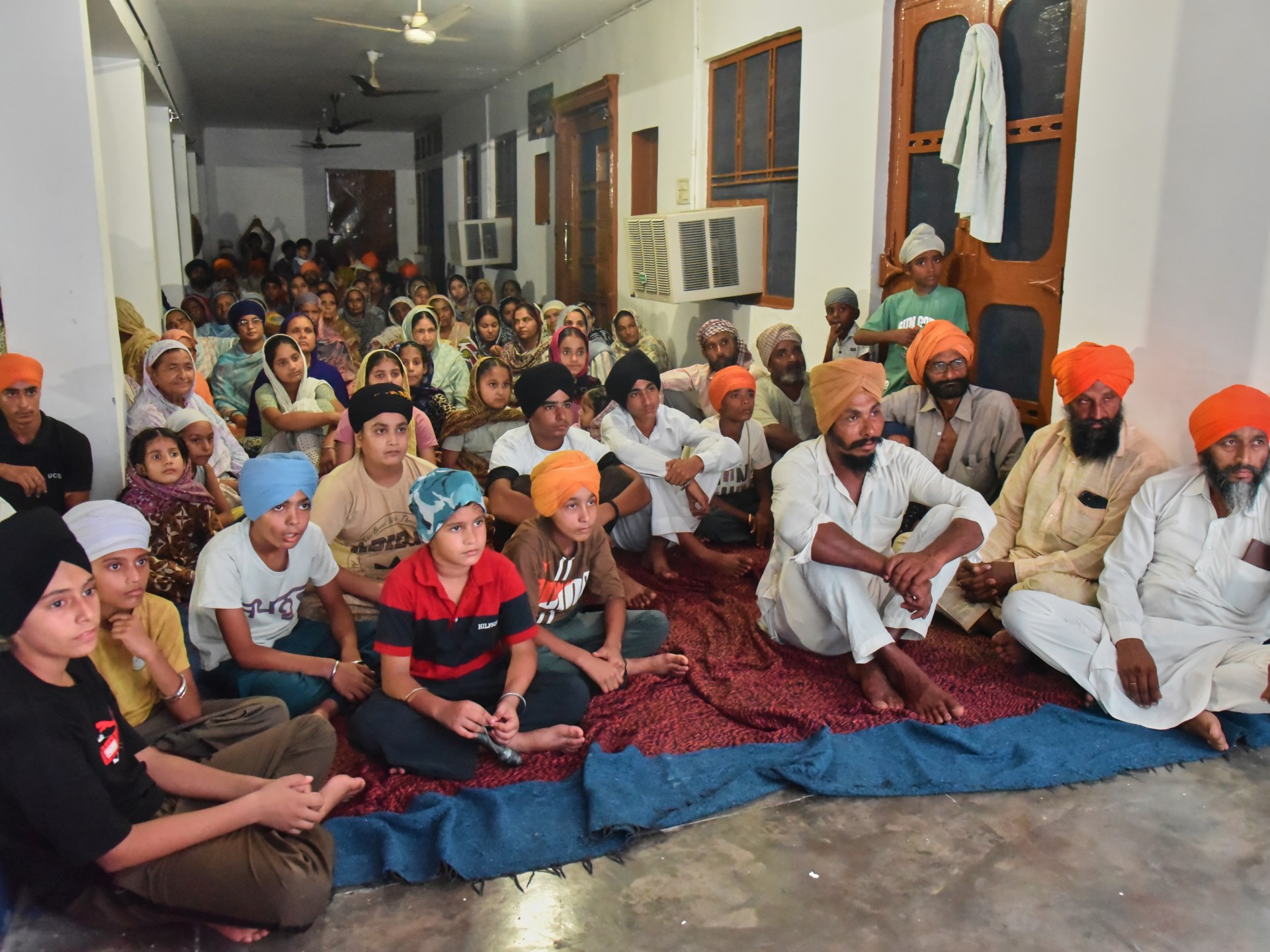
Across Punjab and other parts of India, Sikh groups and activists have also converted Sikh temple compounds and village halls into makeshift cinemas to organise community screenings of Satluj.
The community screenings are free of charge, with locals bringing homemade buttermilk and distributing cold drinks and snacks.
At one such screening in Punjab’s Gurdaspur district, Inderpal Bains told Al Jazeera he was able to watch the film after a long wait. To him, the biopic is “a horror show of reality”.
“This film talks about our pain and the dark tales our parents and grandparents lived through in Punjab,” he said. “The government is yet again burying the evidence of our sufferings.”
Similar screenings have also been reported from Sikh diaspora groups in London, New York, and Toronto.
“No generation should forget its history, no matter how painful it is,” Bains said. “What remains of us if we don’t know how we reached here?”
