

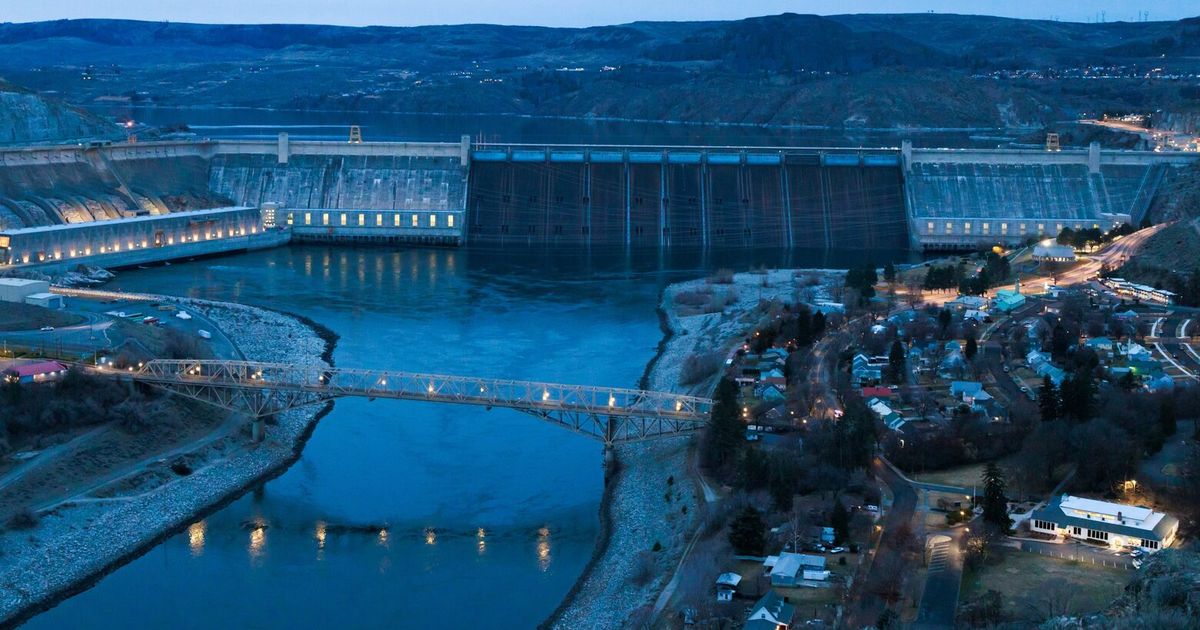
I moved through the Seattle Art Museum’s “Beyond Mysticism” exhibition the way you move through a party, trying to get back to that one person. At last, I circled back to Z. Vanessa Helder’s watercolors of Grand Coulee Dam. It wasn’t that I loved them. Something felt unresolved. The colors were the ones I’d loved since middle school — taupe and rust and rose. That seemed like the problem. They were too perfect. A placard informed me Helder used precisionist techniques, rare in watercolor and guided by what to leave out of a landscape.
The paintings made me think of my grandmother, who had introduced me to the dam as a child. She had always noticed infrastructure before scenery. I felt an itch to see it again.
I arrived at the dam in time for the 11 a.m. tour, during which the Bureau of Reclamation guide described the Grand Coulee’s construction entirely in the first-person plural. As in: We decided to build the largest structure known to mankind. We found the engineers. We knew the river’s potential. This located all of us inside a story of American ingenuity, man triumphing over nature. And yet, I wondered who the “we” really was.
Down the road, at the Colville Tribal Museum, the language changed from “we” to something quieter. It changed to stories about “our people,” a boundary that needed someone on the inside to explain. Photographs showed what the dam had done to the Colville Confederated Tribes. It took the salmon, flooded the community of Kettle Falls and forced relocation. More than 10,000 tribal people gathered for the Ceremony of Tears to say goodbye to a way of life built on the river. Helder painted Kettle Falls twice. Her painting “Pool Below Kettle Falls” (1939-1941) was the one I had stood before the longest, of pure blue water pooling, yet still so that it functioned as a mirror of sky and land. I stood there long enough to notice what wasn’t there. Not a whisper of a fish, not even a shadow. At the time I wondered if it had been an accidental omission. Now I think this might have been Helder’s point.
The dam’s history runs alongside the same era’s boarding schools and allotment policies, a project of assimilation carried out through policy and law at the same time the largest concrete structure in the world was created and celebrated.
I am thinking about that “we” again, now in a different context. I work at the University of Washington Graduate School, where AI proposals arrive fast and are discussed in terms from the past, described as another gold rush or land grab. Washington is now among the Top 10 states for data centers, most located east of the mountains along the Columbia. Researchers at UW’s College of Engineering recently found the river runs warmer near them. How will this change a river that has already powered so much: aluminum, wartime production, electrification, and now powers portions of the cloud? Some of the clearest thinking about what we owe that river is happening in city council chambers and utility commission meetings where citizens show up to argue that inheriting infrastructure means inheriting responsibility.
Grand Coulee Dam was named an official site of America’s 250th anniversary and hosted a three-day festival. That feels like an opportunity. We can tell the story we’ve always told about American ingenuity, a mighty river bent to human will. American technological imagination has never lacked confidence. Or we can tell a fuller story, one that acknowledges the extraordinary power the dam generates and our responsibilities as we continue to ask the river for more.
Grand Coulee is more than a monument to the past. It is an archive of the choices that built the modern Northwest, and of the costs those choices imposed. Each generation inherits this archive and decides what to do with it. It is our time to decide.
