

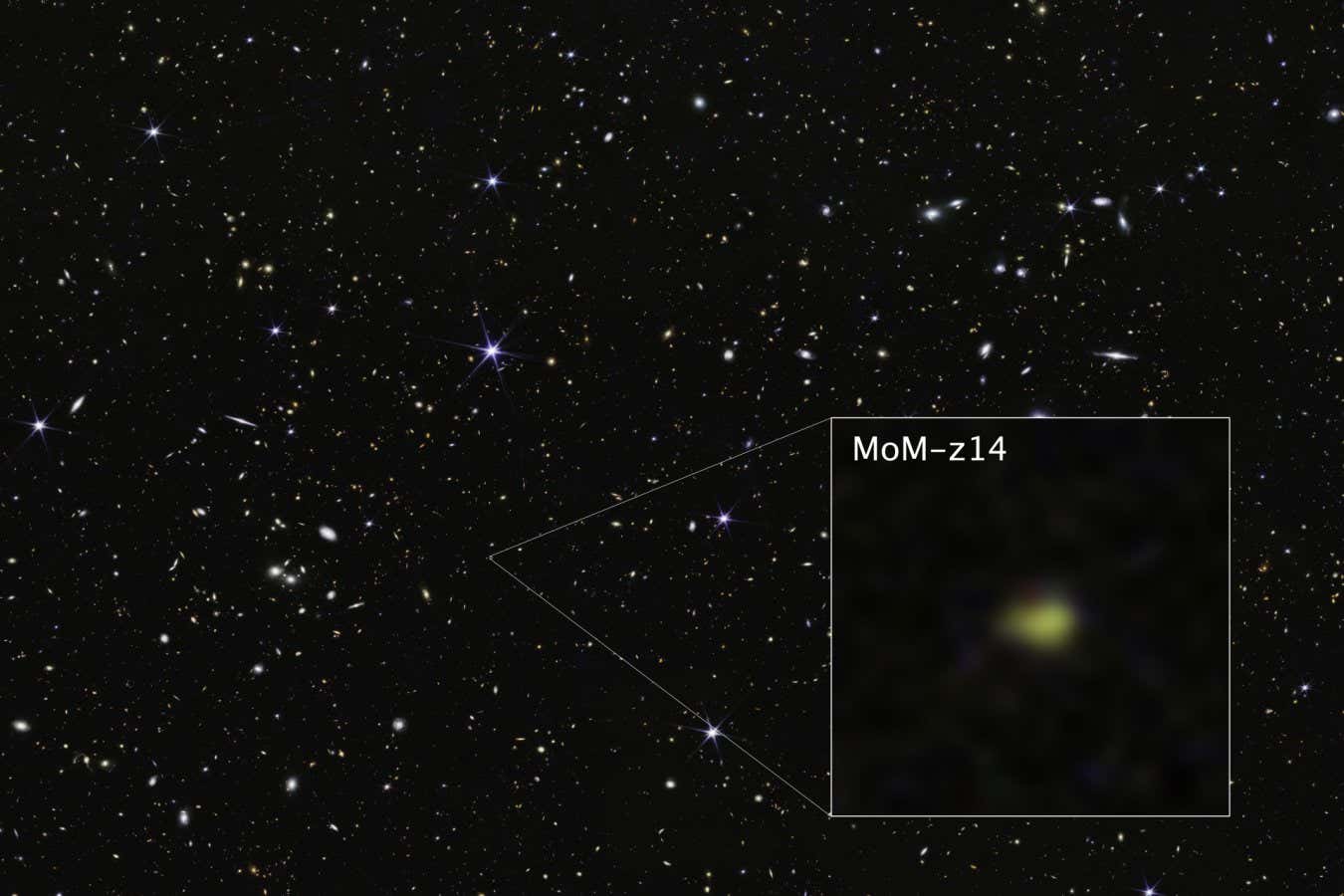
The galaxy MoM-z14 was called a “cosmic miracle” by its discoverers
NASA, ESA, CSA, STScI, R. Naidu (MIT), J. DePasquale
I’m certain scientists before me have thought this about their own era, but nonetheless, I think we are living in a wildly exciting time for galaxy research. Though US and UK research budgets might be doing the opposite, our understanding of the universe is rapidly expanding. In just the few years since its launch on Christmas 2021, the James Webb Space Telescope or, as I prefer to call it, the Just Wonderful Space Telescope (JWST) has transformed our understanding of what galaxies looked like in the early universe. It turns out they were brighter – more full of stars and hot gas – than our standard cosmological picture had previously accounted for.
These observations by JWST are incredibly exciting. We are seeing galaxies that existed only 300 million years after the big bang. Of course, this sounds like a very long time. But compared with the age of the universe – which is a little under 14 billion years old – 300 million is the universe’s baby era. I’m 43, and the same percentage (about 2.14 per cent) of my life is when I was less than a year old.
Rohan P. Naidu at the Massachusetts Institute of Technology led a global team of researchers that discovered one such galaxy last year and dubbed it MoM-z14. The team’s paper refers to MoM as a “cosmic miracle” – brighter than we might have expected a galaxy could possibly be at such an early stage in the evolution of the cosmos. The reason observations like this are only happening for the first time is that we didn’t previously have a telescope with the ability to see objects that were so faint – given how far they are from us. It feels a little bit weird to say that this very faint thing is unexpectedly bright, but that’s the business of astronomy. It is extremely dim for a normal telescope, but compared with theoretical predictions, it is emitting more light than expected.
While the luminous nature of these galaxies makes them scientifically tantalising, their absolute faintness makes them a kind of technical challenge. We must ask ourselves whether we are certain the object being imaged is in fact a galaxy. This past April, Maruša Bradač at the University of California, Davis and a global team of collaborators dug into the data and concluded that two of JWST’s young bright galaxies weren’t galaxies at all! The objects, the team claims in a paper that hasn’t yet been peer-reviewed, are actually brown dwarfs in the Milky Way: star-ish objects inside our own galaxy, rather than galaxies that are far, far away.
I was completely taken aback when I saw this paper because if you asked me what’s the opposite of a galaxy, a brown dwarf would be a good candidate. Too big to be a gas-giant planet like Jupiter, but too small to sustain stellar fusion – a brown dwarf is something that could plausibly fit into a solar system. In other words, brown dwarfs are small and compact compared with the expanse that is a galaxy filled with billions of stars. Only time will tell whether Bradač’s team is right and whether other old galaxy observations are actually a case of mistaken identity.
But we’re well-equipped to find out. My prediction is that 2026 will be remembered as a landmark year for astronomy. Despite attempts by governments to crush research, this year the Vera C. Rubin Observatory in Chile will begin its 10-year Legacy Survey of Space and Time, which will create a detailed map of the southern-hemisphere sky and images of over 5 billion galaxies. Rubin will not only operate simultaneously with JWST, but also with NASA’s next flagship observatory, the Nancy Grace Roman Space Telescope. Roman, which complements the European Space Agency’s currently flying Euclid mission, will image hundreds of millions of galaxies. Together, JWST, Rubin, Roman and Euclid may change everything we know about how a place like our home galaxy, the Milky Way, came to exist.
Topics:
