

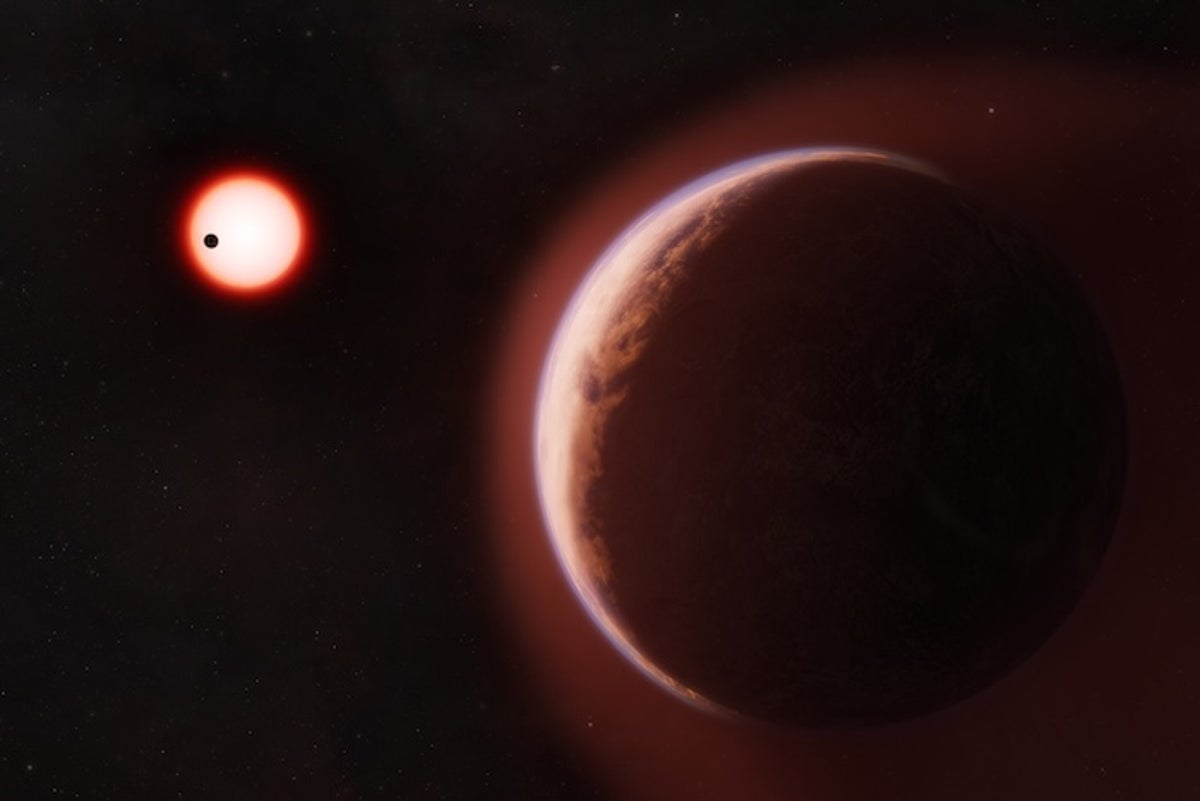
A rocky planet that’s the right distance from its star to be hospitable to life likely has an atmosphere, a new study claims.
The exoplanet, known as LHS 1140 b, is about 49 light-years away from Earth, which means it is a relatively close neighbor, given that the Milky Way is more than 100,000 light-years across. The world was found in 2017 and was even then considered to be a prime candidate in the search for planets that could host life. Now researchers have announced the discovery of helium leaking from LHS 1140 b into space, and that only makes the possibility that life could exist on the planet more likely, says Collin Cherubim, a postdoctoral fellow at Harvard University.
Cherubim is lead author of the study detailing the new findings, which was published in Science on Thursday. He points out that LHS 1140 b meets the big three criteria for being habitable: it’s rocky, it has the right temperature to support liquid water and now there’s proof that it has an atmosphere.
On supporting science journalism
If you’re enjoying this article, consider supporting our award-winning journalism by subscribing. By purchasing a subscription you are helping to ensure the future of impactful stories about the discoveries and ideas shaping our world today.
“This is the only planet that we know has all three of those things, and it happens to be relatively nearby,” he says. “Another huge thing, which is really, really awesome, is that it happens to be orbiting a relatively quiet star,” one that isn’t prone to battering the exoplanet with coronal mass ejections and other catastrophic eruptions.
Signs of atmospheres have been detected on other rocky exoplanets, but those discoveries have been relatively rare and not completely definitive, given there are likely millions, if not billions, of such planets in the Milky Way.
The presence of atmosphere is considered essential to a planet’s ability to host life because of both what it can keep in and what it can keep out. While shielding a planet’s surface from radiation, an atmosphere can also keep water on that surface. That makes the detection of helium escaping from LHS 1140 b “a milestone,” says Laura Kreidberg, an astronomer at the Max Planck Institute for Astronomy in Heidelberg, Germany, who wasn’t involved in the new study.
Cherubim had theorized that some small, rocky planets like LHS 1140 b could develop atmospheres with large amounts of helium over time. To test this, he made a list of all the known planets that fit certain criteria for mass, radius and temperature.
“LHS 1140 b was one of the relatively higher-probability predictions, and it just so happened to be the subject of lots of scrutiny because it’s this really exciting, rocky planet that’s near Earth, that’s in the habitable zone,” he says. “I thought it was a good place to start.”
Using an infrared spectrograph mounted on the Magellan Clay Telescope at the Las Campanas Observatory, Cherubim and colleagues looked for wavelengths of light that would indicate absorption of stellar radiation by helium. The helium is important. While it’s one of the most common elements in the universe, smaller planets with thin atmospheres, such as Mars, have a hard time retaining it because it’s so light that it drifts away, leaving only heavier gases such as carbon dioxide. If LHS 1140 b had helium escaping into space, that would imply the presence of a thicker, multilayered atmosphere, likely with water trapped lower down, close to the surface.
As the data came in and was analyzed, it became apparent to Cherubim that helium was, in fact, being heated up from stellar x-rays and leaking into space.
There was one surprise: while the helium showed up in 2024, when Cherubim used the telescope to examine exoplanet again in 2025, it was gone.
“That was a pretty shocking finding,” he says. “It did cause me to go back to the original data in 2024 and say, ‘Oh, my gosh, did I miss something?’”
The lack of helium in 2025 is the “one tummy rumble that I have” regarding the study, Kreidberg says. “It would have been better if they confirmed it. But at the same time, this type of variability is not crazy. They’re going to follow it up, and I hope they see it again, and I think they will. I think it would be hard to explain this any other way.”
There are a few possible reasons for the divergent observations, including the atmosphere responding to different temperature levels during its orbit or magnetic activity shifting in the exoplanet’s star. The most likely explanation, Cherubim says, is that helium is only detectable at such distances when it’s in an excited state.
“It could be possible, in 2025, just as much helium was escaping, and we just didn’t see any of it because … the amount that was populated into this excited state was different,” he says.
The presence of escaping helium goes against some previously held orthodoxies within the astronomy community, Kreidberg says. The community had largely believed a planet of LHS 1140 b’s size and age would have long ago lost any helium it might have ever had. The planet may be in a transition period in which, as it loses helium to space over time, it is shrinking from its current sub-Neptune size to something that could more closely resemble Earth.
“I think it is very possible that what we’re seeing is a snapshot of this evolution from the smallest gas giant to the biggest rocky planet,” Kreidberg says.
The exoplanet is slated to be among those examined as part of the Rocky Worlds Director’s Discretionary Time program, which is using the James Webb Space Telescope and Hubble Space Telescope to search for evidence of atmospheres on rocky planets. While that could answer the many open questions about LHS 1140 b’s atmosphere, Cherubim still gets some bragging rights.
“This planet is one of the targets in their small sample of rocky worlds, where they’re looking for an atmosphere that they consider to be the most promising,” he says. “Well, they considered it. I kind of beat them to the punch and answered the question already.”
