

My name is Engineer Bainomugisha. Yes, Engineer is my first name and also my career. My parents named me Engineer, and they recognized engineering traits in me from childhood, such as perseverance, resilience, and wanting to understand how things work.
I grew up and spent my early years in a rural part of Uganda, more than 300 kilometers outside of Kampala, the capital city. As a young boy, I was always tinkering and hustling: I harvested old radio batteries to power lighting, created household utensils from wood, and herded animals and sold items to help the village make money.
In high school, I studied physics, chemistry, maths, and biology. When I started studying at Makerere University, in Kampala, I joined the computer science program. This was in 2003. I had never interfaced with a computer before, and this was true for many of my classmates. The limited number of computers meant that student Internet cafés were common, requiring one to pay 500 Ugandan shillings (US $0.14) for 30 minutes. Access to programmable hardware was limited, with no access to microcontrollers or hardware manufacturing.
Once I got the basic introduction to computer science, I was eager to build things with what was available to solve problems for the people around me. At the time, phones were very limited, and it was expensive to make calls, so SMS text messages were very popular. Students, the majority of whom didn’t own phones, needed some way to send texts without one. In my first year, I built a free Web-based SMS platform that allowed people to send messages easily. It quickly gained popularity among university students—a good outcome for my first “product.”
After I graduated in 2006 with a bachelor’s degree in computer science, Professor Venansius Baryamureeba, then the dean of the faculty of computing and information technology at Makerere, inspired me to apply for graduate school in Belgium. I received a scholarship to pursue a master’s degree at Vrije Universiteit Brussel (Free University of Brussels).
There, I encountered Arduino microcontroller boards for the first time. I witnessed undergraduate students using Arduino boards and sensors to implement embedded-systems projects, such as autonomous devices that could detect, identify, sense, and control their surroundings. I wondered how long it would take for universities in Africa to gain access to such hardware. After all, Arduino’s motto is “Empowering anyone to innovate,” but unfortunately, that empowerment had yet to reach sub-Saharan Africa.
Fast forward to today, and the situation has drastically changed. Laptops are now widely available in Africa, Internet connectivity is faster, and smartphones and mobile Internet are common among computer science faculty and students. But the lag between the launch of a technology and its availability in Africa remains significant, as Oluwatosin Kolade’s story illustrates [see “Lessons from a Janky Drone,”].
Africa has immense potential for computer science and electronics engineering to address a wide range of challenges. Existing software solutions may be insufficient, and the public digital infrastructure may be lacking, so projects at the intersection of hardware and software could fill critical gaps. However, it is crucial for students to get better learning opportunities to interact with and build physical systems. There is a wide range of exciting applications in agriculture, transportation, education, and environmental monitoring, which is likely why Kolade’s engineering professor encouraged his team’s surveillance drone project despite the difficulties they encountered.
Access to Hardware Remains a Bottleneck
While the bottlenecks in hardware access for students and researchers in Africa have eased since my time as a student, obstacles persist. As Kolade attests, significant challenges exist in both scholastic funding and the supply chain. This hampers learning and places a large financial burden on young people. As Kolade explains, students must fund their undergraduate projects out of their own pockets, creating significant barriers for people with limited financial resources.
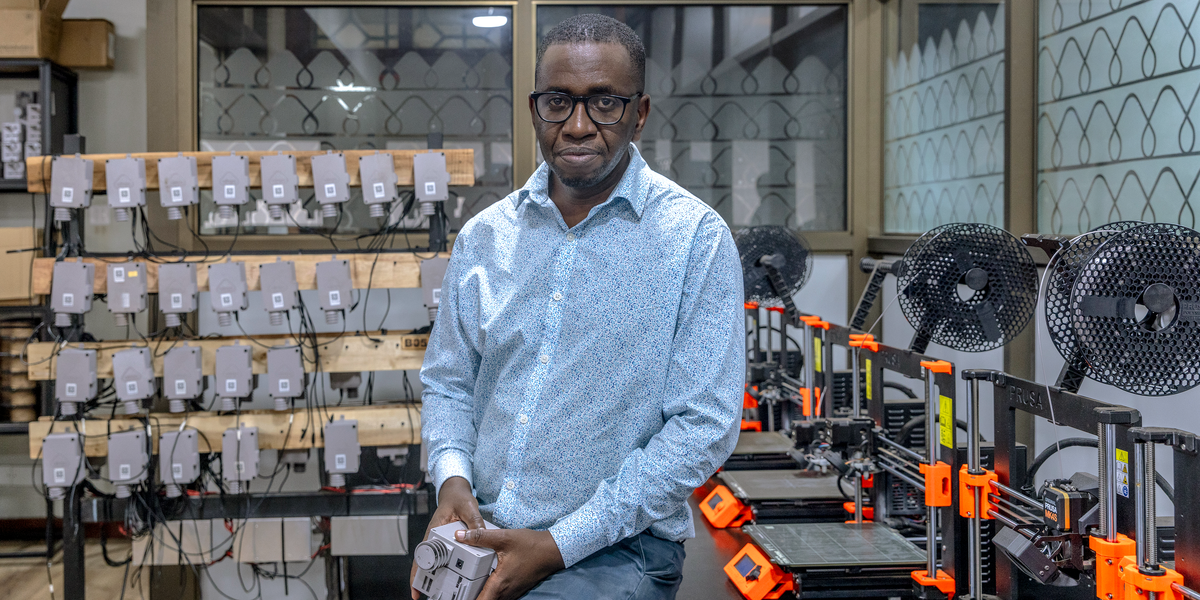
The AirQo project [circuit boards shown here] gives students access to 3D printers, soldering stations, and basic sensor boards and components.Andrew Esiebo
Electronics components must often be sourced from outside the continent, primarily from China, Europe, or the United States. While the number of online stores has increased, the time span from order to delivery can be several months. It is not uncommon for affordable shipping options to require 60 days or more, while faster delivery options can be several times more expensive than the hardware itself. Online shopping, while often necessary, presents an unavoidable complexity for students and faculty, especially if they have limited access to credit and debit cards. By contrast, students in Europe can receive their components within a week, allowing them to complete a hardware project and initiate new iterations before their counterparts in Africa even receive their hardware for initial building. What’s more, some vendors may choose not to ship to addresses in Africa due to transit risks coupled with real or perceived customs complexities.
Customs and tax clearance procedures can indeed be burdensome, with import duties of up to 75 percent in some countries. While some countries in the region offer tax exemptions for educational resources, such exemptions are often difficult to obtain for individual components, or the procedures are unclear and cumbersome. Local vendors, mostly startups and tech hubs, are emerging, but they often lack sufficient stock and may not be able to fulfill bulk orders from educational institutions.
Hardware Access Can Accelerate Education
In light of these challenges, universities and students might be tempted to shift their focus to purely software projects or otherwise alter their priorities. However, this limits both education and innovation. Engineering projects that involve both hardware and software awaken students’ creativity and foster in-depth skills acquisition.
Africa must seek viable solutions. University programs should increase their support of students by providing access to specialized makerspaces and fabrication hubs equipped with the necessary hardware and electronic components. The emergence of high-end makerspaces is encouraging, but the focus should be on providing essential components, such as sensors. Students can learn only so much in makerspaces that have 3D printers but no 3D-printing filament, or printed circuit board fabrication and assembly but no sensor components.
Community groups and workshops focused on hardware projects can help address the accessibility challenges. These communities could tap into the global open-source hardware groups for education and research. Data Science Africa, a nonprofit that trains Africans in data science and machine learning, has run hardware sessions that could potentially be scaled to reach many more students. The emergence of research teams working on large-scale projects involving the development and deployment of hardware systems also presents opportunities for students and staff to access facilities and prototype quickly. Showcasing hardware projects from the continent and sharing lessons learned, successful or not, can inspire new projects. For example, at Makerere University—where I am now a computer science professor and the department chair—the AirQo project, which focuses on environmental sensing, provides access to key equipment, including 3D printers, soldering stations, and basic sensor boards and other electronic components.
Despite the persistent challenges of supply-chain delays, import duties, and limited local vendors that continue to hamper access to hardware across African universities, the continent’s engineering students and educators are finding creative ways to build, innovate, and learn. From my own journey from rural Uganda to pioneering SMS platforms and the emergence of makerspaces and research projects like AirQo, to collaborative communities that connect local innovators with global open-source networks, Africa is steadily closing the technology gap.
The question is no longer whether African students can compete in hardware innovation—it’s how quickly the world will recognize that some of tomorrow’s groundbreaking solutions are already being prototyped in labs from Kampala to Cape Town. They are being built by students like Oluwatosin Kolade, who learned to engineer solutions with whatever he could get his hands on. Imagine what they could do if they had access to the same resources I had in graduate school. African engineering potential is limitless, but to reach our full potential, we need access to technology that is more readily available in much of the world.
From Your Site Articles
Related Articles Around the Web
