

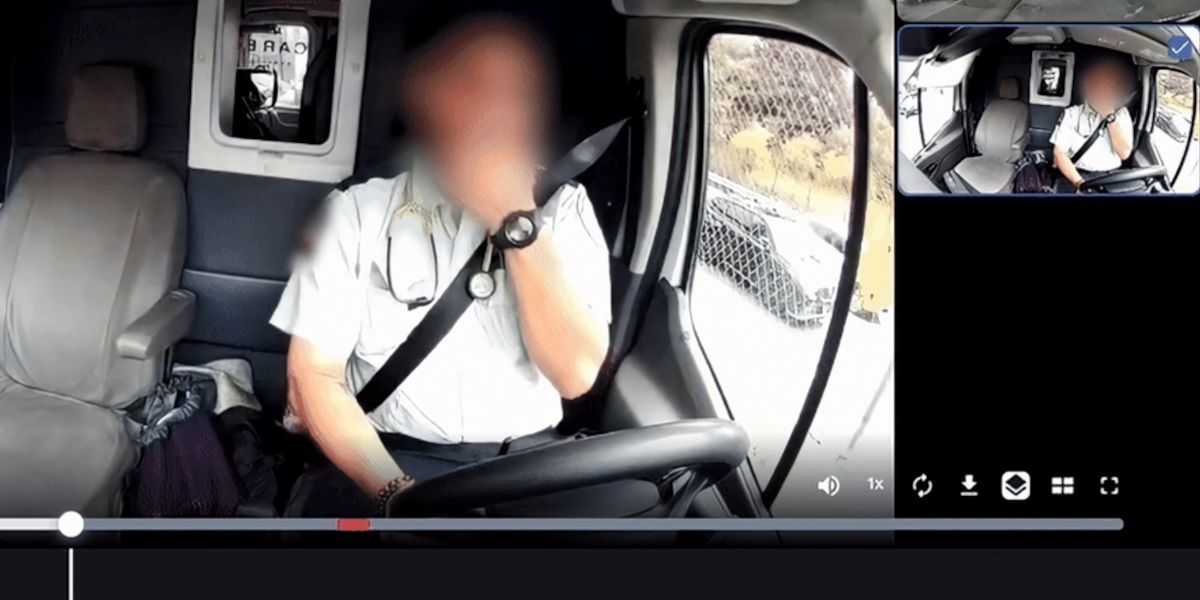
Increasingly, vehicles with advanced driver assistance systems are looking not only at the road but also at the driver. And for good reason. These systems can, paradoxically, make driving less safe as drivers engage in more risky behaviors behind the wheel under the mistaken belief that electronic equipment will compensate for lack of caution.
Attempting to ward off such misuse, automakers have for years used camera-based systems to monitor the driver’s eye movement, posture, breathing, and hand placement for signs of inattention. Those metrics are compared with baseline data gathered during trips with drivers who were fully alert and focused on the road. The point is to make sure that drivers appear alert and ready to take control of the driving task if the suite of electronic sensors and actuators gets overwhelmed or misjudges a situation.
Now, several companies targeting commercial vehicle fleet operators, especially long-haul trucking companies, are introducing AI-enabled dashcam technology that takes driver monitoring a step further. These new dash cams use machine learning to pick up on the subtle behavioral cues that are signs of drowsiness. “Long-haul truckers are particularly at risk of driving drowsy because they often work long hours and drive lengthy routes,” says Evan Welbourne, Vice president for AI and Data at Samsara, which recently introduced its drowsiness detection solution.
The driver monitoring tech developed by Samsara and Motive, both based in and San Francisco, and Nauto, headquartered in nearby Sunnyvale, Calif., deliver real-time audio alerts to a drowsy driver, giving them a prompt to take a break to reduce the risk of a fatigue-related accident. All are configured so that if a dash cam detects that a driver continues to operate the vehicle while displaying signs of drowsiness after the in-cab alert, it can directly contact fleet managers so they can coach the driver and reinforce safety measures.
Each of the systems is trained to pick up on different combinations of signs that a driver is drowsy. For example, Motive’s AI, introduced in July 2024, tracks yawning and head movement. “Excessive” yawning and head posture indicating that the driver’s has taken their gaze away from the roadway for five seconds triggers an alert.
Nauto’s drowsiness detection feature, introduced in November 2021, tracks an individual driver’s behavior over time, tracking yawning and other indicators such as blink duration and frequency and changes in the driver’s overall body posture. Nauto’s AI is trained so that when these signs of drowsiness accumulate to a level associated with unacceptable risk, it issues an alert to the driver.
Samsara’s driver monitoring tech triggers an audio alert to the driver when it detects a combination of more than a dozen drowsiness symptoms, including prolonged eye closure, head nodding, yawning, rubbing eyes, and slouching, which are telltale signs that the driver is dozing off.
Improving Detectors’ Effectiveness
According to the Foundation for Traffic Safety, 17 percent of all fatal crashes involve a drowsy driver. The earliest generation of driver monitoring techaccounted for only one or two signs that a driver might be drifting off to sleep. Driver-monitoring developments such as the Percentage of Eyelid Closure Over Time (PERCLOS) methodology for measuring driver drowsiness, introduced by the U.S. National Highway Traffic Safety Administration (NHTSA) in the mid-1990s, gave system developers a direct physiological indicator to home in on. “But drowsiness is more than a single behavior, like yawning or having your eyes closed,” says Samsara’s Welbourne.
Welbourne notes that the new generation of drowsiness-detection tools are based on the Karolinska Sleepiness Scale (KSS). He explains that “KSS is a nine-point scale for making an assessment based on as many as 17 behaviors including yawning, facial contortions, and sudden jerks” that happen when they are jerking back awake after a brief interval during which they have fallen asleep. “The KSS score accounts for all of them and gives us a quantitative way to assess holistically, Is this person drowsy?”
Stefan Heck, Nauto’s CEO, says his company’s Ai is tuned to intervene at Karolinska Level 6. “We let the very early signs of drowsiness go because people find it annoying if tou alert too much. At Level 1 or 2, a person won’t be aware that they’re drowsy yet, so alerts at those levels would just come across as a nuisance.” By the time their drowsiness reaches Level 5 or 6, Heck says, they’re starting to be dangerous because they exhibit long periods of inattention. “And at that point, they know they’re drowsy, so the alert won’t come as a surprise to them.
Samsara’s Welbourne asserts that his company has good reason to be confident that its AI models are solid and will avoid false positives or false negatives that would diminish the tool’s usefulness to drivers and fleet operators. “Accurate detection is only as good as the data that feeds and trains AI models,” he notes.
With that in mind, the Samsara AI team trained a machine learning model to predict the Karolinska Sleep Score associated with a driver’s behavior using more than 180 billion minutes of video footage (depicting 220 billion miles traveled). The footage came from the dash cams in its customers’ fleet vehicles. A big challenge, Welbourne recalls, was spotting incidences of behaviors linked to drowsiness amid that mountain of data. “It’s kind of rare, so, getting enough examples to train a big model requires poring over an enormous amount of data.” Just as challenging, he says, was creating labels for all that data, “and through several iterations, coming up with a model aligned with the clinical definition of drowsiness.”
That painstaking effort has already begun to pay dividends in the short time since Samsara made the drowsiness-detection feature available in its dash cams this past October. According to Welbourne, Samsara has found that the focus on multiple signs of drowsiness was indeed a good idea. More than three-fourths of the drowsy driving events to which it has been alerted by dash cams since October were detected by behaviors other than yawning alone. And he shares an anecdote about an oilfield services company that uses Samsara dash cams in its vehicles. The firm, which had previously experienced two drowsy driver events a week on average, went the entire first month after drivers started getting drowsiness alerts without any such events occurring.
To drivers concerned that the introduction of this technology foreshadows a further erosion of privacy, Samsara says that its driver-monitoring feature is intended strictly for use within commercial vehicle fleets and that it has no intention of seeking mass adoption in consumer vehicles. Maybe so, but drowsiness detection is already being incorporated as a standard safety feature in a growing number of passenger cars. Automakers such as Ford, Honda, Toyota, and Daimler-Benz have vehicles in their respective lineups that deliver audible and/or visual alert signals encouraging distracted or drowsy drivers to take a break. And it’s possible that government agencies like NHTSA will eventually mandate the technology’s use in all vehicles equipped with ADAS systems that give them Level 2 or Level 3 autonomy.
Those concerns notwithstanding, drowsiness-detection and other driver-monitoring technologies have been generally well received by fleet vehicle drivers so far. Truck drivers are mostly amenable to having dash cams aboard when they’re behind the wheel. When accidents occur, dash cams can exonerate drivers blamed for collisions they didn’t cause, saving them and freight companies a ton of money in liability claims. Now, systems capable of monitoring what’s going on inside the cab will keep the subset of drivers most likely to fall asleep at the wheel—those hauling loads at night, driving after a bout of physical exertion, or affected by an undiagnosed medical condition—from putting themselves and others in danger.
From Your Site Articles
Related Articles Around the Web
