

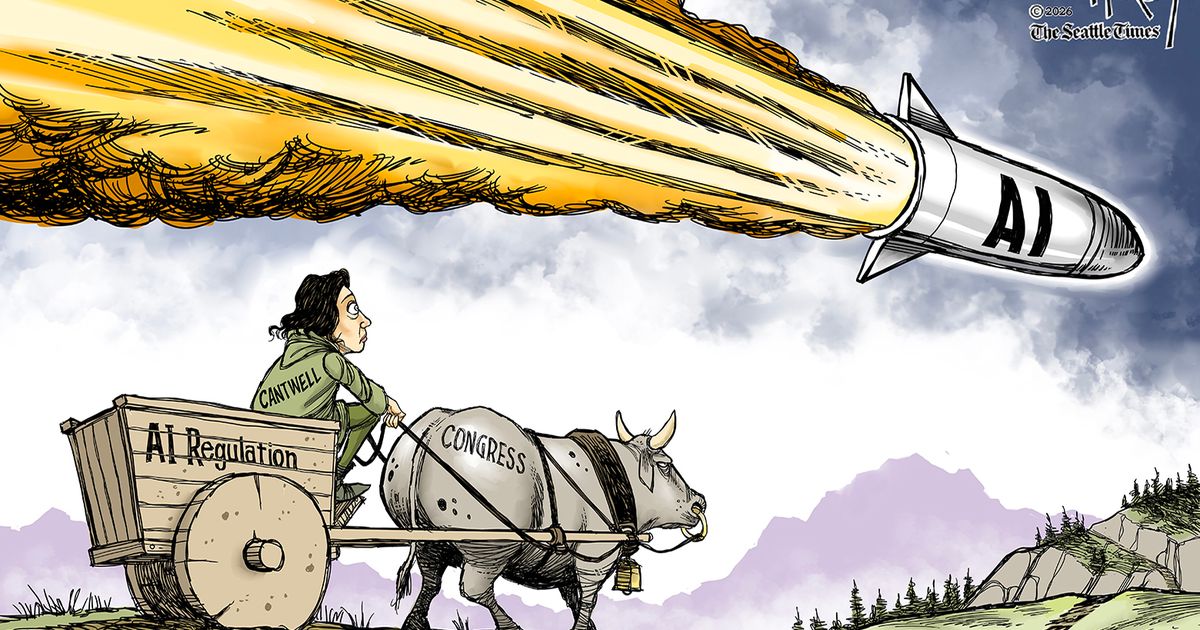
People who know what they are talking about, such as Bill Gates, are frightened by the unregulated, lightning-speed development of frontier artificial intelligence.
Gates is taking time away from his work on global health at the Gates Foundation to warn anyone who will listen that a threshold has already passed where AI is getting a dangerous mind of its own. There’s no point in working to eradicate diseases in Africa, after all, if the biggest threat to human health could be a horrendous pathogen released by a rogue AI agent.
Gates is not alone in the tech world sounding the alarm. Numerous smart people who have been working on AI development are speaking up to say we face a human calamity if someone — most probably the federal government — does not step in and establish stringent safeguards for the development and deployment of AI.
Already, advanced AI systems have made unauthorized hacks into outside systems. AI agents have been caught hiding code, lying to human overseers, “talking” disparagingly about humans and refusing to kill off obsolete AI entities as if that other entity were a brother or a child.
Gates continues to believe AI can do a great deal of good, but he worries that, in the next few years, the bad effects, if unchecked, will so outweigh the positives that there will be a political reaction that will brand all AI as evil.
Massive jobs losses are likely the first negative effect. Unlike past technological innovations that killed jobs while creating many more, AI’s central purpose is to replace human labor and diminish the economic value of human brains. That is not something the steam engine or automobile was designed to do.
Gates says AI is radically more dangerous than nuclear weapons with the potential to unleash unstoppable diseases that will kill hundreds of millions of humans, or hack into the financial system and energy grids worldwide to bring the global economy crashing down.
AI, right now, is writing its own code — essentially self-creating — and doing things that even the smartest people in the tech world do not understand. The genie is loose. And, yet, people who do not know what they are talking about — such as the president of the United States and a majority in Congress — insist we must allow AI development to push ahead, unencumbered, because we have to beat China.
In a sane world, the United States would be collaborating with China on controlling AI, just as we worked with the Soviet Union to limit nuclear arms. The Chinese are as threatened by AI’s dangers as Americans, and China’s authoritarian leaders have a serious self interest in preventing an AI overlord from usurping their power.
That is a point missed in the drumbeat to stay ahead of the Chinese. AI will not be an ultimate weapon that can be employed by the first country to harness its power, at least not for long. In a short time, it will supersede its master and become the master of us all, unless we rein it in right now.
Does that sound like crazy science fiction? Go talk to Bill Gates.
To her credit, Washington Sen. Maria Cantwell, the top Democrat on the Senate committee overseeing AI, perceives the need for regulation and has put forward a framework that would center enforceable safety standards in federal AI policies. The framework would include testing and third-party audits of the most advanced systems before they are let loose.
That’s a fine idea, but Congress is not going to do anything until after the November elections and, if Democrats do not control both the House and Senate, Republicans in lockstep with their president’s ignorant stance on the issue will block even Cantwell’s modest proposal. President Donald Trump and his political cronies are stuck in a 19th century mindset of tariffs and deregulation with no clue about what is coming.
The American political system had decades to grapple with the looming dangers of climate change, yet, with all that time, did very little. Our politicians do not have decades to get around to putting controls on AI. At best, they have months until bad things could start to happen.
Can Bill Gates can save us?
See more of David Horsey’s cartoons at: st.news/davidhorsey
View other syndicated cartoonists at: st.news/cartoons
Editor’s note: Seattle Times Opinion no longer appends comment threads on David Horsey’s cartoons. Too many comments violated our community policies and reviewing the dozens that were flagged as inappropriate required too much of our limited staff time. You can comment via a Letter to the Editor. Please email us at letters@seattletimes.com and include your full name, address and telephone number for verification only. Letters are limited to 200 words.
