
Close Menu
    National News Brief
    Saturday, July 18
    • Home
    • Business
    • Lifestyle
    • Science
    • Technology
    • International
    • Arts & Entertainment
    • Sports
    National News Brief
    Home » Almost the whole of Japan moved eastward after 2011 earthquake

    Almost the whole of Japan moved eastward after 2011 earthquake

    Team_NationalNewsBriefBy Team_NationalNewsBriefJuly 5, 2026 Science No Comments3 Mins Read
    Share
    Facebook Twitter LinkedIn Pinterest Email


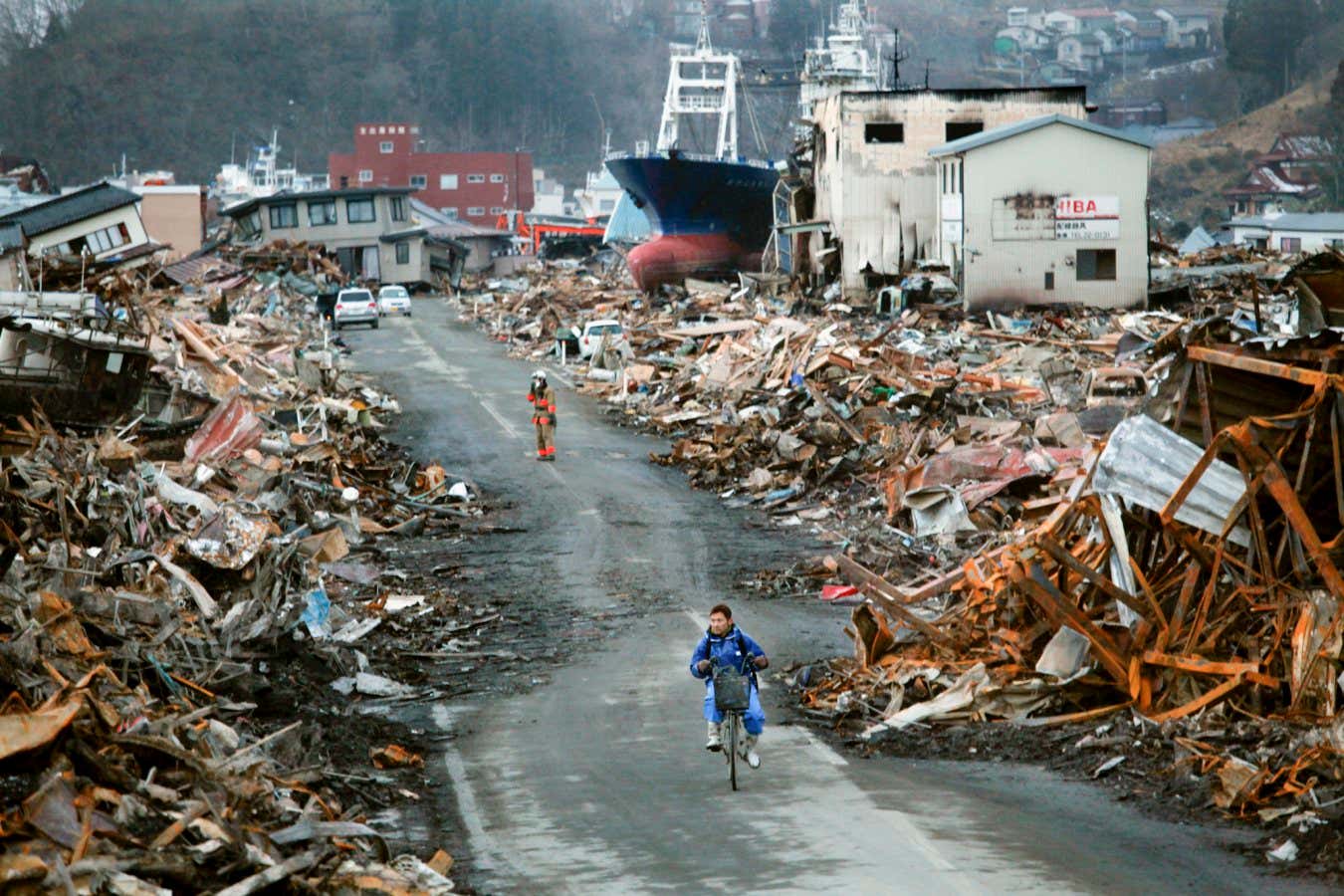
    The fishing port of Kesennuma, Japan, in the aftermath of the Tohoku earthquake in 2011

    Carolyn Cole/Los Angeles Times via Getty Images

    Around 15 minutes after the magnitude-9 Tohoku earthquake on 11 March 2011, almost the whole of Japan jumped half a centimetre to the east. This lurch resulted from an immensely powerful seismic wave that travelled 5800 kilometres to the planet’s core and then bounced back towards the surface.

    In the context of the devastation caused by the earthquake, including localised land movements of many metres and 40-metre tsunami waves that led to the meltdown of three reactors at the Fukushima Daiichi nuclear plant, 5 millimetres may seem insignificant.

    But this movement took place over a distance of 3000 kilometres, nearly seven times longer than the length of the earthquake’s main rupture line and longer than any slip ever recorded.

    What also makes the case unusual is the timing and the pattern, says Sunyoung Park at the University of Chicago. “We see a small 5-millimetre eastward step that happens nearly simultaneously and with similar size across almost all of Japan, without any ordinary earthquake at that exact time.”

    Not only was the shift immense in its north-south extent, but its width encompassed all of Japan and beyond, into the ocean.

    “It is not just a narrow ‘edge’ that moved,” says Park. “The eastward step extends at least across the whole of Japan where we have GPS stations. If we had similarly dense instruments on the seafloor, we could say more precisely how far offshore this motion extends, but on land, the shift is observed pretty much everywhere across Japan.”

    By analysing extensive GPS and seismic data recorded during the catastrophe, Park and her colleagues have figured out how such a phenomenally vast movement was triggered and why the rupture took place 15 minutes after the main quake.

    Earthquakes often generate waves that travel deep into Earth’s interior and reflect off the core, but they usually become quite weak by the time they have travelled to the planet’s centre and then back up.

    In Tohoku’s case, the main shock was so large that the original wave, though weakened, remained powerful enough on its return to the surface to cause the nationwide lurch, as four adjoining tectonic plates moved in unison.

    “We think the vigorous shaking from the original Tohoku earthquake might have already weakened the plate boundaries, making them more susceptible to be moved when the core-reflected wave came by,” says Park.

    The event demonstrates there are previously unrecognised mechanisms of destruction that can follow earthquakes, says Park. “It shows that, after a big earthquake, we might also need to be aware of potential seismic hazards due to such deep-travelling wave arrivals that can trigger more events, and over very large distances.”

    More research is now needed to understand the implications of this kind of movement for other parts of the world with similar faults, says Robin Lee at the University of Canterbury, New Zealand.

    “It shows that large earthquakes can trigger widespread, delayed fault motion minutes later, and over much larger regions than expected,” says Lee.

    Topics:


    Source link

    Team_NationalNewsBrief
    • Website

    Keep Reading

    Cyclospora outbreak linked to iceberg lettuce supplied to Taco Bell

    Permanent daylight savings is bad for Americans’ health—here’s what science says could be better

    What’s the longest total solar eclipse?

    U.S. cities have the worst air quality in the world right now—here’s how to stay safe

    See unprecedented images of Sunda clouded leopards, the ‘ghosts of the forest’

    Ancient Egyptian princesses were ‘powerful’ weapon users, new analysis suggests

    Add A Comment

    Comments are closed.

    Editors Picks

    What is USAID? Who benefits from it and why Musk says he and Trump may shut it down

    February 3, 2025

    HOW THE FEDERAL GOVERNMENT WEAPONIZED THE BANK SECRECY ACT TO SPY ON AMERICANS

    December 13, 2024

    Peace for whom? Iran after the agreement

    June 28, 2026

    OpenAI’s Sam Altman drops major new Sora updates as AI video app soars to number one in U.S.

    October 6, 2025

    How a race for electric vehicles threatens a marine paradise

    June 16, 2025
    Categories
    • Arts & Entertainment
    • Business
    • International
    • Latest News
    • Lifestyle
    • Opinions
    • Politics
    • Science
    • Sports
    • Technology
    • Top Stories
    • Trending News
    • World Economy
    About us

    Welcome to National News Brief, your one-stop destination for staying informed on the latest developments from around the globe. Our mission is to provide readers with up-to-the-minute coverage across a wide range of topics, ensuring you never miss out on the stories that matter most.

    At National News Brief, we cover World News, delivering accurate and insightful reports on global events and issues shaping the future. Our Tech News section keeps you informed about cutting-edge technologies, trends in AI, and innovations transforming industries. Stay ahead of the curve with updates on the World Economy, including financial markets, economic policies, and international trade.

    Editors Picks

    FIFA adds Super Bowl-style concert and championship rings

    July 18, 2026

    Gavin Newsom’s Wife Turns Into a Stuttering Mess When Asked if the Investigation of Her Husband Actually Started Under Biden (VIDEO)

    July 18, 2026

    Mick Jagger Draws Hard Line On AI Recreating The Rolling Stones

    July 18, 2026

    Commentary: Hormuz is no longer one front in US-Iran war – it is becoming a test

    July 18, 2026
    Categories
    • Arts & Entertainment
    • Business
    • International
    • Latest News
    • Lifestyle
    • Opinions
    • Politics
    • Science
    • Sports
    • Technology
    • Top Stories
    • Trending News
    • World Economy
    • Privacy Policy
    • Disclaimer
    • Terms and Conditions
    • About us
    • Contact us
    Copyright © 2024 Nationalnewsbrief.com All Rights Reserved.

    Type above and press Enter to search. Press Esc to cancel.