

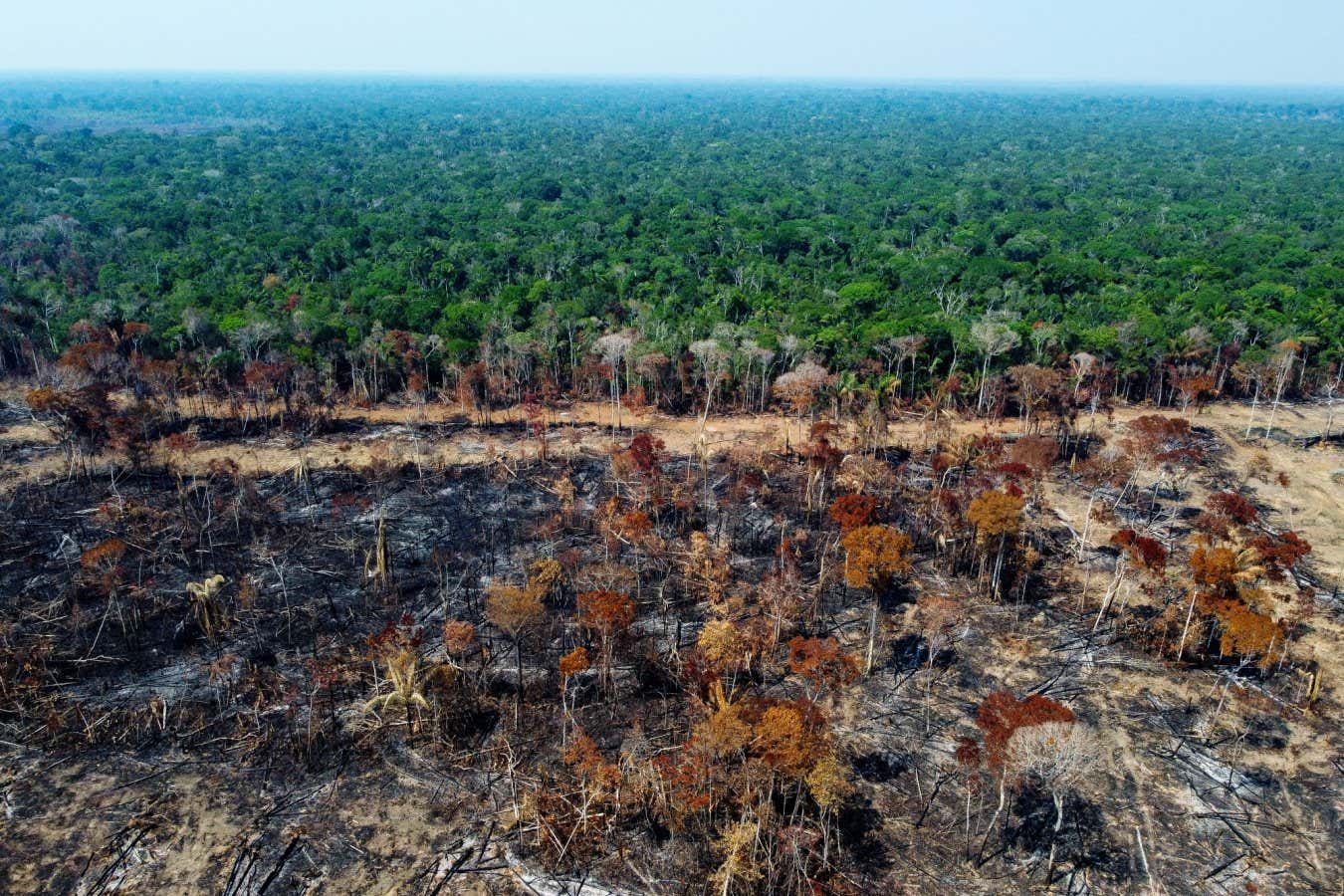
Vast areas of the Amazon rainforest have been burned for cattle ranching
MICHAEL DANTAS/AFP via Getty Images
Deforestation has reduced rainfall over the Amazon, suggesting the rainforest could reach a catastrophic tipping point sooner than expected.
Satellite observations and rain gauge measurements show that the amount of rain falling in the southern Amazon basin declined by 8 to 11 per cent between 1980 and 2019. Tree cover in that part of the Amazon shrank by 16 per cent in roughly the same period, mainly because the forest was slashed and burned for beef cattle ranching.
The northern Amazon basin has suffered far less deforestation and saw only a slight increase in precipitation, which was not statistically significant.
While a recent study linked deforestation to drier weather within 300 kilometres, the new research found this connection across a basin more than 3000 kilometres wide. That shows destroying rainforest can also hurt nearby ranches and soy farms, says Dominick Spracklen at the University of Leeds, UK, who worked on the new study.
“Some people in agribusiness might see a bit of forest as wasted land [they] could go clear,” he says. “That bit of forest is working really hard to maintain regional rainfall that our bit of agriculture is benefitting from.”
Global warming has also been drying the Amazon rainforest, with extreme drought leading to record wildfires in 2024. But atmospheric modelling by Spracklen and his colleagues showed deforestation caused 52 to 75 per cent of the decline in rainfall.
Prevailing winds transport moisture from the Atlantic Ocean that falls as rain over the Amazon. Evaporation and transpiration by plants return three-quarters of that water to the atmosphere. Further downwind, it falls as rain again and returns to the atmosphere for half a dozen cycles or more, fuelling “flying rivers” that carry moisture across the entire rainforest.
If an area of forest is razed, more than half of the rainwater in that area runs off into streams and begins flowing back to the ocean. That starves the flying rivers of moisture and reduces rainfall. It also diminishes the atmospheric instability that leads to storm cloud formation, Spracklen and his colleagues found.
With fewer trees to slow it down, the wind blows faster and carries more moisture out of the region.
Unlike past research, the study marries both data and modelling to explain exactly how deforestation weakens rainfall, says Yadvinder Malhi at the University of Oxford.
“The atmosphere becomes smoother; in some ways it glides. The moisture can travel further out of the forest region because there’s less friction on the ground,” says Malhi. “So there’s some interesting secondary atmospheric processes that aren’t normally captured.”
Scientists are concerned that the combined effects of heat, drought and deforestation could push the Amazon to a tipping point that sees it transform into a savannah, but there is uncertainty on how close this is to happening. Spracklen and his colleagues found that climate models underestimate the impact of deforestation on rainfall by up to 50 per cent, which suggests the rainforest could reach this tipping point much sooner than expected.
A study last year found a 37 per cent chance of some Amazon dieback by 2100 if global warming, which currently stands at 1.4°C, reaches 1.5°C. While that wouldn’t necessarily mean the rainforest will turn to savannah, it would mean a shrubbier forest holding fewer species and less carbon, Spracklen says.
“The Amazon is more sensitive than we think, which is bad news,” he says. “Maybe we’re closer to a deforestation threshold than we thought. But I think there’s lots of uncertainty.”
Topics:
