

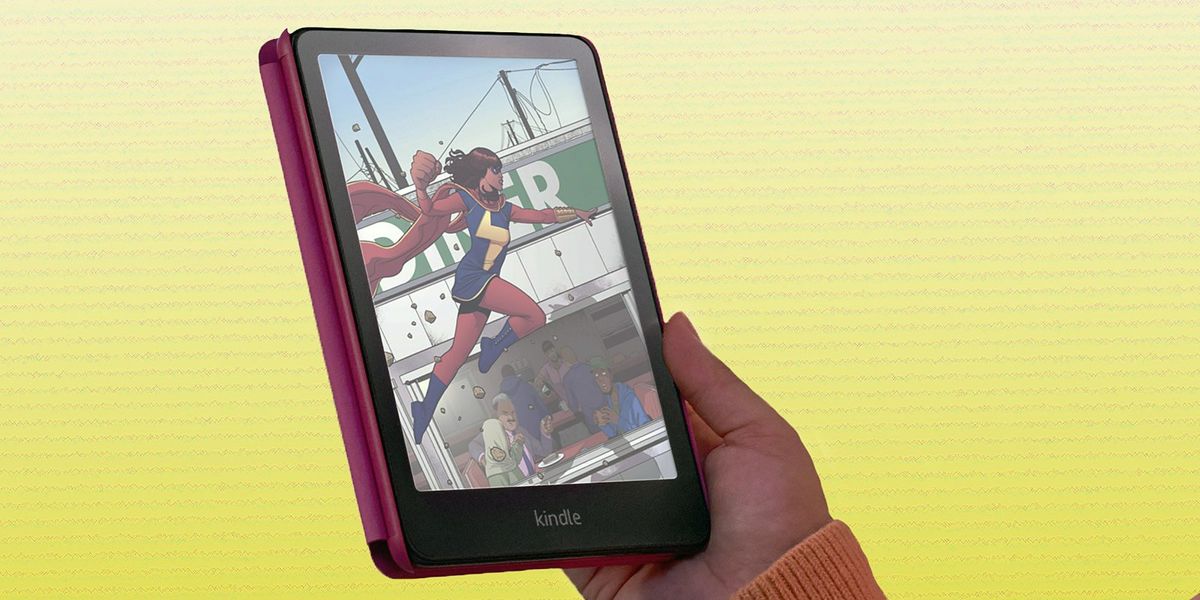
In physical books, yellowing pages are usually a sign of age. But brand-new users of Amazon’s Kindle Colorsofts, the tech giant’s first color e-reader, are already noticing yellow hues appearing at the bottoms of their displays.
Since the complaints began to trickle in, Amazon has reportedly suspended shipments and announced that it is working to fix the issue. (As of publication of this article, the US $280 Kindle had an average 2.6 star rating on Amazon.) It’s not yet clear what is causing the discoloration. But while the issue is new—and unexpected—the technology is not, says Jason Heikenfeld, an IEEE Fellow and engineering professor at the University of Cincinnati. The Kindle Colorsoft, which became available on 30 October, uses “a very old approach,” says Heikenfeld, who previously worked to develop the ultimate e-paper technology. “It was the first approach everybody tried.”
Amazon’s e-reader uses reflective display technology developed by E Ink, a company that started in the 1990s as an MIT Media Lab spin-off before developing its now-dominant electronic paper displays. E Ink is used in Kindles, as well as top e-readers from Kobo, reMarkable, Onyx, and more. E Ink first introduced Kaleido—the basis of the Colorsoft’s display—five years ago, though the road to full-color e-paper started well before.
How E-Readers Work
Monochromatic Kindles work by applying voltages to electrodes in the screen that bring black or white pigment to the top of each pixel. Those pixels then reflect ambient light, creating a paperlike display. To create a full-color display, companies like E Ink added an array of filters just above the ink. This approach didn’t work well at first because the filters lost too much light, making the displays dark and low resolution. But with a few adjustments, Kaleido was ready for consumer products in 2019. (Other approaches—like adding colored pigments to the ink—have been developed, but these come with their own drawbacks, including a higher price tag.)
Given this design, it initially seemed to Heikenfeld that the issue would have stemmed from the software, which determines the voltages applied to each electrode. This aligned with reports from some users that the issue appeared after a software update.
But industry analyst Ming-Chi Kuo suggested in a post on X that the issue is due to the e-reader’s hardware. Amazon switched the optically clear adhesive (OCA) used in the Colorsoft to a material that may not be so optically clear. In its announcement of the Colorsoft, the company boasted “custom formulated coatings” that would enhance the color display as one of the new e-reader’s innovations.
In terms of resolving the issue, Kuo’s post also stated that “While component suppliers have developed several hardware solutions, Amazon seems to be leaning toward a software-based fix.” Heikenfeld is not sure how a software fix would work, apart from blacking out the bottom of the screen.
Amazon did not reply to IEEE Spectrum’s request for comment. In an email to IEEE Spectrum, E Ink stated, “While we cannot comment on any individual partner or product, we are committed to supporting our partners in understanding and addressing any issues that arise.”
The Future of E-Readers
It took a long time for color Kindles to arrive, and the future of reflective e-reader displays isn’t likely to improve much, according to Heikenfeld. “I used to work a lot in this field, and it just really slowed down at some point, because it’s a tough nut to crack,” Heikenfeld says.
There are inherent limitations and inefficiencies to working with filter-based color displays that rely on ambient light, and there’s no Moore’s Law for these displays. Instead, their improvement is asymptotic—and we may already be close to the limit. Meanwhile, displays that emit light, like LCD and OLED, continue to improve. “An iPad does a pretty damn good job with battery life now,” says Heikenfeld.
At the same time, he believes there will always be a place for reflective displays, which remain a more natural experience for our eyes. “We live in a world of reflective color,” Heikenfeld says.
This is story was updated on 12 November 2024 to correct that Jason Heikenfeld is an IEEE Fellow.
From Your Site Articles
Related Articles Around the Web
