

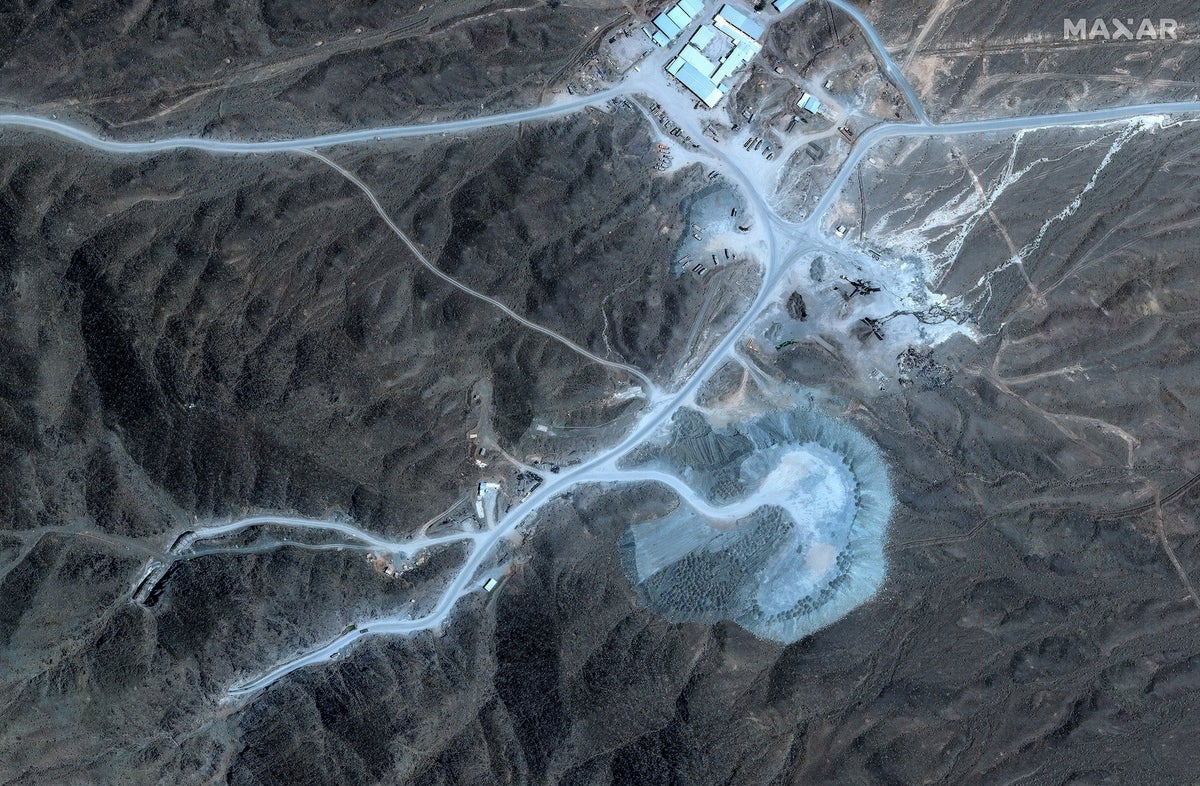
President Donald Trump has renewed threats to bomb Pickaxe Mountain, a site near Iran’s Natanz nuclear enrichment site where the country’s nuclear centrifuges may sit in subterranean tunnels.
But much as the geology of the Strait of Hormuz gives Iran a narrow choke point to throttle international trade, the geology of the mountain, known in Iran as Kuh-e Kolang Gaz La, provides powerful protection for nuclear equipment. And both have the same origin in a massive collision between continents.
Pickaxe Mountain is in central Iran, about 77 miles north of the city of Isfahan. It is inland from the country’s most prominent mountain range, the Zagros Fold-Thrust belt, which runs along the coast of the Persian Gulf in long wrinkles. The fold-thrust belt, and the associated mountains, are the result of the Arabian Plate colliding with the Eurasian Plate. This collision also shaped the Strait of Hormuz into a narrow passage, vulnerable to Iran’s control.
On supporting science journalism
If you’re enjoying this article, consider supporting our award-winning journalism by subscribing. By purchasing a subscription you are helping to ensure the future of impactful stories about the discoveries and ideas shaping our world today.
The origin of Pickaxe Mountain starts earlier in the process of this collision. The ocean that originally separated the two plates, the Neo-Tethys, subducted under the Eurasian Plate like a conveyer belt, bringing the Arabian Plate into its modern-day position. And that is where Pickaxe Mountain and its neighbors, which are part of the Urumieh-Dokhtar Magmatic Arc, come from.
“It’s basically a volcanic arc above a subduction zone,” says Richard Walker, a professor of tectonics at the University of Oxford, who has done research in the area.
When oceanic crust dives beneath a continent, the water-enriched rock it carries triggers melting, creating magma. And this magma makes its way to the surface in the form of volcanoes. Modern-day subduction zone volcanic arcs can be found in Alaska, where the Pacific Plate subducts under the North American Plate, creating the highest concentration of active volcanoes in the U.S. And Mount Saint Helens in Washington State is the result of the Cascadia subduction zone, where the Juan de Fuca Plate dives below North America. The Andes Mountains in South America are dotted with volcanoes that are the result of the Nazca Plate subducting under South America’s continental crust.
Pickaxe Mountain and its surrounding peaks are no longer active: subduction halted in the region around 30 million years ago, when the Neo-Tethys Ocean closed and the Arabian and Eurasian Plates butted together. But farther into southern Iran and neighboring Pakistan, there are still active volcanoes as a result of continuing subduction in the Arabian Sea.
The mountain is made of a tough volcanic rock called andesite, banded through with limestone that was laid down at the edges of the long-lost Neo-Tethys. Andesite gets its name from the Andes, where the same rock appears for the same geological reasons. On the Mohs scale of hardness, which runs from 1 to 10, andesite is a 7, similar to quartz and more resistant than a steel nail.
Pickaxe Mountain is near Iran’s Natanz Nuclear Complex, where an explosion in July 2020, possibly caused by a covert Israeli attack, caused serious damage to the country’s nuclear program. The facility was attacked again in 2021.
In 2020 Iran began digging tunnels 300-plus feet below Pickaxe Mountain to replace the centrifuge assembly facility that was damaged at Natanz, according to the Institute for Science and International Security. The tough andesite provides a 5,275-foot shield for these tunnels, offering extra security. The U.S. “bunker buster” bomb GBU-57 Massive Ordnance Penetrator can penetrate a few hundred feet through fairly soft material, such as earth and clay, but likely only a few dozen feet through harder rock.
According to the Institute, an attack would need to target weak, human-made points, such as ventilation shafts or tunnel entrances, to damage any equipment hidden below. This was the strategy used during June 2025 bombings at Natanz and a nearby nuclear site called Fordow that are thought to have damaged equipment such as centrifuges. Iran’s highly enriched uranium is believed to be sealed in underground tunnels that are buried under rubble from bombing runs.
Iran has not cooperated with the International Atomic Energy Agency in allowing nuclear site inspections since the June 2025 attacks, but the country is not thought to have developed a nuclear weapon.
It’s Time to Stand Up for Science
If you enjoyed this article, I’d like to ask for your support. Scientific American has served as an advocate for science and industry for 180 years, and right now may be the most critical moment in that two-century history.
I’ve been a Scientific American subscriber since I was 12 years old, and it helped shape the way I look at the world. SciAm always educates and delights me, and inspires a sense of awe for our vast, beautiful universe. I hope it does that for you, too.
If you subscribe to Scientific American, you help ensure that our coverage is centered on meaningful research and discovery; that we have the resources to report on the decisions that threaten labs across the U.S.; and that we support both budding and working scientists at a time when the value of science itself too often goes unrecognized.
In return, you get essential news, captivating podcasts, brilliant infographics, can’t-miss newsletters, must-watch videos, challenging games, and the science world’s best writing and reporting. You can even gift someone a subscription.
There has never been a more important time for us to stand up and show why science matters. I hope you’ll support us in that mission.
