

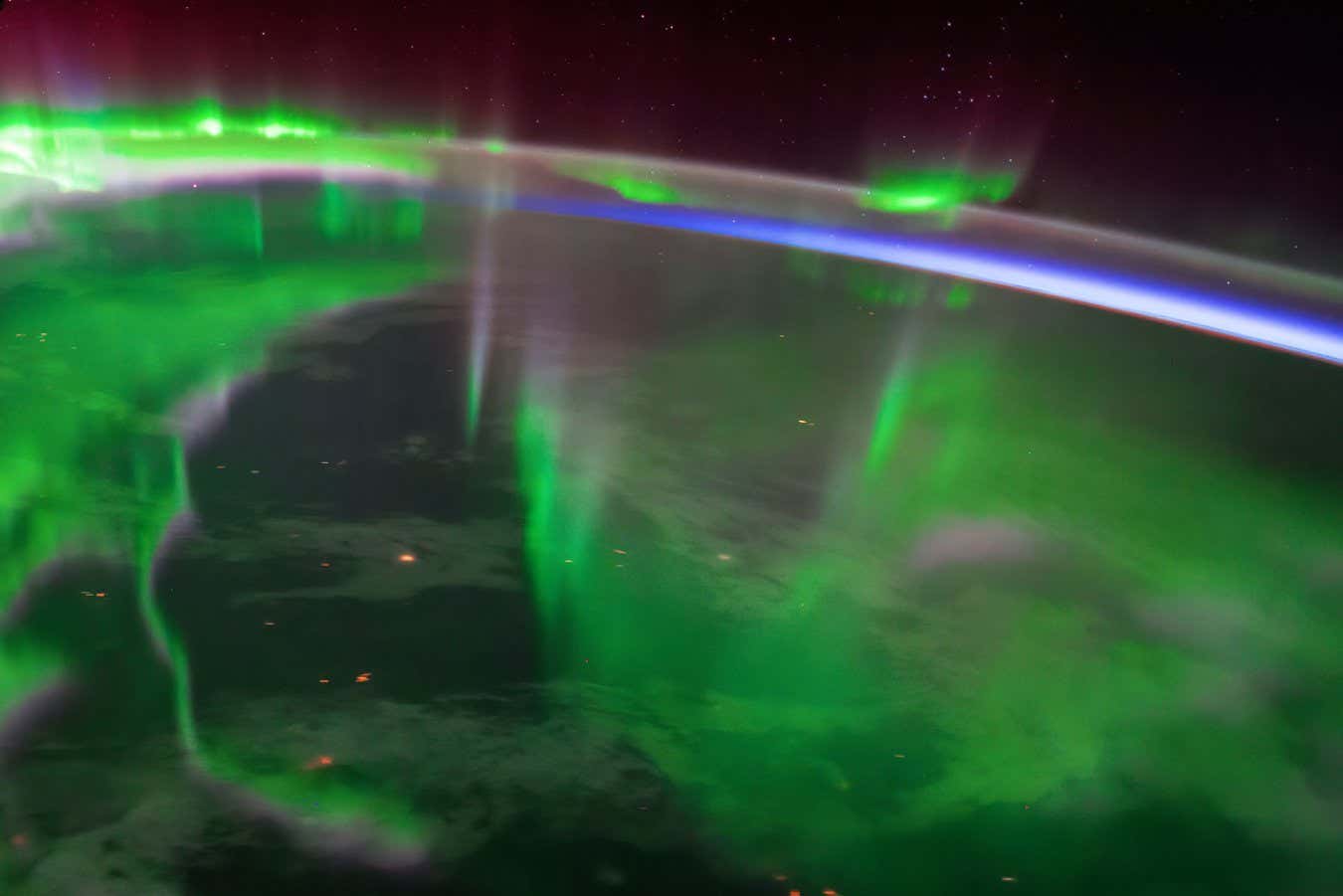
A magnetic field disturbance could have allowed auroras to occur more widely 41,000 years ago
EvgeniyQ/iStockphoto/Getty Images
Around 41,000 years ago, Earth’s magnetic field weakened to just a fraction of modern levels, leading to a huge increase in the radiation hitting the surface of the planet. Some researchers suggest the Laschamps event, as it is known, could have pushed Neanderthals towards extinction, while modern humans might have protected themselves using tailored clothing and ochre sunscreen.
Earth’s magnetic field extends into space and acts as a protective shield against harmful radiation. The magnetic poles usually line up with the north and south poles, but they occasionally wander due to changes in the liquid outer core of the planet.
“Fluctuations in this system can lead to variations in the strength and orientation of Earth’s magnetic field, such as those observed during the Laschamps event,” says Agnit Mukhopadhyay at the University of Michigan.
By studying magnetic signatures preserved in volcanic rocks and sediments, Mukhopadhyay and his colleagues created a detailed 3D reconstruction of Earth’s magnetic field during the Laschamps event.
They found evidence that the magnetic poles had shifted towards the equator and that the field strength had weakened to just 10 per cent of today’s levels.
Auroras, created by charged particles hitting the upper atmosphere, are usually only visible close to the poles, but this would have changed during the Laschamps event. “Auroras would have been visible in much wider areas, possibly even near the equator,” says Mukhopadhyay.
A weakened magnetic field would have allowed more solar and cosmic radiation to reach Earth’s surface, and may have altered regional climates. “These environmental changes may have driven adaptive behaviours in human populations, such as the increased use of protective clothing and ochre for UV shielding,” says Mukhopadhyay.
The researchers argue that the production of tailored clothing and the use of the reddish mineral ochre as a sunscreen may have given Homo sapiens an advantage over Neanderthals, who are thought to have become extinct during this period.
“There’s definitely a rough overlap in terms of timing between the incursion of ancient modern humans into Europe and the Laschamps event,” says Amy Mosig Way at the Australian Museum in Sydney. “But it’s probably a stretch to say modern humans had better sun protection in the form of tailored clothing than Neanderthals, and that this contributed to their ability to travel further than Neanderthals and their subsequent dominance of Eurasia.”
Veronica Waweru at Yale University says there is evidence for ancient humans using ochre around this time. For example, the Porc-Epic site in Ethiopia records ochre use at 45,000 years ago, but this intensified 40,000 years ago, she says. They may have used it for sunscreen or other reasons such as making artwork or adhesives.
Ladislav Nejman at JCMM in the Czech Republic says we don’t know if modern humans used ochre as a sunscreen. “If they did, it could’ve protected them more, but not necessarily saved them,” he says. “Humans in Europe really had it stacked against them at the time.”
He points out that the Laschamps event coincided with an extremely cold period known as Heinrich event 4, as well as a major volcanic eruption in Italy called the Campanian Ignimbrite explosion.
“The huge advantage that Homo sapiens had as a species compared to Neanderthals is that there were other large populations living in Africa and elsewhere, so new Homo sapiens could move into Europe after these events,” says Nejman.
Topics:
